
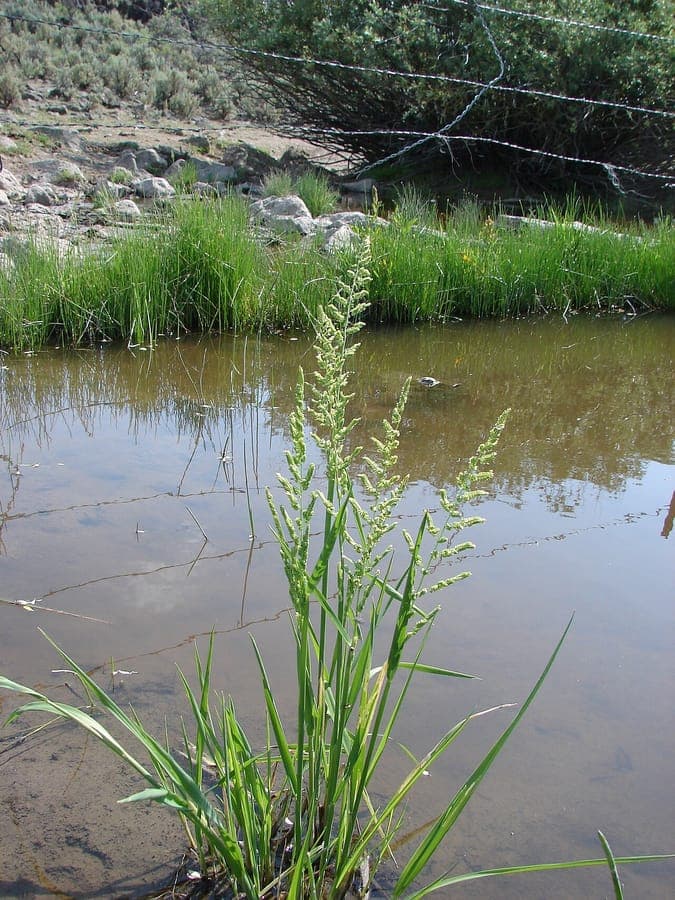
Sheri Hagwood / Public domain, via Wikimedia Commons
Slough grass: complete guide
Beckmannia syzigachne
Want to see Slough grass: complete guide in your garden?
1 minute, no credit card
Overview
Slough grass, or Beckmannia syzigachne, is a resilient perennial grass in the Poaceae family, native to wetlands across North America and parts of Asia, including Alaska, British Columbia, and northern China. It's not flashy, but it's dependable - a plant built for tough, wet conditions where others struggle. In the garden, it thrives in consistently moist to wet soils, making it a top pick for rain gardens, pond margins, or low-lying areas that collect water. It grows well in USDA zones 4 through 8, reaching heights of 60–120 cm, and forms upright, dense clumps that add vertical rhythm to planting schemes. If your garden has a soggy corner, slough grass might be the solution you didn't know you needed.
Appearance & bloom cycle
This grass has a classic graminoid silhouette - narrow, linear leaves that grow up to 1 cm wide and 90 cm long, with a bright green hue that darkens slightly in full sun. From July to August, airy, double-spiked inflorescences rise above the foliage, giving the plant its common name. The blooms are greenish at first, turning tan by late summer and persisting into winter. Unlike many ornamental grasses, slough grass doesn't flop or collapse in winter, maintaining its upright form and providing structure when the rest of the garden goes dormant. The persistent seed heads also offer visual interest and food for birds.
Ideal location
Plant slough grass in full sun to partial shade. It performs best with at least 6 hours of direct sunlight daily. While it tolerates light shade, reduced sun leads to looser growth and fewer blooms. The ideal spot is along a pond edge, in a rain garden, or in a consistently damp border. Avoid dry, sandy soils - this grass demands moisture. If you're designing a water-adjacent planting, use gardenworld.app to map out a layout where slough grass anchors the middle zone, flanked by moisture-loving companions like iris or Joe-Pye weed.
Soil requirements
The soil should be moist to wet, rich in organic matter, and heavy in clay or silt content. It holds water well, which is exactly what this grass prefers. pH should be between 5.5 and 7.5 - slightly acidic to neutral. If your soil drains too quickly, amend it with compost or well-rotted manure to improve water retention. Slough grass struggles in drought-prone areas, so avoid raised beds or fast-draining sandy loams unless you can irrigate regularly.
Watering
Keep the soil consistently moist, especially during the first growing season. Once established, it's more resilient but still relies on reliable moisture. During dry spells, water deeply once a week. Rain gardens are perfect for this species, as they naturally collect runoff. Use a soaker hose or drip irrigation in dry periods to maintain root zone moisture without overwatering.
Free design
Want to see Slough grass: complete guide in your garden? Make a free design now.
Pruning
Wait until late winter or early spring - late February to March - to cut back slough grass. Leave the old growth through winter to provide habitat for beneficial insects and visual texture. Trim the clump down to 15–20 cm above the ground using sharp shears or loppers. Avoid cutting in fall, as this can reduce winter hardiness and expose the crown to frost damage.
Maintenance calendar
- January: Leave plant standing; provides winter interest and shelter
- February: Begin cleanup prep; remove loose debris
- March: Cut back old growth; apply compost around base
- April: New shoots emerge; no fertilizer needed
- May: Monitor soil moisture; plant grows rapidly
- June: Ensure consistent watering during dry spells
- July: Blooms appear; plant at peak visual impact
- August: Seed heads mature; no additional care
- September: Let seeds persist for wildlife; avoid cutting
- October: Soil stays damp; no intervention
- November: Structure remains intact; leave standing
- December: Minimal care; appreciate winter form
Winter hardiness
Slough grass is reliably hardy in USDA zones 4–8. It survives temperatures as low as -34°C without protection. The foliage stays upright through winter, offering windbreak for small insects and adding architectural detail to the dormant garden. No mulching or covering is needed, even in harsh winters.
Companion plants
Pair slough grass with other moisture-loving perennials like Eutrochium fistulosum (Joe-Pye weed), Iris versicolor (blue flag iris), or Carex vulpinoidea (fox sedge). It also blends well with Molinia caerulea and Filipendula rubra. These combinations create a naturalistic wetland edge planting, perfect for wildlife gardens. For a balanced design, mix in some taller grasses and shorter groundcovers to vary texture and height. Use gardenworld.app to experiment with plant pairings and visualize how slough grass fits into your overall garden scheme.
Closing
Slough grass won't win any beauty contests, but it's a quiet workhorse in wet areas. It stabilizes soil, tolerates fluctuating water levels, and asks for little in return. It's not commonly found in standard garden centres, but specialty nurseries or online growers often carry it. You might also check larger retailers like OBI or Hornbach in Europe, or browse local wetland plant suppliers. If you've got a damp spot that needs a tough, attractive solution, give slough grass a try - it might just become your most reliable performer.
Want to see Slough grass: complete guide in your garden? Make a free design now.
Upload a photo, pick a style, and get a photorealistic design with plant list in under a minute.
No credit card required


Similar plants
Sporobolus pungens: complete guide
Sporobolus pungens
Sporobolus pungens is a stoloniferous Mediterranean coastal grass with outstanding salt and drought tolerance, perfect for seaside and dry gardens.
Mediterranean aegilops: complete guide
Aegilops biuncialis
Everything about Aegilops biuncialis, a Mediterranean annual grass with ornamental spikes and outstanding drought tolerance for dry gardens.
Silver bluestem: complete guide
Bothriochloa saccharoides
Full guide to Bothriochloa saccharoides (silver bluestem): site, soil, watering, winter hardiness, pruning, and garden companions.