
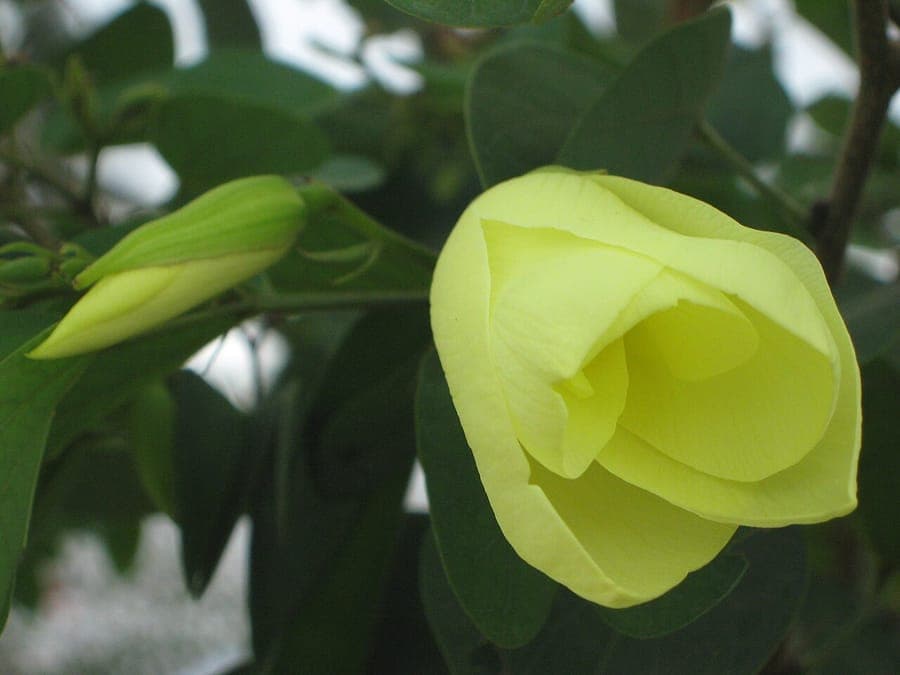
SKsiddhartthan / CC BY-SA 4.0, via Wikimedia Commons
Bell Bauhinia: Complete Guide
Bauhinia tomentosa
Want to see Bell Bauhinia: Complete Guide in your garden?
1 minute, no credit card
Overview
The bell bauhinia (Bauhinia tomentosa), also known as yellow orchid tree or St. Thomas-tree, is a spectacular subtropical shrub or small tree native to Africa and Sri Lanka. This plant is renowned for its extended, luxurious blooming period, producing hundreds of bright yellow flowers with prominent crimson or red-brown centers. For gardeners in southern regions or possessing a sunny, protected microclimate, this tree offers unparalleled tropical beauty.
Appearance and Bloom
The bell bauhinia grows as a shrub or small tree, reaching two to five meters in height. The stems are softly hairy with a pale coloration. The leaves are characteristically bilobed - heart-shaped with a distinctive notch at the apex, a defining feature of the genus. From April through October (in warm climates), spectacular yellow flowers with prominent red-brown center markings appear abundantly. These papilionaceous (butterfly-like) blooms remain open for several days. Following flowering, long, flattened pods develop, containing glossy black seeds.
Ideal Location
This plant requires very sunny positions. A minimum of eight hours of direct daily sunlight is essential for vigorous growth and abundant flowering. In temperate climates, a south or southwest-facing protected location is optimal, such as against a south-facing wall. Wind damage occurs readily, so choose sheltered positions where the delicate flowers receive protection.
Soil
Well-drained, moderately fertile soil is preferred. Plant in a mixture of garden soil amended with organic material such as compost or leaf mold. A pH of 6.0 to 7.5 is suitable. Heavy clay soils require amendment with sand and humus. Container specimens benefit from pot soil augmented with perlite for superior drainage.
Free design
Want to see Bell Bauhinia: Complete Guide in your garden? Make a free design now.
Watering
The bell bauhinia requires regular moisture during the growing season but cannot tolerate waterlogging. Water when the top inch feels dry. During hot summers, daily watering may be necessary. During winter dormancy, reduce significantly. Ensure excellent drainage always.
Pruning
Pruning encourages a more compact form and promotes branching. Prune weak or excessively long shoots following the blooming season. The plant tolerates fairly severe cutting and will regrow vigorously. Remove dead or damaged branches throughout the year as needed.
Maintenance Calendar
Spring (March-May): Growth resumes. Water regularly. Fertilize monthly with balanced feed. Summer (June-August): Intense flowering period. Water consistently. Apply fertilizer bi-weekly during peak growth. Autumn (September-October): Gradually reduce feeding and watering. Winter (November-February): Rest period. Minimal watering. Cease all feeding. Maintain temperatures above 10 degrees Celsius.
Winter Hardiness
The bell bauhinia is frost-tender. Temperatures below 5 degrees Celsius damage this specimen. In temperate climates, it must be grown in containers and moved indoors before winter. In southern Dutch regions, outdoor overwintering is possible on very protected sites with comprehensive frost protection.
Companion Planting
The bell bauhinia serves spectacularly as a wall covering against a sunny south-facing wall. In combination with passion vine (Passiflora), it creates stunning tropical impact. As a container plant on a terrace, it commands attention. Plant it alongside other tropical specimens such as banana (Musa) or clivia for an exotic garden effect.
Closing Remarks
The bell bauhinia offers tropical grandeur in temperate gardens. Its extended blooming season and exotic flowers justify the additional care required. Source specimens from specialized tropical nurseries. Gardenworld.app assists in designing tropical front gardens where Bauhinia tomentosa thrives and displays its full floral magnificence.
Want to see Bell Bauhinia: Complete Guide in your garden? Make a free design now.
Upload a photo, pick a style, and get a photorealistic design with plant list in under a minute.
No credit card required


Similar plants
Tall Silky Lupine: complete guide
Lupinus elatus
Tall silky lupine is a fast-growing Californian perennial with silvery foliage and blue-purple flower spikes, ideal for a prairie-style garden.
Garfield Lupine: complete guide
Lupinus garfieldensis
The Garfield lupine is a rare, fast-growing American perennial for alkaline, dry grassland gardens, with striking blue flower spikes.
Lupinus elegans: complete guide
Lupinus elegans
Lupinus elegans, the elegant lupine, is a spectacular blooming plant from Mexico with blue flower spikes. Care, cultivation and garden use.