
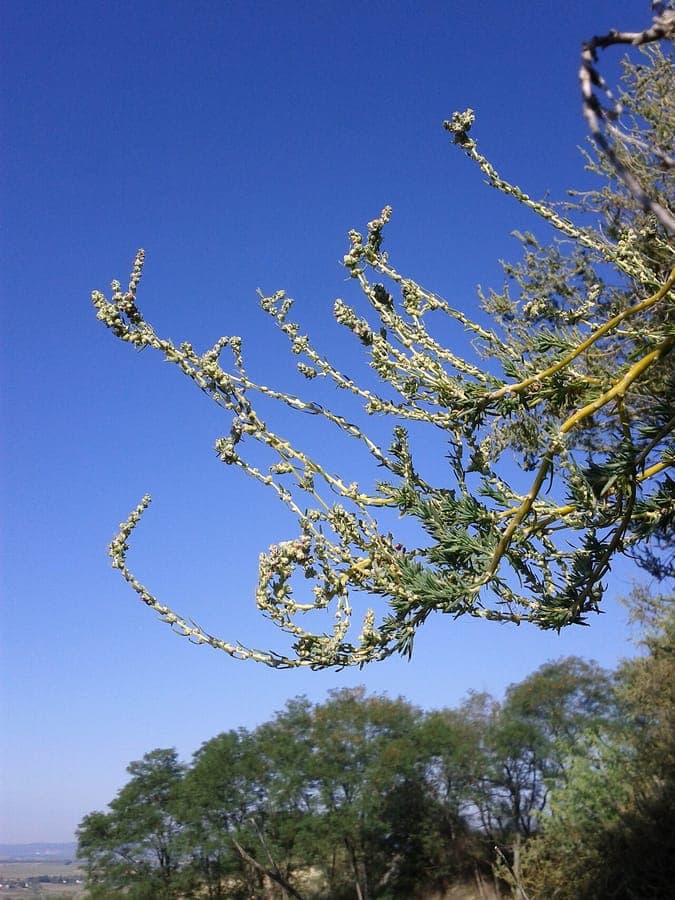
Stefan.lefnaer / CC BY-SA 3.0, via Wikimedia Commons
Prostrate Summercypress: complete guide
Bassia prostrata
Want to see Prostrate Summercypress: complete guide in your garden?
1 minute, no credit card
Overview
Prostrate Summercypress (Bassia prostrata, also called Forage kochia) is a low, spreading shrublet from the Amaranthaceae family (amaranth and orache family). Native to Central and Eastern Europe through Western and Northern China, it is a true lover of dry conditions.
This plant forms a low, dense mat of fine foliage and is perfect for xeriscaping (water-saving garden design), dry rock gardens and Mediterranean gardens. It is low-maintenance and demands virtually no feeding or intensive management.
Appearance and bloom
Prostrate Summercypress typically grows only 20-40 cm tall but can spread 60-90 cm wide in a low, mat-forming habit. Its fine foliage is light green to grey-green, very decorative and soft to touch.
Flowers are small and inconspicuous, greenish (June-September), but not particularly ornamental. The plant is valued chiefly for its foliage beauty. In autumn, the foliage can take on a reddish-brown or purplish tint, offering additional interest.
Ideal location
Place Bassia prostrata in full sun (minimum 8 hours direct sunlight daily). This plant dislikes shade and will become thin and weak without enough light. It also thrives in warm, exposed locations and at coastal sites where salt and wind tolerance are needed.
The plant is ideal for rock gardens, dry slopes, stony areas and as massing between other drought-tolerant species.
Soil
Bassia prostrata is incredibly tolerant of soil type. It grows in virtually all soil types, from sand to clay, as long as drainage is good. Prefers neutral to slightly alkaline pH (7.0-7.5), but adapts to acidic and alkaline soils alike.
Most important: avoid waterlogging. If you have heavy clay soil, work in sand or gravel. The plant tolerates saline soils well and can even grow in coastal garden conditions.
Free design
Want to see Prostrate Summercypress: complete guide in your garden? Make a free design now.
Watering
Once established (about 2-3 months after planting), water needs are minimal. Water only during extreme drought or very intense sunny spells if leaves show wilting.
During the first season, water regularly (weekly to fortnightly) so the root system establishes well. Let the soil dry out between waterings.
Pruning
Pruning is not strictly necessary. You can cut back excessive growth to maintain shape or balance larger specimens. Remove dead foliage.
At season's end (October-November), you can tidy lightly, but most shrubs need no pruning at all.
Maintenance calendar
March: Check for winter damage. April-May: Regular watering in early growth, no feeding. June-September: Flowering, minimal care. October-November: Growth slows, reduce water drastically. December-February: Winter dormancy, minimal care.
Winter hardiness
Bassia prostrata is hardy in USDA zones 5-10 (to roughly -18 degrees Celsius). In very cold zones (4 and colder), the plant may experience frost damage, but usually recovers in spring.
In zone 4, mulch the plant in December for extra protection. In warmer zones (9-10), it grows year-round.
Companion plants
Bassia prostrata combines beautifully with other drought-tolerant plants: lavender, Santolina, sedums, Verbascum, Achillea and Echinops. It also works well nestled between stones in rock gardens.
Grouping works well: place 3-5 specimens in dense clusters for strong visual impact.
Closing
Prostrate Summercypress is a reliable, low-maintenance choice for dry, sunny locations. With minimal care, it behaves like a silent perfectionist in your garden. Source plants from nurseries selling Mediterranean species. For more tips on dry gardens and water-saving design, visit gardenworld.app. Happy growing!
Want to see Prostrate Summercypress: complete guide in your garden? Make a free design now.
Upload a photo, pick a style, and get a photorealistic design with plant list in under a minute.
No credit card required


Similar plants
Bassia laniflora (woolly summer-cypress): complete guide
Bassia laniflora
Full guide to Bassia laniflora: origin, appearance, ideal location, soil, watering and care for this drought-tolerant annual.
Suaeda spicata: complete guide
Suaeda spicata
Everything about Suaeda spicata (spiked seablite): a rare salt-tolerant coastal succulent from the western Mediterranean and Macaronesia.
California amaranth: complete guide
Amaranthus californicus
Full guide to California amaranth (Amaranthus californicus): growing tips, ideal location, soil needs, watering, and garden design ideas.