
Mason Brock (Masebrock) / Public domain, via Wikimedia Commons
Wild indigo: complete guide
Baptisia tinctoria
Want to see Wild indigo: complete guide in your garden?
1 minute, no credit card
Overview
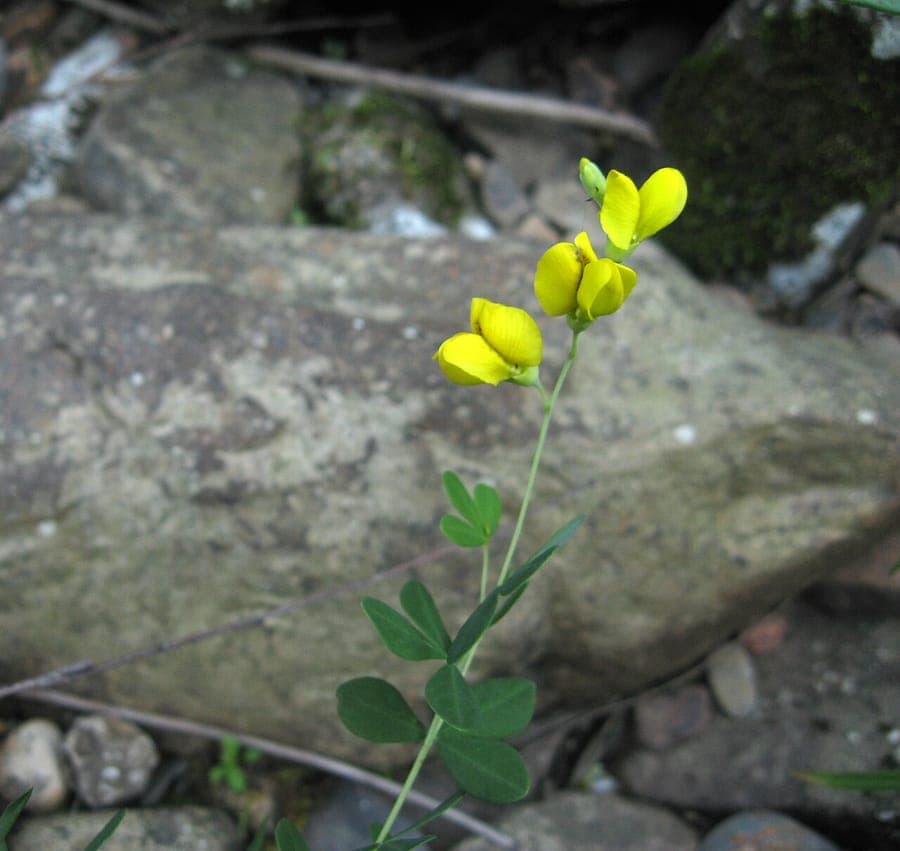
Yellow wild indigo (Baptisia tinctoria) is a rewarding, long-lived perennial from the dry woodlands, open heathlands and sandy soils of eastern North America. A member of the pea family (Fabaceae), it is related to lupines, clovers and wisteria, and fixes atmospheric nitrogen through root nodules, enriching the soil around it. Its historical value as a dye plant - the leaves yield a weak blue dye similar to true indigo - accounts for the name tinctoria (Latin: used for dyeing). In European gardens it remains underused, but it has a devoted following among prairie-garden and naturalistic-planting enthusiasts who value its bright golden blooms in May–June, its architectural black autumn seed pods and its extraordinary toughness once established. On gardenworld.app it features in low-maintenance border designs and naturalistic planting schemes for dry, acid soils.
Baptisia tinctoria is one of those rare perennials that becomes markedly better with age. Young plants in their first two seasons produce modest growth, but by year three or four they develop into bold, rounded clumps 60–90 cm high and equally wide, with an elegant, slightly glaucous grey-green foliage that is attractive even out of flower. Established clumps are nearly indestructible and resent being moved; plant them in their final position and allow them to colonise their space over years.
Appearance and bloom cycle
At maturity, yellow wild indigo forms a rounded, self-supporting mound of finely branched, upright to slightly arching stems densely clothed in small trifoliate leaves, each leaflet 1–3 cm long in a fresh grey-green, slightly glaucous colour. The overall texture is airy and refined, quite different from the bolder, larger-leaved Baptisia australis (blue false indigo). In autumn the stems turn almost jet black and remain standing well into winter, providing valuable silhouette interest in naturalistic borders.
Flowering occurs in May–June over three to five weeks. The flowers are small, 1.5–2 cm, bright golden yellow, and borne in upright racemes at the tips of the branches, reminiscent of miniature yellow lupin spikes. The pea flower structure - standard, wings and keel - is clearly visible and provides a reliable landing platform for bumblebees, which are by far the most frequent and effective pollinators. After flowering, inflated seed pods develop, turning from green to jet black as they ripen through late summer; when fully dry in October they rattle audibly in the wind, earning the plant the folk name 'rattleweed'. These pods remain decorative throughout autumn and winter, adding a graphic, skeletal quality that suits prairie-style planting.
Ideal location
Yellow wild indigo performs best in full sun to light partial shade. In full sun the flowering is most profuse and the plant grows most compactly; in partial shade - up to about four hours of shade per day - it remains attractive but the stems may be slightly laxer. In its native habitat it colonises dry, open woodland edges and sandy heathlands receiving at least six hours of direct sun. Avoid damp, waterlogged positions; the deep taproot rots in persistently wet soil.
As a specimen plant in a dry herbaceous border, as a structural element in a prairie planting or as a background shrub-like perennial in a naturalistic scheme, the plant excels. The taproot makes transplanting difficult once established; always plant in the final intended position and allow it to settle over two or three seasons before judging its performance. Allow 60–80 cm spacing between established individuals in a border context.
Soil requirements
Poor to moderately fertile, well-drained, slightly to moderately acid soil (pH 5.8–7.0) is ideal. Yellow wild indigo actively dislikes alkaline, chalky or very fertile soils; on nutrient-rich loam it produces excessive leafy growth with fewer flowers and a tendency to flop. On heavy clay, work sharp sand or perlite into the planting hole to improve drainage; on very poor dry sand it often performs better than any other perennial, its nitrogen-fixing roots compensating for the lack of soil nutrients.
Do not fertilise. As a legume with root nodules containing nitrogen-fixing Rhizobium bacteria, this plant provides its own nitrogen supply and benefits from no additional feeding. Applying nitrogen fertiliser invariably creates lush, floppy growth at the expense of flower production. A mulch of pine bark, composted oak or beech leaves suits the plant's preference for acid conditions, conserves moisture in summer and slowly improves the soil structure.
Free design
Want to see Wild indigo: complete guide in your garden? Make a free design now.
Watering
Established yellow wild indigo is outstandingly drought tolerant. In a typical temperate European climate with 600–700 mm annual rainfall, supplementary watering is rarely necessary after the plant's second year. The deep taproot explores subsoil moisture that surface watering never reaches. In the first year after planting, water weekly during dry spells - approximately 6–10 litres per plant - until the root system is established.
Overwatering is more harmful than underwatering for this species. Wet soil combined with high temperatures promotes stem rot and powdery mildew. Always water at the base, never on the foliage. In extremely dry summers with less than 20 mm monthly rainfall, a single deep watering every three to four weeks is sufficient for mature plants. Drip irrigation positioned at the outer edge of the clump, rather than directly at the crown, is the safest approach. Gardenworld.app features drought-resilient garden plans that incorporate Baptisia tinctoria as a structural anchor plant in dry, sunny borders.
Pruning
Almost no pruning is needed. The single most beneficial intervention is cutting the stems back to 10–15 cm above ground level in late winter or very early spring - February to March - just before new growth emerges. This encourages compact, well-structured regrowth. The attractive black seed pods and stems can remain standing all winter until this pruning moment; they provide valuable silhouette interest and winter shelter for overwintering insects.
Never attempt to divide or transplant an established clump; the taproot almost always breaks during disturbance and the plant rarely recovers from relocation. Propagation is possible from seed - harvest the black pods in October when they begin to rattle, separate the seeds and sow in gritty compost in a cold frame in autumn for germination the following spring - or from root cuttings taken in very early spring before growth starts.
Maintenance calendar
January–February: attractive black pods remain standing; no action. March: cut stems to 10–15 cm; top-dress with acid leaf mould if desired. April: new shoots emerge; avoid disturbing root zone. May–June: full bloom; enjoy the golden racemes and visiting bumblebees. July: pods forming; grey-green foliage at its best. August: pods turning black; stop any fertilising. September–October: pods fully black and rattling; harvest seed if desired. November: leave stems as winter silhouette. December: dormancy.
Winter hardiness
Yellow wild indigo is rated USDA zones 4–5, tolerating minimum temperatures of -28 to -34 °C. It overwinters without any protection in the Netherlands, Belgium, the UK and Germany. The woody crown at the base of the plant is the most frost-sensitive part; a light mulch of bark over the crown in the first winter of young plants adds useful protection. Established plants are frost-hard at the crown and the deep taproot is insulated from all but the most extreme cold. No other protection is needed.
Companion plants
Yellow wild indigo thrives alongside other dry-tolerant and acid-loving perennials. In a heathland-inspired border, combine it with heather (Calluna vulgaris), cross-leaved heath (Erica tetralix), goldenrod (Solidago 'Goldensmog') and sheep's sorrel (Rumex acetosella), where its yellow blooms create a vivid spring contrast. In a prairie border, pair with rudbeckia (Rudbeckia hirta), dark mullein (Verbascum nigrum) and meadow sage (Salvia pratensis) for a naturalistic summer display.
For a North American prairie design, combine the species with its close relatives: Baptisia australis (blue), Baptisia alba (white) and Baptisia sphaerocarpa (yellow) flower in succession from May to July and create an imposing multi-coloured drift. Coneflower (Echinacea purpurea), wild lupine (Lupinus perennis) and orange coneflower (Rudbeckia fulgida 'Goldsturm') are outstanding neighbours. Specialist perennial nurseries are the best source for this plant; it is rarely stocked at large garden centres. Visit gardenworld.app to create a custom garden design featuring yellow wild indigo as a season-long structural accent in your own garden.
Closing thoughts
Yellow wild indigo is the perennial for gardeners who value quiet resilience and honest beauty over flashy novelty. Its golden spring blooms, its graphic black winter pods, its near-total drought tolerance and its soil-enriching root nodules make it an ideal candidate for the sustainable, low-input garden of the future.
Want to see Wild indigo: complete guide in your garden? Make a free design now.
Upload a photo, pick a style, and get a photorealistic design with plant list in under a minute.
10,000+ gardens designed already
No credit card required


Similar plants
Tall Silky Lupine: complete guide
Lupinus elatus
Tall silky lupine is a fast-growing Californian perennial with silvery foliage and blue-purple flower spikes, ideal for a prairie-style garden.
Garfield Lupine: complete guide
Lupinus garfieldensis
The Garfield lupine is a rare, fast-growing American perennial for alkaline, dry grassland gardens, with striking blue flower spikes.
Lupinus elegans: complete guide
Lupinus elegans
Lupinus elegans, the elegant lupine, is a spectacular blooming plant from Mexico with blue flower spikes. Care, cultivation and garden use.