
Robert H. Mohlenbrock @ USDA-NRCS PLANTS Database / USDA SCS. 1989. Midwest wetland flora: Field office illustrated guide to plant species. Midwest National Technical Center, Lincoln / Public domain, via Wikimedia Commons
Bacopa rotundifolia: complete guide
Bacopa rotundifolia
Want to see Bacopa rotundifolia: complete guide in your garden?
1 minute, no credit card
Overview
Bacopa rotundifolia - commonly called disk water-hyssop, round-leaved water hyssop or wet waterhyssop - is a low-growing, stoloniferous aquatic herb in the family Plantaginaceae. It is native to a vast swath of the Americas, from the Canadian prairies of Alberta and Saskatchewan south through the central and eastern United States to Honduras, Bolivia and north-western Argentina. The species was formally described in 1891 by Wettstein in Engler and Prantl's Natürliche Pflanzenfamilien, based on earlier collections by the French botanist André Michaux.
In its native habitat the plant grows in shallow standing water, mudflats, stream margins and seasonally flooded meadows. It forms dense, floating or creeping mats by means of rooting stolons that strike new roots at each node. This stoloniferous spread is one of its most useful horticultural characteristics: a single small plant can colonise a pond margin 60 to 100 cm across within one growing season. The plant is also listed as naturalised in southern Spain, Greece and California, which gives some indication of the mild-climate conditions it prefers.
For gardeners who enjoy creating naturalistic water features, gardenworld.app offers a wealth of design inspiration for incorporating marginal aquatics like Bacopa rotundifolia into pond gardens, rain gardens and boggy borders.
Appearance and bloom cycle
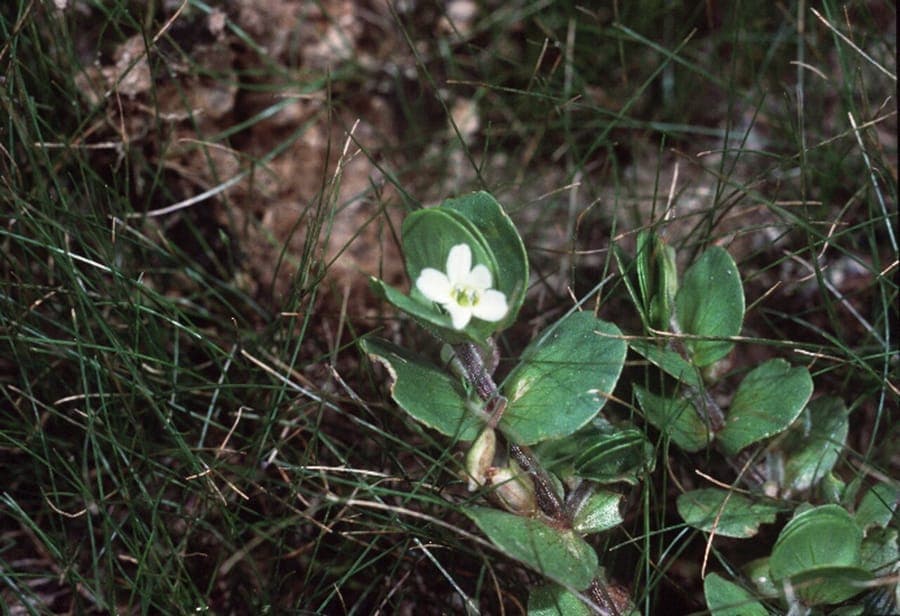
The leaves are the plant's most distinctive feature. Each leaf is broadly elliptic to nearly circular, 1 to 3 cm in diameter, with a smooth or very gently undulating margin, a rounded apex and a conspicuous central midrib. The texture is slightly succulent and the colour a fresh medium green. Leaves are opposite along the creeping stems, giving the mat a neat, tightly tiled appearance when viewed from above. Stems are slender, 10 to 30 cm long in typical conditions, but can extend considerably further in deeper water where the plant produces elongated floating shoots.
Flowers appear from May through September in the leaf axils - small five-petalled white blooms 5 to 8 mm across. They are individually modest but appear in such profusion throughout the long flowering season that they create a gentle white haze along the water's edge during summer. The flowers attract small bees, hoverflies and other short-tongued pollinators seeking nectar. Seed capsules are inconspicuous and seldom cause any nuisance in garden ponds; the main means of spread in cultivation is by stolons.
The plant's compact, creeping form means it rarely exceeds 10 cm in height above the water line, making it an unobtrusive but effective edge-softener for formal pond surrounds and a natural-looking inhabitant of wildlife ponds alike.
Ideal location
Bacopa rotundifolia thrives in full sun to light partial shade. Maximum sun exposure promotes denser growth and a more profuse flower display; deep shade causes the plant to become sparse and reduces flowering. The ideal position is at a pond margin or stream edge where the plant's roots are in permanently wet soil or shallow water 0 to 20 cm deep. It can also be grown in planting baskets set on shallow ledges within a formal pond.
The species tolerates short periods of complete submersion without ill effects, provided adequate light follows. It also endures brief dry spells on exposed mud banks, as long as the substratum retains some moisture. In terms of climate hardiness, Bacopa rotundifolia is best suited to USDA zones 7–10; temperatures below about -5 °C will kill the above-ground portions.
The plant suits a wide range of garden styles: naturalistic wildlife ponds, Japanese-inspired water gardens, prairie-style rain gardens with wet depressions, and contemporary formal ponds where a creeping marginal softens the geometric edge. In mild Atlantic-climate gardens it can function as a reliably perennial marginal; in colder regions it is treated as an annual or over-wintered indoors.
Soil requirements
The preferred growing medium is permanently moist to wet, moderately fertile, clay-loam soil with a pH between 5.4 and 7.8. This wide pH tolerance means the plant thrives in slightly acidic, peaty marginal soils as well as in the slightly alkaline, calcium-rich substrates common to constructed ponds using lime-mortared stonework. Nutrient requirements are modest; Bacopa rotundifolia grows adequately in lean marginal soils, though a slow-release aquatic fertiliser tablet pushed into the basket or root zone in March will encourage more vigorous flowering.
For planting in baskets, use proprietary aquatic compost (heavy clay-loam formulation) topped with a layer of pea gravel to prevent soil particles from clouding the water. Standard multipurpose potting compost is unsuitable as it floats when submerged. Pot size should be at least 2 litres; baskets of 3 to 5 litres are better for robust growth. Planting distance when establishing directly in a pond margin is 20 to 30 cm centre to centre; the stolons will bridge the gaps within weeks.
Watering
When grown in its natural position at a pond margin or in permanently wet ground, Bacopa rotundifolia requires no supplementary watering. Its roots are in constant contact with moist soil or open water. In a bog garden or rain garden, the aim is simply to keep the soil permanently moist - never allowing it to dry out fully.
If grown in a container on a terrace (a less common but feasible use), the pot must stand in a saucer filled with water at all times. Rain water or de-mineralised water is preferable to hard tap water, particularly in chalk or limestone areas, as the plant originates in soft, slightly acid freshwater habitats. During hot summer spells, evaporation from a permanently wet container can be substantial and daily top-up may be necessary.
The main seasonal risk is frost: if the pond or marginal bed freezes solid to the root depth, the plant will die. In areas with occasional light frost, a 10 cm mulch of straw or dead leaves over the marginal planting zone offers useful insulation.
Free design
Want to see Bacopa rotundifolia: complete guide in your garden? Make a free design now.
Pruning
Very little pruning is required. The creeping form means no structural cutting is ever needed. In autumn, after the first frosts blacken the foliage, the dead stems can be cut back to within 2 to 3 cm of the root zone using sharp secateurs or scissors. Removing the dead material promptly keeps the pond tidy and prevents the slow release of nutrients from decomposing plant matter, which can encourage algae in spring.
During the growing season, if the mat expands beyond its allocated area, simply cut back the leading stolons with scissors or a sharp knife and remove the cut pieces from the water. The plant will not resent hard cutting back; it re-grows vigorously from the root zone and remaining stolons. In basket culture, simply lift the basket, trim back overhanging growth and replace.
No hard annual pruning is needed. The plant is not invasive in a problematic sense in most temperate garden ponds, though it can spread enthusiastically in warm, nutrient-rich water. A quick inspection and trim in late June and again in late August keeps growth controlled without stress to the plant.
Maintenance calendar
March–April: First new shoots emerge from root zone. Check baskets and marginal plantings are well secured. Apply an aquatic fertiliser tablet to each basket. Top up pond level after winter evaporation.
May–June: Growth accelerates; first flowers open. Monitor stolon spread and trim if needed. Begin removing any algae that compete with marginals. Ensure pond water level is stable.
July–August: Peak flowering. Maintain pond water level during dry spells. Remove any yellowing leaves and dead flower stems to keep the plant looking fresh.
September–October: Flowering decreases. Begin cutting back dead material. Evaluate over-wintering strategy: in mild gardens leave plants in place; in frost-prone areas take cuttings or move baskets to a frost-free location.
November–February: Dormancy period. Keep root zone above freezing if possible. Maintain a small area of open water in ponds to prevent complete icing over.
Winter hardiness
Bacopa rotundifolia is moderately frost-sensitive and reliably perennial only in USDA zones 7 to 10 (minimum temperatures from -17 °C to approximately -1 °C respectively). In British and north-west European gardens - typically zone 7 or 8 - the plant often survives mild winters when the root zone remains insulated by a layer of water or saturated soil above it. In severe winters with prolonged hard frosts, surface ice can penetrate deep enough to kill roots.
To guarantee continuity, take a few rooted stolon cuttings in September and keep them in a bucket of pond water in a cool, frost-free location (5–10 °C) such as an unheated greenhouse or shed. Replant outdoors from mid-April once the risk of ground frost has passed. In regions where the species is non-hardy, local garden centres stock it as an annual aquatic from spring onwards. Propagation from cuttings is straightforward: a 10 cm length of stolon with at least two nodes, placed in wet sand or aquatic compost, roots within 10 to 14 days at 18–22 °C.
Companion plants
Bacopa rotundifolia combines beautifully with other marginal and pond-edge plants. For textural contrast at a similar height, water mint (Mentha aquatica) provides a strongly aromatic, slightly taller carpet with lilac flower spikes in late summer. Frogbit (Hydrocharis morsus-ranae) drifts freely on the water surface with floating rosettes that complement the creeping bacopa nicely. For vertical accents behind the low mat, yellow flag iris (Iris pseudacorus, 80–120 cm), lesser bulrush (Typha angustifolia, 100–150 cm) and arrowhead (Sagittaria sagittifolia, 40–70 cm) provide excellent companions.
In a naturalistic wildlife pond, Bacopa rotundifolia works as the transitional layer between open water and the taller emergent zone, providing a gradient of habitat that benefits amphibians, dragonflies and wading birds. Its long flowering season supplies nectar for small pollinators throughout the summer.
For additional colour in the wet zone, creeping jenny (Lysimachia nummularia) with its golden-yellow flowers or brooklime (Veronica beccabunga) with its blue flower spikes both pair well, flowering in contrasting colours that highlight the white blooms of the bacopa. All three thrive in permanently wet conditions and require minimal care once established.
Closing
Bacopa rotundifolia is a modest but reliable marginal aquatic that brings a naturalistic, fine-textured quality to pond edges, bog gardens and wet borders. Its tolerance of fluctuating water levels, its long flowering season and its undemanding nature make it an ideal choice for gardeners of all experience levels. The only challenge is its susceptibility to hard frost, which is easily managed through simple over-wintering measures.
For further ideas on how to incorporate water-loving marginal plants into your garden design - including planting combinations, pond-edge planting plans and seasonal care - visit gardenworld.app, where you will find detailed design inspiration tailored to gardens of every size and style.
Want to see Bacopa rotundifolia: complete guide in your garden? Make a free design now.
Upload a photo, pick a style, and get a photorealistic design with plant list in under a minute.
10,000+ gardens designed already
No credit card required


Similar plants
White Beardtongue: complete guide
Penstemon albidus
Discover white beardtongue (Penstemon albidus) - elegant perennial with white to cream flowers. Drought-resistant, perfect for prairie and dry gardens.
Longsepal Beardtongue: complete guide
Penstemon calycosus
Discover longsepal beardtongue (Penstemon calycosus) - beautiful perennial with lilac-blue flowers. For partial shade and moist soil. Ideal for naturalized.
Penstemon cusickii: complete guide
Penstemon cusickii
Discover Cusick's beardtongue, a compact alpine flowering plant with violet-pink blooms. Perfect choice for rock gardens and water-wise landscaping.