
Jean-Jacques MILAN / CC BY-SA 3.0, via Wikimedia Commons
Groundselbush: complete guide
Baccharis halimifolia
Want to see Groundselbush: complete guide in your garden?
1 minute, no credit card
Overview
Baccharis halimifolia, commonly known as groundselbush, is a tough, deciduous shrub that really comes into its own in late autumn when most other garden plants have gone quiet. Native to the Atlantic and Gulf coasts of the United States, it thrives in brackish marshes, coastal dunes, and disturbed sandy soils. In temperate gardens across the UK and northern Europe, it adapts well-especially in coastal areas, but also inland if given the right spot. It grows 1.5 to 3 meters tall and spreads about 1.5 meters wide, making it ideal for back-of-border planting or as a loose hedge. On gardenworld.app, you can visualise how this airy, sun-loving shrub fits into your seasonal garden layout.
Appearance & bloom cycle
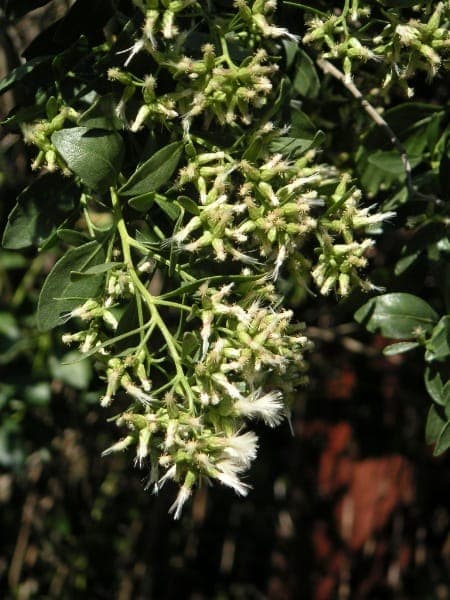
Groundselbush has an open, upright habit with silvery-green, broadly oval leaves that are coarsely toothed and arranged alternately along the stems. The undersides of the leaves have a soft, downy texture and a pale grey tint. While the foliage is modest in summer, the real show begins in September. Female plants produce masses of fluffy white flower heads that resemble tiny dandelion clocks. These persist through October and into November, creating a soft, cloud-like effect in the border. Male plants flower too, but their blooms are less showy. Since this is a dioecious species, you'll want to plant at least one female-and ideally a male nearby-for best flowering results.
Ideal location
Full sun is non-negotiable for strong growth and maximum flowering. Aim for at least 6 hours of direct sunlight daily. Light shade is tolerated, but bloom production drops significantly. Choose a spot with good air circulation to avoid fungal issues-avoid planting under dense eaves or tight corners. This shrub excels in coastal gardens thanks to its tolerance for salt spray and wind. Inland, pick a site with well-drained soil and room to expand. Position it where you can enjoy its late-season bloom, perhaps near a path or seating area.
Soil requirements
Groundselbush isn't fussy about soil type. It grows well in sandy, loamy, or gravelly soils as long as drainage is good. A slightly acidic to neutral pH (5.5–7.0) is ideal. Avoid heavy clay or waterlogged sites-these can lead to root rot. If your soil is dense, amend the planting hole with horticultural sand and compost to improve structure. No fertiliser needed; in fact, too much nitrogen leads to leggy growth and fewer flowers.
Free design
Want to see Groundselbush: complete guide in your garden? Make a free design now.
Watering
During the first growing season, water weekly-about 10 litres per plant during dry spells. Once established, it's highly drought-tolerant thanks to a deep root system. Mature shrubs rarely need supplemental watering unless facing prolonged dry periods. Overwatering is more dangerous than underwatering-always let the soil dry out between waterings. Water at the base to keep foliage dry and reduce disease risk.
Pruning
Pruning isn't essential, but it helps maintain shape and encourages bushier growth. Cut back in late winter or early spring (February to March), before new shoots emerge. You can reduce height and width by up to half if needed. Remove dead, damaged, or crossing branches first. Since flowers form on new wood, avoid pruning after April-otherwise, you'll cut off next season's bloom. Use sharp, clean secateurs and disinfect between cuts to prevent disease spread.
Maintenance calendar
- Jan: Inspect structure, remove any winter damage
- Feb: Begin light pruning
- Mar: Complete pruning before bud break
- Apr: Monitor for new growth, no action needed
- May: Check for aphids, especially on new shoots
- Jun: Flower buds forming, no extra watering
- Jul: Tolerant of heat; water only in extreme drought
- Aug: Dormant phase, minimal care
- Sep: Bloom begins-enjoy the show
- Oct: Peak flowering, great for pollinators
- Nov: Flowers fade, but seed heads remain; leave for birds
- Dec: Clean up fallen leaves, check for pests
Winter hardiness
Groundselbush is hardy in USDA zones 6 to 10. In the UK and most of northern Europe (zone 8), it survives winter without protection. Young plants may suffer tip dieback in harsh winters, but usually recover in spring. No winter mulch is required, though a light organic layer around the base can help young shrubs. Keep the root zone dry in wet winters to prevent rot.
Companion plants
Pair with late-season perennials like New England aster (Symphyotrichum novae-angliae), ornamental grasses (e.g., Panicum or Calamagrostis), and silver-foliaged plants such as Artemisia or Santolina. It works well in coastal schemes with sea holly (Eryngium) and thrift (Armeria). Avoid invasive ground covers that compete for roots. The fluffy seed heads attract goldfinches and other small birds in autumn and winter.
Closing
Groundselbush is an underrated shrub that delivers when most others don't. It won't wow you in June, but come October, it lights up the garden with soft, white clouds of bloom. Low maintenance, salt-tolerant, and great for wildlife-it's a smart choice for coastal or drought-prone gardens. Available at most garden centres across the UK. Use gardenworld.app to model how this plant adds seasonal interest and structure to your garden design.
Want to see Groundselbush: complete guide in your garden? Make a free design now.
Upload a photo, pick a style, and get a photorealistic design with plant list in under a minute.
No credit card required


Similar plants
Calendula stellata: complete guide
Calendula stellata
Complete guide to Calendula stellata, the star-flowered marigold from Sicily: location, soil, watering and companion planting tips.
Korean chrysanthemum: complete guide
Chrysanthemum x rubellum
Chrysanthemum x rubellum is a hardy autumn perennial with single pink to copper flowers from August to November. Care and combinations.
Helianthus divaricatus: complete guide
Helianthus divaricatus
Helianthus divaricatus is a North American woodland sunflower with yellow summer blooms, ideal for naturalistic borders and shady edges.