
Wikimedia Commons / Public domain, via Wikimedia Commons
Sterile oat: complete guide
Avena sterilis
Want to see Sterile oat: complete guide in your garden?
1 minute, no credit card
Overview
Avena sterilis, commonly known as Sterile oat, is a striking annual grass that brings movement and texture to the summer garden. While often dismissed as a weed in agricultural settings, in ornamental gardening it's prized for its airy, dancing inflorescences and low-maintenance nature. Native to parts of southern Europe and North Africa, it thrives in sunny, well-drained spots and requires minimal care once established. It's perfect for wildflower meadows, naturalistic borders, or even large containers.
On gardenworld.app, you can design a seasonal planting scheme that highlights the delicate sway of Sterile oat among complementary perennials and grasses.
Appearance & bloom cycle
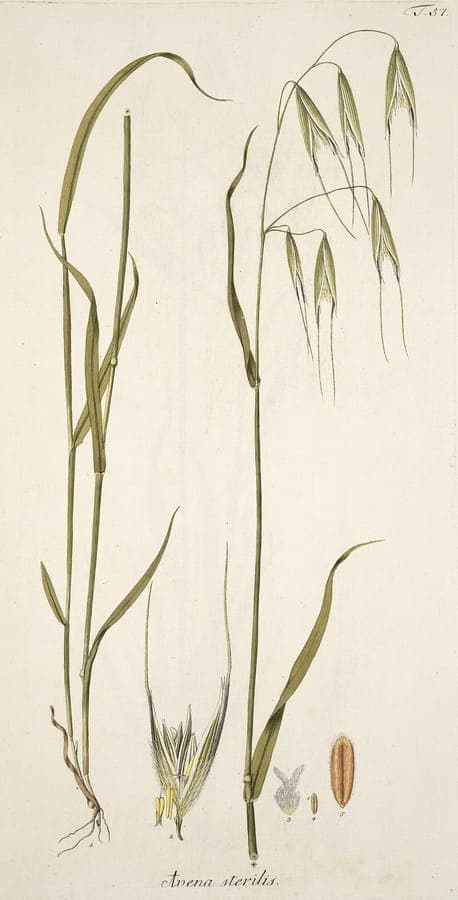
Sterile oat grows between 60 and 120 cm tall, with slender, flexible stems and narrow, grey-green leaves. From June to August, it produces loose, drooping panicles 15–25 cm long that shimmer in the breeze. The flowers are not brightly coloured, but their silvery-grey hue and fine texture create a soft, dreamy effect, especially in morning or evening light. As the season progresses, the seed heads dry and turn tawny, adding autumnal interest.
Being an annual, it completes its life cycle in one season. While it can self-seed, the spread is usually modest in garden conditions, especially if seed heads are cut before full maturity.
Ideal location
Full sun is essential-aim for at least 6 hours of direct sunlight daily. Sterile oat needs space to move, so plant it where wind can flow freely, like open borders, dry slopes, or along gravel paths. Avoid heavily shaded areas, as this leads to weak stems and flopping. For visual impact, plant in groups of 5–7 or more to create a wave-like effect.
It performs well in containers too, provided the pot is at least 30 cm in diameter and has good drainage. Place it on a sunny patio or balcony where its movement can be appreciated up close.
Soil requirements
This grass is adaptable to a wide range of soils-sandy, loamy, or clay-as long as drainage is adequate. It dislikes waterlogged conditions, especially in winter. The ideal pH ranges from 5.5 to 7.5, but it tolerates mildly acidic or alkaline soils.
No fertiliser is needed. In fact, rich soil encourages excessive leaf growth and weak stems. For container planting, use a standard, low-nutrient potting mix, or blend in some horticultural sand to improve drainage.
Watering
Once established, Sterile oat is highly drought tolerant. Water young plants regularly during the first 3–4 weeks after sowing or transplanting to help roots develop. After that, rainfall is usually sufficient. During prolonged dry spells, water deeply once a week, allowing the soil to dry out between sessions.
Overwatering is a bigger risk than underwatering. Soggy soil leads to root rot and weak growth. If your garden has heavy clay, consider raised beds or mounds to improve drainage.
Free design
Want to see Sterile oat: complete guide in your garden? Make a free design now.
Pruning
Little pruning is required. After flowering, you can cut back the spent stems to prevent unwanted self-seeding or leave them standing for winter structure and wildlife value. In formal gardens, remove faded flower heads to maintain a tidy look.
Dried seed heads make excellent additions to autumn bouquets. Harvest them when they start to turn brown and hang upside down in a dry, airy space to cure.
Maintenance calendar
- Jan: Clear any remaining dead foliage
- Feb: No action needed
- Mar: Remove old growth, prepare beds
- Apr: Sow seeds directly outdoors when soil reaches 10°C or start in pots under cover
- May: Thin seedlings, protect from late frosts (USDA zones 8–10)
- Jun: Plants enter flowering phase, ensure good air circulation
- Jul: Peak bloom, enjoy movement and texture
- Aug: Monitor seed development; cut heads if preventing spread
- Sep: Allow some seeds to drop for next year, or collect manually
- Oct: Cut back or leave for winter interest
- Nov: Tidy up as needed
- Dec: Final cleanup, check for volunteer seedlings
Winter hardiness
As an annual, Sterile oat does not survive winter. It dies after seed set. In mild climates (USDA zones 9–10), occasional self-seeding may occur, but it's not reliable. For consistent results, resow each spring. No winter protection is needed.
Companion plants
Pair Sterile oat with other sun-loving, drought-tolerant plants. Good companions include Echinacea purpurea, Rudbeckia hirta, Coreopsis, and ornamental grasses like Stipa tenuissima or Panicum virgatum. The fine texture of the oat contrasts beautifully with bold, daisy-like flowers.
Avoid aggressive spreaders like mint or bindweed, which can overwhelm it. Also steer clear of heavy feeders that require rich soil-these conditions weaken Sterile oat.
On gardenworld.app, you can preview how Sterile oat interacts with other plants in a virtual border builder, helping you visualise height, texture, and seasonal flow.
Closing
Sterile oat isn't a flashy showstopper, but it's a quietly powerful plant that adds rhythm and lightness to the garden. Its ease of care, resilience, and elegant form make it ideal for beginner and experienced gardeners alike. Whether used in a meadow-style planting or a modern container display, it brings a sense of wild grace. Sow it in the right spot, step back, and let it do its thing. For layout ideas and planting combinations, visit gardenworld.app to explore custom designs that make the most of this graceful grass.
Want to see Sterile oat: complete guide in your garden? Make a free design now.
Upload a photo, pick a style, and get a photorealistic design with plant list in under a minute.
No credit card required


Similar plants
Sporobolus pungens: complete guide
Sporobolus pungens
Sporobolus pungens is a stoloniferous Mediterranean coastal grass with outstanding salt and drought tolerance, perfect for seaside and dry gardens.
Mediterranean aegilops: complete guide
Aegilops biuncialis
Everything about Aegilops biuncialis, a Mediterranean annual grass with ornamental spikes and outstanding drought tolerance for dry gardens.
Silver bluestem: complete guide
Bothriochloa saccharoides
Full guide to Bothriochloa saccharoides (silver bluestem): site, soil, watering, winter hardiness, pruning, and garden companions.