
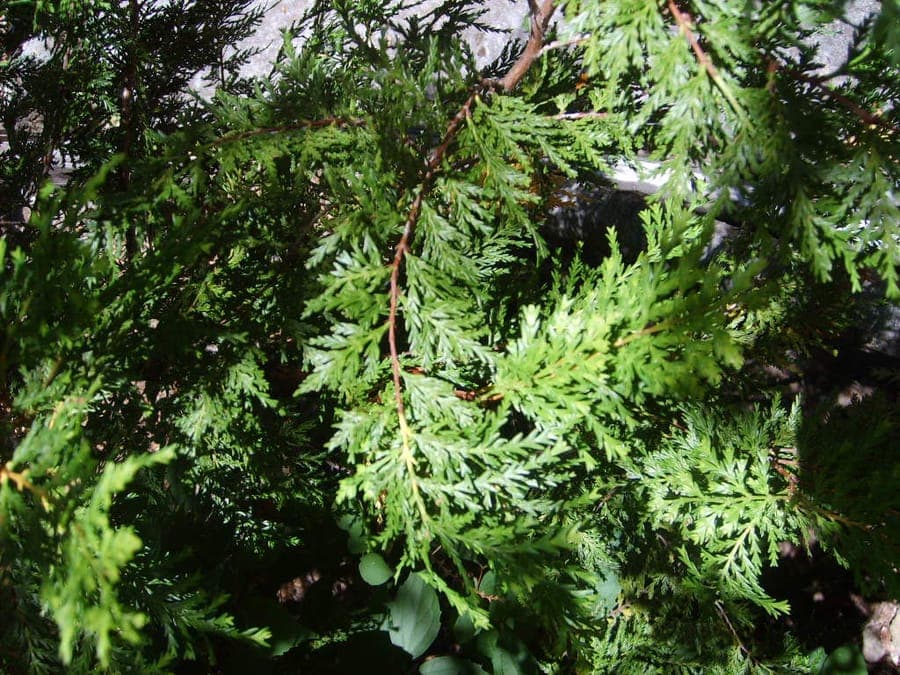
User:Daga / CC BY 2.5, via Wikimedia Commons
Austrocedrus chilensis: complete guide
Austrocedrus chilensis
Want to see Austrocedrus chilensis: complete guide in your garden?
1 minute, no credit card
Overview
Austrocedrus chilensis, commonly known as Chilean Cedar or Cordilleran Cypress, is an elegant coniferous tree from the Cupressaceae family. This column-forming tree originates from forests of Chile and Argentina and adds grace and verticality to any landscape. With its fine, scale-like foliage and columnar form, it's a classic choice for formal gardens and ornamental collections.
The foliage of Austrocedrus chilensis is highly characteristic. The fine, scale-like leaves are densely arranged, giving the tree a very neat, compact appearance. The tree grows naturally upright, requiring minimal to no pruning.
Appearance and Bloom
Austrocedrus chilensis grows in a rigid, columnar form, usually 20-30 meters tall in nature, though regularly smaller in gardens, 5-15 meters. The tree has a very tight, regular silhouette ideal for formal gardens.
The foliage is scaly, fine and dense, giving the tree a neat, festive appearance. Color is usually green to gray-green, depending on form and growing conditions.
The fruits are small cones approximately 1-1.5 centimeters long with several scales. These cones ripen in the first year of formation, adding extra visual interest.
The tree produces inconspicuous flowers in spring. These are too small to be visually significant.
Ideal Location
Austrocedrus chilensis thrives best in a sunny location, though it can tolerate partial shade. The tree prefers good air circulation and grows better in areas with regular rainfall.
Wind protection can be beneficial in very windy areas, especially for young trees. Once established, it's fairly wind-resistant.
The tree feels at home in moderate climates and shouldn't grow in very hot, dry environments. It's ideal for European climates with moderate to cool temperatures.
Soil
Austrocedrus chilensis grows well in diverse soil types as long as they're well-drained. The tree is at home in both sandy and clayey soils, as long as drainage is good.
The ideal composition consists of approximately 50% garden soil, 20% sand, and 30% organic material. The tree thrives in soils with pH between 6-7.5.
The tree is fairly low-maintenance regarding soil requirements and can grow in diverse soil settings.
Free design
Want to see Austrocedrus chilensis: complete guide in your garden? Make a free design now.
Watering
Austrocedrus chilensis requires regular water, especially during the first years of establishment and during dry periods. Young trees should receive regular, consistent water to build strong root systems.
Once established, the tree thrives with natural rainfall, though watering during dry periods is beneficial. Overwatering should be avoided.
Winter: Water can be reduced when the tree actively grows.
Pruning
Austrocedrus chilensis requires minimal pruning thanks to its naturally neat form. The tree grows naturally columnar and compact.
Remove dead or diseased wood where needed. You can, however, carefully prune the tree for more compact growth.
Formal pruning is rarely needed. This tree is almost self-forming.
Maintenance Calendar
Spring (March-May): Growth begins. Water regularly. Apply feeding for young trees.
Summer (June-August): Full growth period. Consistent watering important.
Autumn (September-October): Growth slows. Reduce water carefully.
Winter (November-February): Dormant state. Minimal watering if needed.
Winter Hardiness
Austrocedrus chilensis is very hardy and tolerates temperatures down to -20 degrees Celsius. This makes it suitable for most European climates.
The tree actually benefits from cold periods and grows better in moderate to cool climates. Very hot summers can cause stress.
Snow and ice can damage branches through their weight, but the tree usually recovers well.
Companion Plants
Austrocedrus chilensis works well in combination with other conifers and formal garden plants. Ilex crenata (Japanese Holly), Buxus sempervirens (Boxwood), and Taxus baccata (Yew) are good companions.
It combines well with other vertical elements in formal gardens or as an accent in mixed borders.
Ornamental grass at the base can provide contrast.
Conclusion
Austrocedrus chilensis offers gardeners a classic, elegant choice for permanent structure and verticality. With its naturally neat form, elegant foliage, and winter hardiness, it's a perfect plant for formal gardens and ornamental appreciation. Whether you're having a gardenworld.app design created or gardening independently, this Chilean Cedar certainly deserves consideration if you're seeking ornament with permanent character traits.
Want to see Austrocedrus chilensis: complete guide in your garden? Make a free design now.
Upload a photo, pick a style, and get a photorealistic design with plant list in under a minute.
No credit card required


Similar plants
Cupressus macnabiana: complete guide
Cupressus macnabiana
The Fragrant Cypress offers elegant growth with fine, aromatic foliage. Perfect for temperate climates and as specimen trees in contemporary gardens.
Cupressus guadalupensis: complete guide
Cupressus guadalupensis
The Guadalupe cypress: an elegant conifer for gardens. Complete cultivation guide for this Mexican cypress. Information about care, location, form and maintenance.
Juniperus ashei: complete gids
Juniperus ashei
Ontdek de prachtige Ashe-jeneverbes, een robuuste naaldboom uit Texas. Lees alles over teelt, onderhoud en tips voor een gezonde groei in deze uitgebreide gids.