
Salicyna / CC BY-SA 4.0, via Wikimedia Commons
Fat-hen: complete guide
Atriplex prostrata
Want to see Fat-hen: complete guide in your garden?
1 minute, no credit card
Overview
Fat-hen, or Atriplex prostrata, is a resilient, low-growing herb that thrives in tough conditions where many plants fail. Native to coastal regions across southern and central Europe-from Albania to the Baltic States and Belgium-it's well adapted to saline soils, dry winds, and poor substrates. Part of the Amaranthaceae family, this forb stands out with its prostrate growth, silvery foliage, and tolerance for urban pollution. Whether you're designing a seaside garden or working with compacted, alkaline soil, Fat-hen earns its place as a functional yet understated performer.
This plant spreads horizontally, reaching 50–80 cm in width but rarely exceeding 30 cm in height. Growth rate is moderate-around 20–30 cm per season-and it behaves as an annual or short-lived perennial depending on winter severity. On gardenworld.app, you can visualise how Fat-hen integrates into low-maintenance, drought-tolerant planting schemes that thrive in exposed sites.
Appearance & bloom cycle
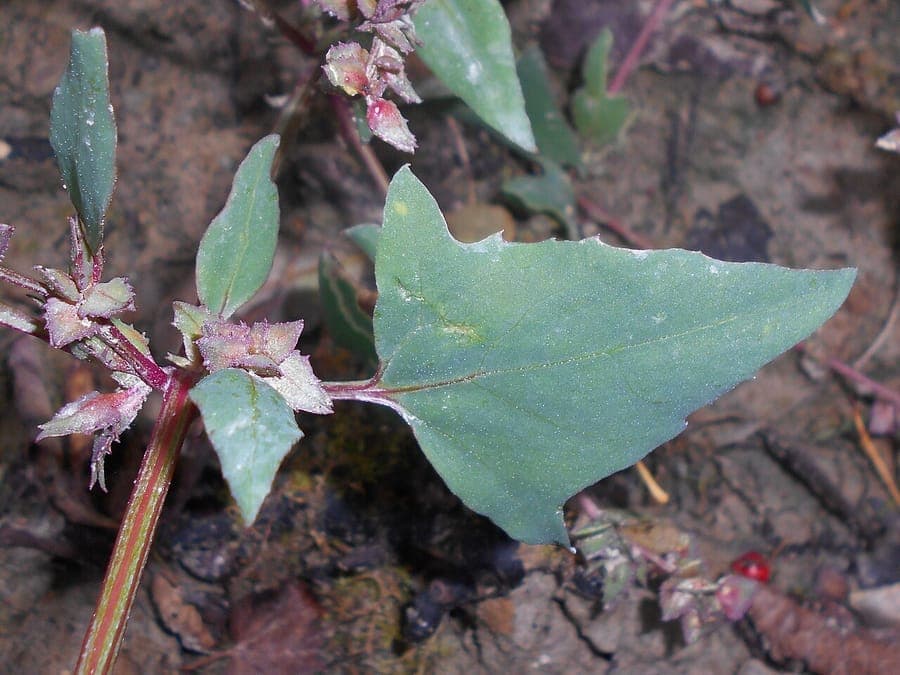
Fat-hen forms a dense mat of trailing stems that root at the nodes, creating a stable ground cover. The leaves are triangular to rhombic, 2–5 cm long, with a distinctive grey-green, mealy texture caused by salt-excreting glands. Leaf margins are irregular, often with a pointed basal lobe-giving the plant its spear-like appearance.
From June to August, small, wind-pollinated flowers appear in dense clusters along the stems. These are greenish to brownish, lacking petals, and inconspicuous to the casual observer. By September, seed bracts turn silvery and persist into winter, adding subtle visual texture. The plant dies back in colder zones but regenerates from seed or basal shoots in spring.
Ideal location
Choose a full sun spot-rated 8 out of 10 for light exposure-where the plant receives at least 6 hours of direct sunlight daily. Fat-hen excels in coastal gardens, rocky slopes, or urban edges exposed to salt spray and drying winds. It's hardy in USDA zones 7–9 and performs well on south- or west-facing walls, gravel paths, or between paving stones.
Avoid shaded or damp areas. This plant dislikes waterlogged roots and will struggle in heavy clay without amendment. On gardenworld.app, you can build a custom planting plan that accounts for wind exposure and soil drainage, ensuring Atriplex prostrata establishes quickly and spreads effectively.
Soil requirements
Fat-hen prefers well-drained, calcareous to neutral soils with a pH between 7.0 and 7.5. It tolerates sandy, gravelly, or disturbed soils and thrives in alkaline conditions. Ideal substrates include coastal sand, urban rubble, or lean loam with added grit. Avoid organic-rich or water-retentive mixes-these promote weak growth and fungal issues.
If planting in clay, amend the top 20 cm with 30% coarse sand or crushed granite to improve drainage. No fertiliser is needed; excess nutrients lead to leggy growth and reduced salt tolerance. This plant is particularly effective in post-industrial landscapes where soil quality is low.
Free design
Want to see Fat-hen: complete guide in your garden? Make a free design now.
Watering
Once established, Fat-hen is highly drought-tolerant. During the first 4–6 weeks after planting, water once weekly if rainfall is below 20 mm. Check soil moisture at 5 cm depth-water only when dry. After establishment, supplemental irrigation is rarely needed, even during dry summers.
When watering, apply at the base in the early morning to reduce evaporation and prevent leaf diseases. In extreme drought (e.g., July–August with no rain for 14+ days), a deep soak once every 10–14 days helps prevent stress. Overwatering leads to root rot and reduced hardiness.
Pruning
Pruning isn't required for plant health, but a light trim in early spring (February–March) encourages bushier growth. Cut back old stems to 5–10 cm above ground using clean, sharp shears. Remove any dead foliage or accumulated debris to prevent slug habitat and fungal development.
If the plant spreads beyond desired boundaries, simply pull out unwanted runners by hand. Do not compost invasive sections unless seeds are fully removed. Regular light trimming maintains a neater appearance without harming the plant's natural habit.
Maintenance calendar
- January: Inspect for winter damage; remove any collapsed stems.
- February–March: Prune old growth; clear leaf litter.
- April–May: Monitor for seedlings; thin or transplant as needed.
- June–August: Peak bloom; check for aphids (rarely problematic).
- September–October: Seeds mature; collect for propagation or allow natural dispersal.
- November–December: Minimal care; mulch young plants with straw in zone 7 if prolonged frost is expected.
Winter hardiness
Fat-hen is hardy in USDA zones 7–9. Top growth often dies back in winter, especially after hard frosts, but the plant regenerates from the base or seed bank in spring. In zone 7, a light mulch of straw or gravel helps protect crown tissue. Avoid wet winter soils-drainage is critical for overwintering success.
In colder zones (6 and below), treat as an annual or self-seeding biennial. Seed viability remains high for 2–3 years if stored in a cool, dry place.
Companion plants
Pair Fat-hen with other salt- and drought-tolerant species: Sea Holly (Eryngium maritimum), Prickly Pear (Opuntia humifusa), Beach Grass (Ammophila arenaria), or Ice Plant (Delosperma cooperi). These combinations create resilient, low-water borders ideal for seaside properties or roadside plantings.
Avoid moisture-loving plants like Hostas or Astilbes. Instead, use structural companions such as Sedum 'Autumn Joy' or Russian Sage (Perovskia atriplicifolia) to add height and contrast. gardenworld.app offers planting templates featuring these combinations for instant design inspiration.
Closing
Fat-hen (Atriplex prostrata) is a quiet achiever in challenging gardens. It won't dominate a border, but it stabilises soil, tolerates neglect, and thrives where little else survives. With minimal watering, no fertiliser, and low pruning needs, it's a smart choice for sustainable, low-input landscapes. Available at garden centres across the UK, often sold as part of coastal seed mixes or native wildflower trays. Whether you're restoring a dune edge or designing a gravel garden, this plant delivers reliability. Use gardenworld.app to plan your layout and see how Fat-hen complements other tough, sun-loving perennials in a cohesive, resilient design.
Want to see Fat-hen: complete guide in your garden? Make a free design now.
Upload a photo, pick a style, and get a photorealistic design with plant list in under a minute.
No credit card required


Similar plants
Bassia laniflora (woolly summer-cypress): complete guide
Bassia laniflora
Full guide to Bassia laniflora: origin, appearance, ideal location, soil, watering and care for this drought-tolerant annual.
Suaeda spicata: complete guide
Suaeda spicata
Everything about Suaeda spicata (spiked seablite): a rare salt-tolerant coastal succulent from the western Mediterranean and Macaronesia.
California amaranth: complete guide
Amaranthus californicus
Full guide to California amaranth (Amaranthus californicus): growing tips, ideal location, soil needs, watering, and garden design ideas.