
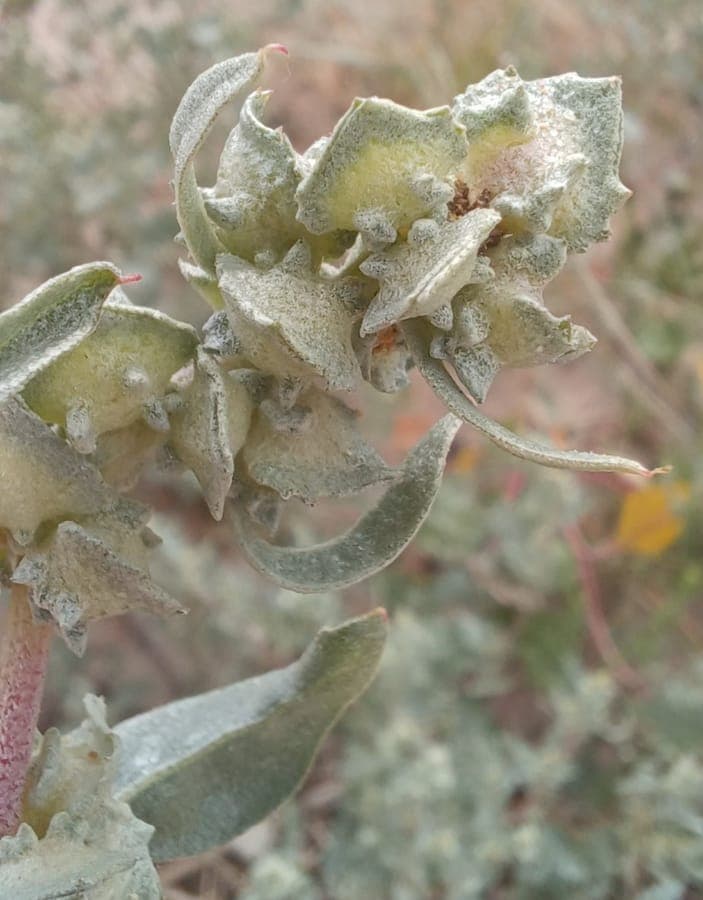
E Wusk / CC BY-SA 4.0, via Wikimedia Commons
Frosted orache: complete guide
Atriplex laciniata
Want to see Frosted orache: complete guide in your garden?
1 minute, no credit card
Overview
Frosted orache (Atriplex laciniata) is a resilient annual herb native to coastal regions across Western and Northern Europe, including the UK, France, and the Low Countries. As a member of the Amaranthaceae family, it thrives in harsh environments - think salt spray, dry sandy soil, and nutrient-poor conditions. In the wild, you'll find it colonising coastal dunes, shingle banks, and disturbed sandy ground. It's not flashy, but it's tough, and that makes it invaluable for coastal gardens or restoration projects.
Typically reaching 30 to 80 cm in height, this plant grows upright with a loose, branching habit. Its life cycle is strictly annual: it germinates in spring, flowers mid-summer through autumn, and dies with the first frosts. But it self-seeds reliably in suitable conditions, returning year after year. On gardenworld.app, you can visualise how this plant fits into a drought-tolerant garden layout, helping you place it where light and drainage are optimal.
Appearance & bloom cycle
The most striking feature of Atriplex laciniata is its deeply lobed, silvery-green foliage. The leaves, 2–5 cm long, are covered in a fine, mealy coating that gives them a frosted appearance - hence the common name. This layer reduces water loss and reflects excess sunlight, two key adaptations for life in exposed coastal zones.
From July to October, the plant produces small, greenish flower clusters in the leaf axils. The flowers lack petals and are wind-pollinated. Male and female flowers grow on separate plants (dioecious), so for successful seed production, you'll need multiple individuals. Seeds mature by late autumn and disperse naturally, often germinating the following spring if conditions allow.
Ideal location
Frosted orache scores a 9 out of 10 for light needs. It demands full sun - at least 6 to 8 hours of direct sunlight daily. In shade, it becomes leggy and weak-stemmed, with sparse foliage. The best spot in your garden is a south- or southwest-facing area with no overhead shade from trees or buildings.
It's ideal for coastal gardens, where salt-laden winds and dry air are common. Inland, use it in gravel gardens, dry borders, or on sandy patches where few other plants survive. If you're unsure whether your garden meets the exposure requirements, gardenworld.app offers sun and wind exposure mapping to help you plan accurately.
Soil requirements
This plant prefers light, sandy soils with a pH between 7.5 and 8.0. It tolerates alkaline, calcareous substrates and thrives in low-fertility ground. Avoid rich, organic soils - they promote weak growth and reduce hardiness. If your soil is heavy clay, amend it with coarse sand or pumice to improve drainage.
Do not add compost or fertiliser. Atriplex laciniata is adapted to poor soils, and excess nutrients can harm it. Also, ensure the site doesn't stay wet; prolonged moisture leads to root rot. Raised beds or sloped areas work well.
Free design
Want to see Frosted orache: complete guide in your garden? Make a free design now.
Watering
Once established, frosted orache is extremely drought-tolerant. Water only during prolonged dry spells in the first few weeks after germination. Check soil moisture by inserting your finger up to 3 cm deep - if it's dry, water lightly at the base.
Avoid overhead watering to prevent fungal issues. After the seedlings reach 10 cm, further irrigation is usually unnecessary. Overwatering is a common mistake and results in floppy growth and poor flowering.
Pruning
Pruning is rarely needed. The plant has a natural, open growth form that fits well in informal or naturalistic designs. You can remove dead or damaged stems if desired, but they typically don't pose a problem.
If you're collecting seed, leave the plants intact until late October. Cut them back in November, after seeds have dispersed. Use clean, sharp shears to avoid disease transmission.
Maintenance calendar
- January: No action needed
- February: Start seeds indoors at 15–18°C if desired
- March: Sow directly outdoors from mid-March when soil is workable
- April: Light misting during dry spells; protect seedlings from frost
- May: Thin seedlings to 20–30 cm spacing
- June: No feeding; watch for waterlogging
- July: Flowering begins; monitor for wind damage
- August: Peak bloom; wind pollination active
- September: Seeds maturing; reduce watering
- October: Harvest seeds or allow natural dispersal
- November: Cut back dead stems; mulch lightly
- December: Dormant phase; check for volunteer seedlings
Winter hardiness
As an annual, Atriplex laciniata doesn't survive winter as a mature plant. However, seeds can overwinter in the soil and germinate the next spring, especially in open, sunny spots. It's hardy in USDA zones 7–9, where mild winters allow for natural reseeding.
To encourage self-sowing, leave seed heads in place or scatter seeds on bare, sandy soil. Lightly cover with sand or straw to protect from heavy rain and birds.
Companion plants
Pair frosted orache with other coastal or sand-loving species. Good companions include marram grass (Ammophila arenaria) for structure, sea lavender (Limonium vulgare) for late-summer colour, and sea holly (Eryngium maritimum) for architectural form. All share similar needs: full sun, sharp drainage, and low fertility.
Avoid planting near moisture-loving or heavy-feeding perennials like asters or delphiniums - they'll struggle in the same conditions.
Closing
Frosted orache is an underrated gem for coastal and low-maintenance gardens. It asks for little - just sun, sand, and space - and in return, it provides texture, resilience, and subtle seasonal interest. Its silvery foliage adds contrast, and its tolerance of salt and drought makes it a reliable performer.
Seeds are available at garden centres across the UK, though not always in stock. Ask specifically at spring planting time. With thoughtful design - like the kind you can build on gardenworld.app - this annual herb can become a recurring highlight in a sustainable, natural garden.
Want to see Frosted orache: complete guide in your garden? Make a free design now.
Upload a photo, pick a style, and get a photorealistic design with plant list in under a minute.
No credit card required


Similar plants
Bassia laniflora (woolly summer-cypress): complete guide
Bassia laniflora
Full guide to Bassia laniflora: origin, appearance, ideal location, soil, watering and care for this drought-tolerant annual.
Suaeda spicata: complete guide
Suaeda spicata
Everything about Suaeda spicata (spiked seablite): a rare salt-tolerant coastal succulent from the western Mediterranean and Macaronesia.
California amaranth: complete guide
Amaranthus californicus
Full guide to California amaranth (Amaranthus californicus): growing tips, ideal location, soil needs, watering, and garden design ideas.