
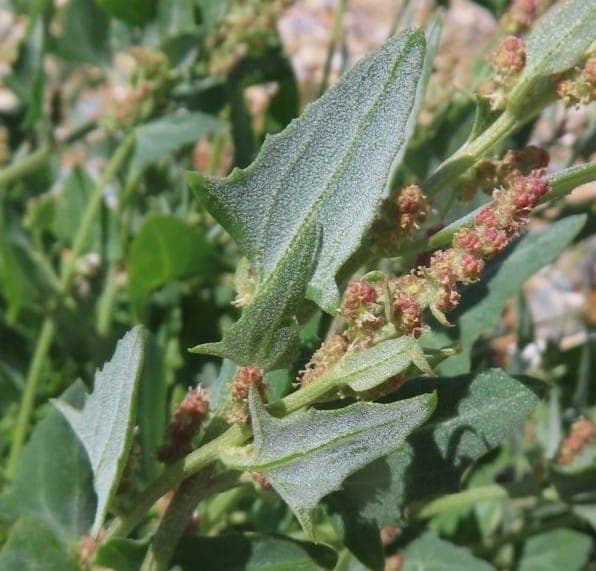
E Wusk / CC BY-SA 4.0, via Wikimedia Commons
Scotland orache: complete guide
Atriplex glabriuscula
Want to see Scotland orache: complete guide in your garden?
1 minute, no credit card
Overview
Scotland orache, or Atriplex glabriuscula, is a tough, perennial herb that thrives in coastal regions across northern and western Europe. Native from the Baltic to Ireland and Iceland, it's a survivor of salty winds, poor soils, and relentless sun. In the garden, it's not flashy, but it brings resilience and subtle beauty. Reaching 30–60 cm in height, it forms compact, upright clumps with silvery-grey foliage that glimmers in the wind. It's perfect for naturalistic planting schemes, coastal gardens, or where soil is thin and dry. If you're designing a seaside space, gardenworld.app can help you place Scotland orache exactly where it will thrive.
Appearance & bloom cycle
The plant has narrow, lance-shaped leaves covered in a fine, waxy bloom that reduces water loss and reflects intense sunlight. This gives it a soft, silvery appearance that contrasts beautifully with green-leaved neighbours. From August through October, small green flowers appear in dense, spike-like clusters along the stems. They're not showy, but they add texture and attract tiny pollinators like hoverflies. After flowering, the plant sets small, hard fruits that persist into winter, offering food for birds and visual interest in the dormant garden. The growth habit is upright but slightly spreading, forming clumps about 40 cm wide over time.
Ideal location
Scotland orache demands full sun-think 9 to 10 hours of direct light daily. It performs best in open, exposed areas with good air circulation. Ideal spots include coastal dunes, gravel gardens, rockeries, or dry, sandy borders. Avoid shaded or damp corners; the plant will stretch, flop, and likely rot. Urban gardens with reflective heat from walls or paving suit it well. Use gardenworld.app to map sun exposure in your garden and find the perfect microclimate for this sun-hungry species.
Soil requirements
It thrives in well-drained, sandy or gravelly soils with a pH between 7.0 and 7.5. Tolerant of salt, alkalinity, and even moderate compaction, it's ideal for seaside plots where salt spray and poor fertility are common. Avoid heavy clay or rich, moisture-retentive loams-these lead to root rot. A little grit or crushed stone mixed into the planting hole improves drainage. Don't add compost or fertiliser; too much fertility causes weak growth and reduces drought tolerance.
Free design
Want to see Scotland orache: complete guide in your garden? Make a free design now.
Watering
Once established, Scotland orache is extremely drought-tolerant. Water young plants weekly for the first 6–8 weeks after planting in spring (April–May). After that, rely on rainfall. Only water during prolonged dry spells in summer, and even then, sparingly. Overwatering is the fastest way to kill it. If you're using irrigation, a drip system on a timer works best-deliver water at soil level to avoid wetting the foliage.
Pruning
Minimal pruning is needed. In early spring, cut back old stems to about 10 cm above ground to encourage fresh, compact growth. Remove any dead or damaged material. You can tidy up spent flower spikes in late autumn, but leaving them provides winter structure and food for wildlife. Use clean, sharp secateurs to prevent disease spread.
Maintenance calendar
- Jan: Check for winter damage. Remove loose debris.
- Feb: No action unless ground is dry-light watering if needed.
- Mar: Cut back old growth. Clear mulch from crown.
- Apr: Plant new specimens. Water if dry.
- May: Final watering for young plants. Watch for slugs.
- Jun: No care needed. Plant builds strength.
- Jul: Monitor in heatwaves, but avoid watering.
- Aug: Flowers emerge. Check for pests.
- Sep: Peak bloom. No pruning.
- Oct: Bloom fades. Collect seeds or let self-seed.
- Nov: Remove diseased leaves. Leave stems for winter interest.
- Dec: Dormant. No feeding or watering.
Winter hardiness
Scotland orache is hardy in USDA zones 6–9. It survives cold winters, though top growth may die back in zone 6. The root system remains alive and resprouts in spring. In exposed coastal areas, it often stays semi-evergreen. No mulch or protection is required, but in harsh inland winters, a light layer of straw can help.
Companion plants
Pair it with other salt- and drought-tolerant species: sea holly (Eryngium maritimum), thrift (Armeria maritima), sand sedge (Carex arenaria), and yarrow (Achillea millefolium). For contrast, use dark-leaved sedums or purple moor grass (Molinia caerulea). Avoid moisture-loving plants like hostas or astilbes. On gardenworld.app, you can preview planting combinations that include Scotland orache in coastal gravel gardens.
Closing
Scotland orache won't win beauty contests, but it earns respect through endurance. It asks for little-full sun, sharp drainage, and no fuss-and gives back with structure, texture, and year-round presence. Use it to stabilise sandy soil, create low-maintenance borders, or add silvery tones to a modern garden. It's a quiet achiever, perfect for gardeners who value function as much as form. For design ideas, explore gardenworld.app's coastal planting templates where Scotland orache plays a supporting yet essential role.
Want to see Scotland orache: complete guide in your garden? Make a free design now.
Upload a photo, pick a style, and get a photorealistic design with plant list in under a minute.
No credit card required


Similar plants
Bassia laniflora (woolly summer-cypress): complete guide
Bassia laniflora
Full guide to Bassia laniflora: origin, appearance, ideal location, soil, watering and care for this drought-tolerant annual.
Suaeda spicata: complete guide
Suaeda spicata
Everything about Suaeda spicata (spiked seablite): a rare salt-tolerant coastal succulent from the western Mediterranean and Macaronesia.
California amaranth: complete guide
Amaranthus californicus
Full guide to California amaranth (Amaranthus californicus): growing tips, ideal location, soil needs, watering, and garden design ideas.