
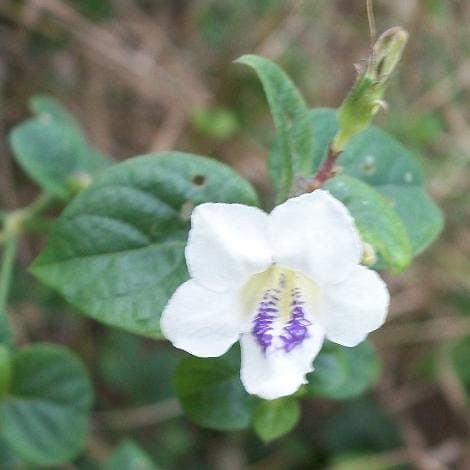
Michaelwild at en.wikipedia / CC BY-SA 3.0, via Wikimedia Commons
Chinese violet: complete guide
Asystasia gangetica
Want to see Chinese violet: complete guide in your garden?
1 minute, no credit card
Overview
Chinese violet (Asystasia gangetica) is a tropical plant from the Acanthaceae family, native to warm regions of India, Bangladesh, and Southeast Asia. It is also known as Ganges primrose or Philippine violet.
It is an elegant, compact-growing plant with lovely purple to blue flowers. In temperate climates, it is typically grown as a houseplant or conservatory plant, though it can move outdoors in summer.
Appearance and bloom
Chinese violet forms a dense, bushy plant with opposite, oval leaves. Foliage is glossy, dark green, approximately 5 to 8 centimeters long.
Flowers appear in clusters with characteristic symmetry: two purple to blue petals above, white to light purple below. These two-tone flowers are highly attractive and appear throughout summer and fall.
The plant reaches 30 to 60 centimeters tall and forms naturally into a compact ball shape.
Ideal location
Chinese violet grows best in warm, bright spots with indirect daylight. Do not place in direct harsh afternoon sun, which causes leaf scorch.
- Light: Bright, indirect daylight; minimum 3 to 4 hours daily
- Temperature: Minimum 15-18 degrees Celsius; ideal 20-25 degrees
- Humidity: Prefers moderate to high air humidity
In winter it tolerates more sun when intensity is lower.
Soil
For container plants, use:
- Loose, nutrient-rich potting soil
- Good drainage (add perlite or coarse sand)
- Neutral to slightly acid pH (6.0 to 7.0)
- For outdoors: sandy to loamy soil with organic matter
Free design
Want to see Chinese violet: complete guide in your garden? Make a free design now.
Watering
Chinese violet prefers regularly moist soil, but not waterlogged. Follow this guideline:
- Summer: Water when top layer feels dry
- Winter: Less water; allow soil to dry more frequently
- Humidity: Mist foliage regularly
Avoid hard water; use filtered or rainwater.
Pruning
Chinese violet grows compactly and needs minimal pruning. However, you can:
- Remove spent flowers regularly to encourage new blooms
- Lightly trim in spring for fuller growth pattern
- Shorten long, spindly stems
Maintenance calendar
- March-May: Growing season begins; repot in fresh soil; water regularly
- June-September: Peak blooming; feed regularly; mist against dryness
- October-November: Water less; stop feeding
- December-February: Winter dormancy; minimal water; keep cool
Winter hardiness
Chinese violet is not cold hardy in temperate climates. It must overwinter indoors or in a heated conservatory. In tropical areas it grows year-round outdoors.
Companion plants
In a conservatory or greenhouse, Chinese violet combines well with:
- Thunbergia (black-eyed Susan)
- Clerodendron (glory bower)
- Bougainvillea (paper flower)
- Impatiens (busy lizzie)
Propagation
The plant propagates easily via:
- Cuttings: Soft wood in spring; plant in moist soil
- Seeds: Sow in warm propagator
Closing
Chinese violet is a reliable flowering houseplant that provides years of enjoyment. With regular watering, adequate light, and warm conditions, it proves an easy, decorative plant. For more tips on tropical houseplants, visit gardenworld.app. Transform your home into a tropical paradise with gardenworld.app.
Want to see Chinese violet: complete guide in your garden? Make a free design now.
Upload a photo, pick a style, and get a photorealistic design with plant list in under a minute.
No credit card required


Similar plants
Limestone wild petunia: complete guide
Ruellia strepens
Ruellia strepens is a long-blooming perennial native to central and eastern North America, with lavender trumpet flowers from June to September.
Shrimp plant: complete guide
Justicia brandegeeana
Everything about the shrimp plant (Justicia brandegeeana): cultivation, ideal location, watering, pruning and overwintering of this popular tender ornamental.
Caricature-plant: complete guide
Graptophyllum pictum
Grow the vibrant Caricature-plant with its striking patterned foliage. Care tips, cultivation, and pairing ideas for indoors and outdoors.