
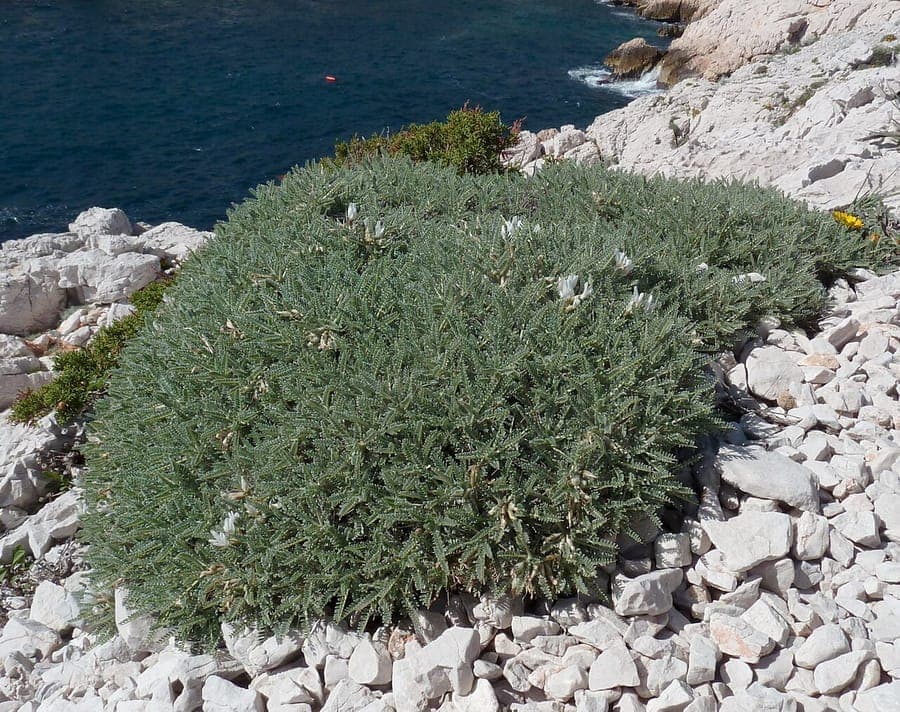
Aroche / CC BY-SA 3.0, via Wikimedia Commons
Astragalus tragacantha: complete guide
Astragalus tragacantha
Want to see Astragalus tragacantha: complete guide in your garden?
1 minute, no credit card
Overview
Astragalus tragacantha, better known as tragacanth, is a sturdy perennial from the Fabaceae (pea) family. This Mediterranean native grows from southern France to the Iberian Peninsula. With its fine, silvery-green foliage and bright yellow flowers, it's an excellent choice for dry, sunny garden designs.
The plant forms compact mounds of 30-50 cm in height and spread. It's a durable choice for rock gardens, Mediterranean borders, and steppe gardens. Tragacanth is renowned for its outstanding drought tolerance and low maintenance requirements.
Appearance and Bloom
Astragalus tragacantha has characteristic compound leaves that are very finely-divided, giving a soft, almost woolly appearance. The leaf color is silvery-green to gray, creating a calming effect.
Flowers appear in May-June in dense, compact clusters of bright yellow color. These flowers attract many pollinators and provide valuable nectar for bees and butterflies.
After blooming, interesting seed pods form and remain visible throughout the season. These seed pods are architecturally interesting and add winter texture.
Ideal Location
Astragalus tragacantha thrives in full sun. It loves warm, dry spots where other plants might wilt. This makes it ideal for south or west-facing positions.
The plant works well in rock gardens, alpine troughs, and as border edging along pathways. It's also suitable for green roofs and containers on south-facing terraces.
Ensure good air circulation to prevent fungal problems, especially during humid summers.
Soil
Soil must be well-draining - this is essential. Astragalus tragacantha cannot tolerate waterlogging. Use sand, gravel, or perlite to lighten heavy soils.
The plant grows well in poor soils. You don't need to add much nutrition; in fact, overly fertile soils stimulate excessive leaf growth at the expense of flowers.
Ideal pH is neutral to slightly acidic (6.5-7.5).
Free design
Want to see Astragalus tragacantha: complete guide in your garden? Make a free design now.
Watering
Once established, Astragalus tragacantha is extremely drought-tolerant. Young plants need regular watering in their first year to establish, but afterward you'll find them refreshingly independent.
In Mediterranean summers, water weekly if the soil feels bone-dry. However, prefer too dry over too wet - excess moisture causes root rot.
In winter with moist soils, barely any extra watering is needed. The plant sustains itself on natural moisture.
Pruning
Astragalus tragacantha requires minimal pruning. In spring, remove only dead foliage. The plant naturally forms a compact mound.
If the plant becomes somewhat shaggy after several years, you can gently deadhead immediately after flowering. This helps maintain compactness.
Maintenance Calendar
March: Remove dead foliage. Plant is still in winter dormancy.
April: Growth begins. Plant starts to green up.
May-June: Beautiful flowering period. Enjoy the yellow blooms.
July-August: Hot period. Plant is fully drought-tolerant now.
September-October: Plant self-sows. Leave seed pods for bird food.
November-February: Winter dormancy. Plant retains foliage.
Winter Hardiness
Astragalus tragacantha is winter-hardy to USDA zone 6 (-23 to -17 degrees Celsius). In milder regions of the Netherlands, it stays outside year-round, but in northern and higher-elevation areas, extra drainage may be needed.
The greatest threat is not cold, but wet winters. Plant material in wet, heavy soils can rot from below.
Companion Plants
Astragalus tragacantha combines well with other Mediterranean drought-tolerant plants:
- Lavender (Lavandula): Similar growing and flowering requirements
- Fescue (Festuca): Silvery grasses in complementary colors
- Rock Rose (Helianthemum): Other low-growers with yellow flowers
- Mediterranean Sage (Salvia): Silver-gray partners
- Stonecrops (Sempervivum): For structural contrast
Closing Thoughts
Astragalus tragacantha is an ancient, reliable plant for dry gardens. With its fine texture, yellow flowers, and extreme drought tolerance, it deserves more attention from garden designers. In water-conscious gardens, this is a true winner.
Check GardenWorld for more Mediterranean plant combinations.
Want to see Astragalus tragacantha: complete guide in your garden? Make a free design now.
Upload a photo, pick a style, and get a photorealistic design with plant list in under a minute.
No credit card required


Similar plants
Tall Silky Lupine: complete guide
Lupinus elatus
Tall silky lupine is a fast-growing Californian perennial with silvery foliage and blue-purple flower spikes, ideal for a prairie-style garden.
Garfield Lupine: complete guide
Lupinus garfieldensis
The Garfield lupine is a rare, fast-growing American perennial for alkaline, dry grassland gardens, with striking blue flower spikes.
Lupinus elegans: complete guide
Lupinus elegans
Lupinus elegans, the elegant lupine, is a spectacular blooming plant from Mexico with blue flower spikes. Care, cultivation and garden use.