
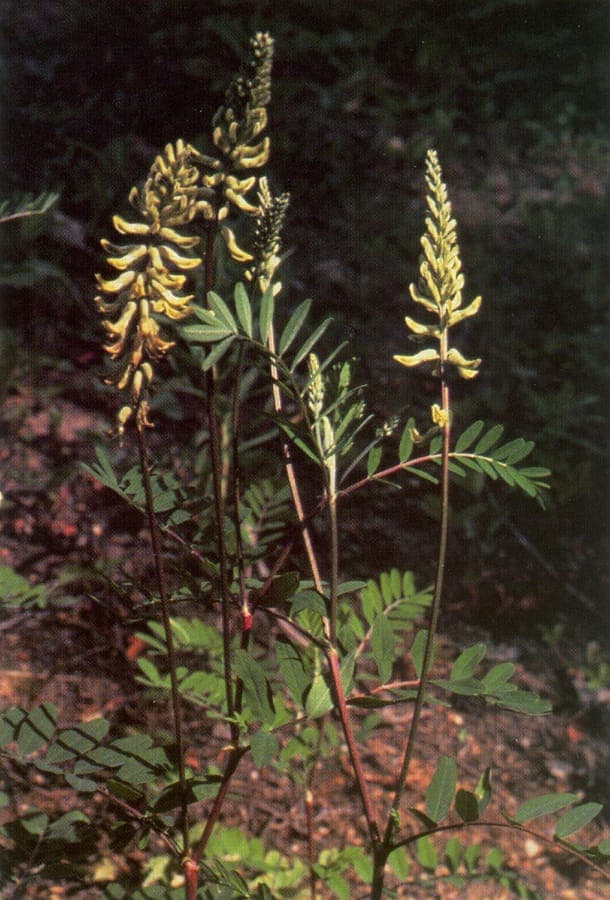
Joe F. Duft / Public domain, via Wikimedia Commons
Canada milk-vetch: complete guide
Astragalus canadensis
Want to see Canada milk-vetch: complete guide in your garden?
1 minute, no credit card
Overview
Astragalus canadensis, commonly called Canada milk-vetch or Canadian milkvetch, is a tall herbaceous perennial in the pea family (Fabaceae). It is native across a vast swath of North America, from the Canadian provinces of Ontario and Quebec south through the Great Plains and eastern United States as far as Louisiana, Texas, and Georgia. It inhabits open prairies, meadow edges, riverbanks, and the margins of woodlands - places where the soil is well-drained but not too poor.
Like all legumes, Canada milk-vetch forms a symbiotic relationship with nitrogen-fixing Rhizobium bacteria in root nodules. This biological ability to capture atmospheric nitrogen makes the species ecologically valuable in both wild and cultivated landscapes. Over several growing seasons, established plants measurably improve the nutrient profile of the surrounding soil, benefiting neighbouring plants such as grasses and forbs. Related garden-worthy species include Baptisia australis (blue wild indigo) and Glycyrrhiza uralensis (licorice root), both also in Fabaceae.
The plant forms a clump-forming, somewhat stoloniferous habit, with erect stems rising 60 to 120 cm depending on soil richness and moisture. Dense cylindrical flower spikes appear in June through August, packed with small creamy-yellow pea flowers that are irresistible to bumblebees, native bees, and small butterflies. After blooming, inflated oblong pods of 1.5 to 3 cm develop and ripen to brown by late summer.
Appearance & bloom cycle
Canada milk-vetch sends up robust, slightly angled stems clothed in pinnately compound leaves of 13 to 35 leaflets each. Individual leaflets are narrowly elliptic, 1.5 to 4 cm long, and bright medium green, giving the plant an airy, fine-textured appearance despite its substantial height. The overall silhouette is erect and vase-shaped, with multiple stems fanning outward from the central crown.
Flowering begins in late May in warm sites and peaks in June to early July. Each spike is 5 to 15 cm long and carries 30 to 80 individual flowers tightly packed along a central rachis. Individual blossoms are classic pea-flower shape: a broad standard petal above, two lateral wing petals, and a boat-shaped keel enclosing the reproductive organs. Colour ranges from creamy white to pale straw yellow. The blooms are lightly fragrant on warm days, and the hum of visiting bumblebees is one of the pleasures of growing this plant.
Once pollinated, pods develop throughout July and August. Each pod contains 6 to 15 seeds. The brown, papery pods persist into autumn and add winter interest, and birds occasionally forage for seeds. A mature clump after three or four seasons can spread 60 to 90 cm across and becomes an impressive structural presence in a perennial border.
Ideal location
Canada milk-vetch performs best in full sun to light partial shade. A minimum of 5 to 6 hours of direct sunlight per day produces the fullest flower spikes and sturdiest stems. In deeper shade the stems etiolate and may require staking, while flowering is significantly reduced.
The plant thrives in open borders, prairie-style plantings, naturalistic meadow gardens, and along the edges of ponds or streams. It is not suitable for containers or formal clipped hedges. Space individual plants 60 to 90 cm apart to allow for their mature spread and for adequate air circulation. A sheltered position is useful for the tallest specimens on exposed sites, though staking is rarely necessary in a well-planted mixed border where neighbouring plants provide mutual support.
Soil requirements
This species adapts readily to a wide range of soils, performing well on pH 6.0 to 8.0 - from moderately acidic loams to slightly alkaline chalky soils. The single most important requirement is reasonable drainage: waterlogged clay soils suppress the nitrogen-fixing bacteria and cause root rot. On heavy soils, incorporate coarse grit and compost to a depth of 30 cm before planting.
Do not fertilize heavily with nitrogen at planting. Excessive nitrogen fertilizer inhibits the formation of Rhizobium nodules, defeating the plant's natural competitive advantage. A modest top-dressing of well-rotted compost (5 cm) in early spring of the second and subsequent years is sufficient. On thin sandy soils, initial establishment is slower but the plant self-improves its growing conditions once nodulation is underway. Mulching with wood chips or straw to a depth of 5 to 8 cm conserves moisture and moderates soil temperature.
Free design
Want to see Canada milk-vetch: complete guide in your garden? Make a free design now.
Watering
Once established, Canada milk-vetch is moderately drought-tolerant, reflecting its origins on the prairies and open grasslands of central North America. In the first growing season, water weekly during dry spells, applying 2 to 3 litres per plant to encourage deep root development. Young plants that receive insufficient water show rolled leaflets and reduced stem height.
From the second year onwards, supplemental watering is needed only during prolonged dry periods exceeding three weeks without rain. During summer heat waves above 28 degrees Celsius, additional watering every two weeks helps sustain flowering. Avoid overwatering: permanently wet soil is the most common cause of failure. Drip irrigation or soaker hoses at soil level are ideal. Avoid overhead irrigation where possible, as persistently wet foliage can encourage fungal spot diseases in humid conditions.
Pruning
Canada milk-vetch requires minimal pruning. The simplest approach is to cut stems down to 10 to 15 cm in late autumn once the foliage has died back after the first frosts. However, leaving the stems and pods standing through winter provides perching sites for small birds, seed for winter foragers, and structural interest in the garden. Cut back in early spring (February to March) before new growth emerges.
During the growing season, removing spent flower spikes encourages the plant to produce additional flowering stems. If self-seeding is not desired, deadhead regularly as pods begin to swell. Collected ripe seed can be sown in spring after 4 to 6 weeks of cold stratification in a refrigerator to break dormancy. Germination takes 2 to 4 weeks at 15 to 20 degrees Celsius.
Maintenance calendar
February-March: Cut old stems to 10 cm. Apply 5 cm of compost around the crown, keeping the centre clear. Check for emerging shoots. April: Water young plants if the soil is dry. Weed around the base while the plant is still compact. May: Stems grow rapidly to 40 to 60 cm. No fertilizer needed. Water if prolonged dry spell occurs. June: Full bloom. Enjoy visiting bees and butterflies. Water during heat waves. July: Peak bloom continues. Deadhead if self-seeding is unwanted. Watch for aphids on soft new growth. August: Pods develop and ripen. Collect seed if desired. Bloom gradually fades. September: Plant begins to die back. Reduce watering. Leave pods for wildlife. October-November: Stems provide winter structure. Apply leaf mulch around the crown before hard frost. December-January: Plant dormant underground. No maintenance required.
Winter hardiness
Canada milk-vetch is exceptionally cold-hardy, rated to USDA zone 3 (temperatures down to -40 degrees Celsius). Its native range includes the Canadian prairies and the northern Great Plains, where winters are reliably severe. In European gardens - including the Benelux, the UK, Germany, and northern France - the plant overwinters reliably without protection.
In the first winter after planting, a 5 to 10 cm layer of leaf mulch over the crown is a sensible precaution while roots are still establishing. From the second year onwards, no winter protection is needed. Above-ground growth dies back at the first frost; the root crown is entirely frost-hardy and regrows reliably each spring. Even after exceptionally cold winters with prolonged ground frost, Canada milk-vetch bounces back from its deep root system.
Companion plants
Canada milk-vetch integrates beautifully into prairie-style and naturalistic borders. Recommended companions include:
- Echinacea purpurea (purple coneflower): overlapping bloom in June to August, similar height at 70 to 100 cm, outstanding for pollinators
- Rudbeckia fulgida (orange coneflower): yellow flowers from August to October extend the border's season after milk-vetch finishes
- Solidago canadensis (goldenrod): tall yellow flower plumes in August to September complement the earlier blooms
- Panicum virgatum 'Shenandoah' (switch grass): warm-season ornamental grass reaching 90 to 120 cm provides movement and contrast
- Monarda fistulosa (wild bergamot): aromatic, bee-attracting, similar flowering period and height
- Veronicastrum virginicum (culver's root): tall white spires for late summer, creating a dramatic mixed planting
Discover how to combine Canada milk-vetch with other perennials in a cohesive design at gardenworld.app. Use the planting tool to test colour combinations and spacing before committing to a layout. For more plant profile guides and garden inspiration, visit gardenworld.app.
Conclusion
Canada milk-vetch earns its place in any garden with ambitions toward ecological richness and low-maintenance planting. It fixes nitrogen, feeds pollinators, provides structural presence from May through November, and overwinters reliably in most of Europe. For naturalistic gardeners who want a plant that earns its keep, Astragalus canadensis is an excellent choice that improves the garden ecosystem season after season.
Want to see Canada milk-vetch: complete guide in your garden? Make a free design now.
Upload a photo, pick a style, and get a photorealistic design with plant list in under a minute.
10,000+ gardens designed already
No credit card required


Similar plants
Tall Silky Lupine: complete guide
Lupinus elatus
Tall silky lupine is a fast-growing Californian perennial with silvery foliage and blue-purple flower spikes, ideal for a prairie-style garden.
Garfield Lupine: complete guide
Lupinus garfieldensis
The Garfield lupine is a rare, fast-growing American perennial for alkaline, dry grassland gardens, with striking blue flower spikes.
Lupinus elegans: complete guide
Lupinus elegans
Lupinus elegans, the elegant lupine, is a spectacular blooming plant from Mexico with blue flower spikes. Care, cultivation and garden use.