
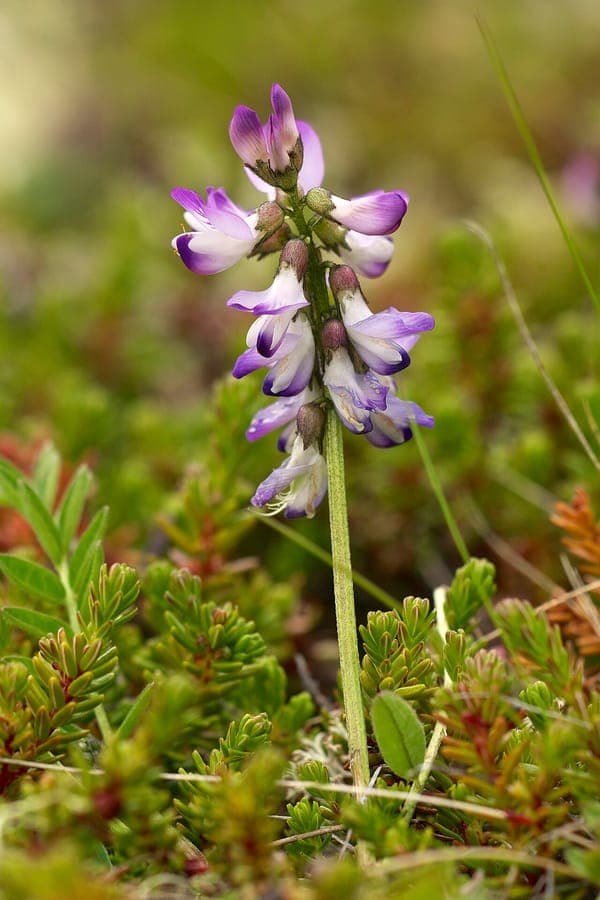
Jörg Hempel / CC BY-SA 3.0 de, via Wikimedia Commons
Alpine milk-vetch: complete guide
Astragalus alpinus
Want to see Alpine milk-vetch: complete guide in your garden?
1 minute, no credit card
Overview
Astragalus alpinus, commonly known as Alpine milk-vetch, is a low-growing, mat-forming perennial that thrives in harsh, exposed conditions. Native to high-altitude regions across Europe and North America, it's adapted to short growing seasons, intense sunlight, and cold winters. It won't dominate your garden, but it earns its place through resilience and subtle beauty.
On gardenworld.app, you can design a rock garden layout that integrates Alpine milk-vetch seamlessly into scree beds or crevice gardens. Its ability to stabilise soil and self-maintain in lean conditions makes it ideal for naturalistic designs.
Appearance & bloom cycle
This plant stays modest, reaching just 4–8 cm in height but spreading up to 25 cm wide. The foliage is fleshy, pinnate, and forms a dense ground-hugging carpet. Leaves are grey-green, often with a fine pubescence that reduces water loss - a smart adaptation for alpine life.
Flowering occurs from late June through August. The blooms are soft pink to pale purple, arranged in short racemes of 10–15 flowers. They're not flashy, but they offer a delicate charm and attract small pollinators like solitary bees and hoverflies. Seed pods develop by late summer and may persist into autumn, adding textural interest.
Ideal location
Full sun is non-negotiable. Alpine milk-vetch needs at least 6–8 hours of direct sunlight daily. Choose south- or west-facing slopes, rock walls, or gravel gardens where heat reflects and drainage is rapid. Avoid shaded or humid corners - this plant dislikes competition and damp air.
It's perfect for green roofs, alpine troughs, or between flagstones in a dry courtyard. Pair it with dwarf conifers, cushion spurge, or creeping thyme for a layered, textured look. Explore layout ideas on gardenworld.app to visualise how it fits in small-space or xeriscaped gardens.
Soil requirements
This species demands sharp drainage. Use a gritty mix: 2 parts loam, 1 part coarse sand, and 1 part perlite or crushed granite. Avoid rich composts or clay-heavy soils - they retain moisture and cause root rot.
The pH range is flexible: 5.5 to 7.8. It tolerates slightly acidic to slightly alkaline conditions, reflecting its presence on limestone screes in the Alps and dolomitic hills in Austria. A topdressing of gravel helps prevent stem rot by keeping foliage dry.
Watering
Once established, Alpine milk-vetch is drought-tolerant. Water only during prolonged dry spells (3+ weeks without rain), and even then, do so sparingly. Overwatering is the fastest way to kill it.
For the first growing season, water weekly to help roots establish. Use rainwater when possible - tap water, especially if hard, can alter soil pH over time. Water at the base to avoid wetting the foliage, which can lead to fungal issues in humid climates.
Free design
Want to see Alpine milk-vetch: complete guide in your garden? Make a free design now.
Pruning
No pruning is required. The plant maintains a neat, compact form naturally. In early spring, you can tidy up any dead or damaged stems with sharp scissors, but avoid cutting into old wood.
If the plant becomes sparse after several years, you can lift and divide it in late spring. Replant divisions 15 cm apart and water lightly until rooted. This also helps prevent self-seeding if you want to control its spread.
Maintenance calendar
- January–February: Dormant. No action needed.
- March: Remove any winter-damaged foliage. Check for slugs on new growth.
- April: Divide if needed. Top-dress with gritty soil.
- May: Monitor for drought. Water young plants if conditions are dry.
- June–August: Flowering period. Avoid fertilising.
- September: Allow seed pods to mature for self-sowing, or deadhead to prevent spread.
- October–December: Mulch lightly with gravel or pine needles in wet climates to protect crowns from winter rot.
Winter hardiness
USDA zones 3–7. It survives temperatures as low as -40°C when soil is well-drained. In wetter zones like the UK or Pacific Northwest, the main threat is winter wet, not cold. Elevate plantings on slopes or mounds to improve drainage.
Avoid organic mulches like bark or compost in winter - they hold moisture and invite rot. A thin layer of inorganic mulch (gravel, scoria) is safer and mimics its natural habitat.
Companion plants
Choose companions with similar needs: Silene acaulis, Draba spp., Saxifraga oppositifolia, or dwarf Dianthus. Avoid vigorous spreaders like mint or ivy - they'll overwhelm this slow grower.
Good structural partners include dwarf conifers, stonecrop varieties, and low-growing sedges. In a garden design on gardenworld.app, you'll often see Alpine milk-vetch used to soften hardscapes while requiring almost no maintenance.
Closing
Alpine milk-vetch isn't for gardeners who want instant impact. It's for those who appreciate understated plants that endure. It asks for little - just sun, grit, and space - and gives back with reliable blooms and year-round structure.
If you're designing a low-maintenance, eco-friendly garden in a cold or dry climate, this plant deserves a spot. Find it at local garden centres or specialist nurseries. Once planted in the right spot, it can persist for a decade or more with minimal intervention.
Want to see Alpine milk-vetch: complete guide in your garden? Make a free design now.
Upload a photo, pick a style, and get a photorealistic design with plant list in under a minute.
No credit card required


Similar plants
Tall Silky Lupine: complete guide
Lupinus elatus
Tall silky lupine is a fast-growing Californian perennial with silvery foliage and blue-purple flower spikes, ideal for a prairie-style garden.
Garfield Lupine: complete guide
Lupinus garfieldensis
The Garfield lupine is a rare, fast-growing American perennial for alkaline, dry grassland gardens, with striking blue flower spikes.
Lupinus elegans: complete guide
Lupinus elegans
Lupinus elegans, the elegant lupine, is a spectacular blooming plant from Mexico with blue flower spikes. Care, cultivation and garden use.