
Wikimedia Commons / CC BY-SA 3.0, via Wikimedia Commons
Alpine aster: complete guide
Aster alpinus
Want to see Alpine aster: complete guide in your garden?
1 minute, no credit card
Overview
Aster alpinus, commonly known as Alpine aster, is a compact, hardy perennial from the Asteraceae family. Unlike most asters that bloom in autumn, this one lights up the garden from April through June. That makes it a standout for gardeners wanting early-season colour without high maintenance. Native to alpine regions across Europe and Asia-from the Alps to Siberia-it's adapted to cold, rocky, and well-drained conditions. It reaches just 20 to 25 cm in height, making it ideal for the front of borders, rockeries, or stone walls.
On gardenworld.app, you can design a planting scheme that highlights low-growing perennials like Alpine aster, ensuring proper spacing and soil compatibility. It's a great choice for gravel gardens, drought-prone areas, or naturalistic plantings where structure and early interest matter. Once established, it's nearly carefree, asking for little more than sun and sharp drainage.
Appearance & bloom cycle
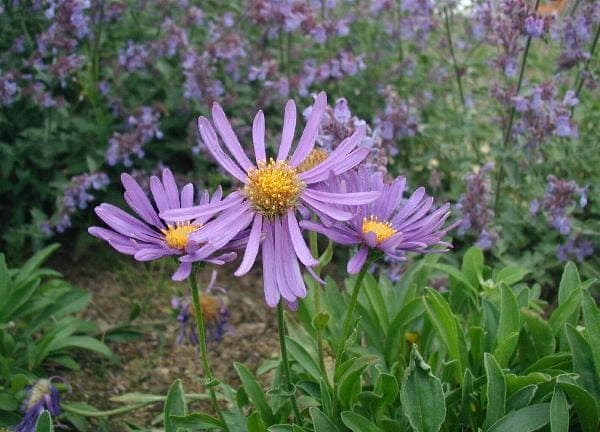
The Alpine aster forms a dense mat of narrow, dark green leaves that emerge early in spring. From April to June, it produces cheerful daisy-like flowers, 4 to 6 cm wide, with vibrant purple to pale blue rays and a golden centre. The blooms are held just above the foliage, creating a carpet of colour. Some cultivars, like 'Goliath' (with 8 cm flowers) or 'Punkie' (deep purple), offer bolder impact and are available at garden centres like Thompson & Morgan or local independents.
After flowering, the seed heads add winter texture, especially when dusted with frost. While it won't rebloom heavily, a light trim may encourage a few late-season flowers in mild autumns. The plant stays evergreen in milder zones, with foliage persisting through winter.
Ideal location
Full sun is best-this plant thrives where it gets at least 6 hours of direct light. In hotter southern zones, a bit of afternoon shade helps prevent scorching. It prefers open, airy spots with good air circulation to avoid fungal issues. Avoid damp, stagnant areas. Ideal spots include rock gardens, crevices in retaining walls, or raised beds with gravel mulch. It pairs well with other alpine specialists and doesn't compete well with aggressive root systems.
Soil requirements
Alpine aster demands sharply drained, alkaline to neutral soil (pH 6.5–8.0). It tolerates poor, sandy, or stony soils but fails in heavy clay or waterlogged conditions. Improve drainage by mixing in grit, gravel, or coarse sand. Avoid rich compost-too much fertility leads to floppy growth and fewer flowers. If your soil is acidic, add garden lime to raise the pH slightly.
You can use gardenworld.app to assess your soil type and get planting suggestions tailored to rocky, dry conditions. The platform helps match plants to your garden's microclimate, saving time and effort.
Free design
Want to see Alpine aster: complete guide in your garden? Make a free design now.
Watering
Water newly planted asters regularly for the first few weeks. Once rooted, they're highly drought-tolerant. Mature plants rarely need supplemental watering, even in dry springs. Overwatering is a bigger risk than underwatering-root rot is the main cause of failure. Water at soil level to keep foliage dry and reduce disease risk.
Pruning
Minimal pruning is needed. After flowering, trim back spent stems to just above the leaf rosette to maintain neatness and possibly encourage a second flush. In late autumn or early winter, leave stems intact for winter interest and seed-eating birds. In early spring, gently rake out any dead or matted foliage to make way for new growth.
Maintenance calendar
- January: Check for winter damage; remove only dead material.
- February: Prepare soil around plants; avoid disturbing roots.
- March: Clear old leaves; no feeding required.
- April: First blooms appear; watch for aphids.
- May: Peak flowering; no extra care needed.
- June: Flowering winds down; trim lightly if desired.
- July: Dormant phase; avoid watering unless prolonged drought.
- August: Monitor for stem rot in humid areas.
- September: Optional tidy-up pruning.
- October: Let plants rest; no cutting back.
- November: Leave standing for winter structure.
- December: Fully hardy; no protection needed.
Winter hardiness
Alpine aster is extremely cold-hardy, surviving temperatures down to -30°C (USDA zones 3–7). It dies back slightly in harsh winters but reliably returns in spring. The key to winter survival is dry soil-wet roots in frozen ground cause rot. Mulch lightly with gravel, not organic matter, to prevent moisture retention.
Companion plants
Pair with other alpine or rock garden plants: creeping thyme, sedum, dwarf dianthus, or campanula. It contrasts beautifully with silver-foliaged plants like artemisia or helianthemum. Avoid tall, vigorous perennials that shade it out. It works well with spring bulbs like crocus or snowdrops-plant them nearby so the aster foliage fills in as bulbs die back.
Closing
The Alpine aster is a quiet achiever-small, early, and tough. It brings colour when little else is blooming and asks for almost nothing in return. Plant in groups of five or more for visual impact. Buy potted plants in spring from local garden centres or sow seeds in summer. With the right spot and soil, this alpine gem will return year after year, proving that simplicity and resilience make for lasting garden beauty.
Want to see Alpine aster: complete guide in your garden? Make a free design now.
Upload a photo, pick a style, and get a photorealistic design with plant list in under a minute.
No credit card required


Similar plants
Calendula stellata: complete guide
Calendula stellata
Complete guide to Calendula stellata, the star-flowered marigold from Sicily: location, soil, watering and companion planting tips.
Korean chrysanthemum: complete guide
Chrysanthemum x rubellum
Chrysanthemum x rubellum is a hardy autumn perennial with single pink to copper flowers from August to November. Care and combinations.
Helianthus divaricatus: complete guide
Helianthus divaricatus
Helianthus divaricatus is a North American woodland sunflower with yellow summer blooms, ideal for naturalistic borders and shady edges.