
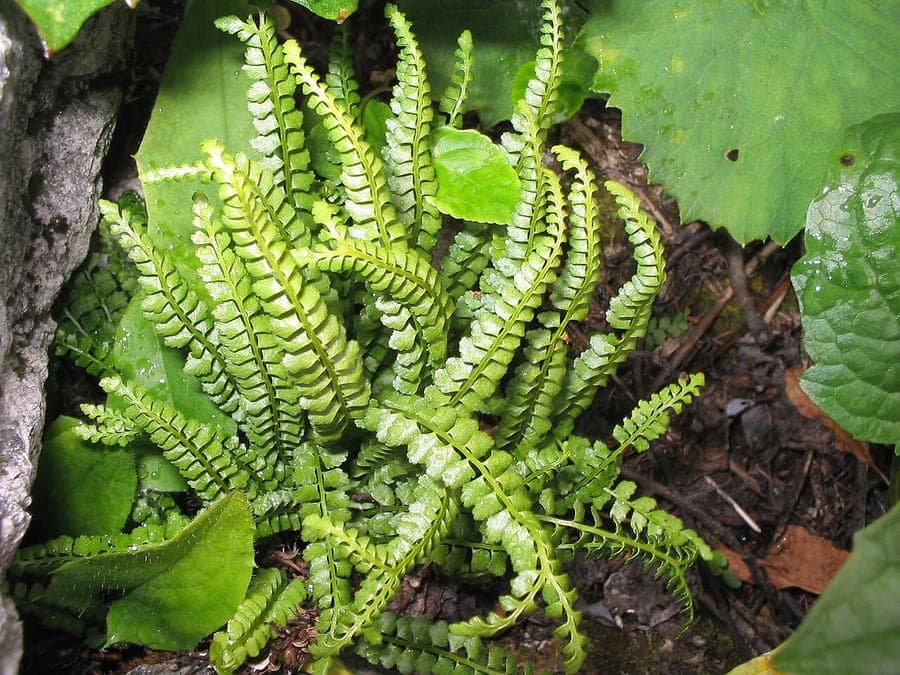
Wikimedia Commons / CC BY-SA 3.0, via Wikimedia Commons
Green spleenwort: complete guide
Asplenium viride
Want to see Green spleenwort: complete guide in your garden?
1 minute, no credit card
Overview
Green spleenwort (Asplenium viride) isn't your average garden plant. It's a delicate fern that thrives in narrow cracks of limestone walls, on shaded cliffs, and in moist woodland crevices. Native across parts of North America and Europe, it's built for survival in tough, airy spots where soil is scarce. If you've got a shaded stone wall, a north-facing rockery, or a cool, damp corner under trees, this fern might be the quiet star you've been missing.
On gardenworld.app, you can create a custom garden layout that highlights naturalistic planting zones - perfect for integrating green spleenwort into a shaded rock wall or mossy slope.
Appearance & bloom cycle
Ferns don't bloom, but green spleenwort has a distinct growing season from June through September. During this time, new fronds unfurl with a bright, glossy green stalk - the 'spleenwort' part of the name comes from old herbal beliefs, but the 'green' is spot-on. Fronds reach 10–25 cm long and 2–3 cm wide, with finely divided, lance-shaped leaflets arranged neatly along a central rachis. The stalks are a vivid green, setting them apart from similar ferns like Asplenium trichomanes, which has dark, wiry stalks.
Spore production happens on the underside of mature fronds. The sori are linear and covered with a thin, translucent indusium. Spores mature in late summer and disperse in damp air - no flowers, but a quiet, effective reproductive strategy.
Ideal location
This fern wants cool, moist, and shaded. Think north-facing walls, under evergreen canopies, or in the shelter of a stone wall with good airflow. Avoid full sun, especially midday heat - it'll scorch the fronds. A spot under deciduous trees like beech or maple works well, as long as the canopy isn't too dense.
Height matters: green spleenwort grows best 1–1.5 m off the ground in wall crevices. If you're building a dry stone wall or restoring an old one, consider planting it directly into the joints. On gardenworld.app, use the 3D garden planner to visualize how to position these ferns for maximum natural effect.
Soil requirements
Forget garden soil - green spleenwort needs a gritty, well-drained, lime-rich substrate. Use a mix of crushed limestone, fine gravel, leaf litter, and a touch of peat-free compost. pH should be neutral to slightly alkaline (7.0–7.5). Avoid acidic or heavy compost-heavy mixes; they retain too much moisture and can rot the roots.
For container growing: blend 50% limestone chips, 30% horticultural charcoal, 20% leaf mould. Ensure the pot has excellent drainage and place it in a sheltered, humid spot.
Free design
Want to see Green spleenwort: complete guide in your garden? Make a free design now.
Watering
Keep the roots and surrounding air consistently moist, but never soggy. Mist the fronds regularly, especially in dry spells. Water at the base in early morning or evening when the surface feels dry. In wall crevices, the stone retains moisture, so deep watering isn't needed often - just occasional misting.
In winter, reduce watering but don't let the plant dry out completely. In areas with little snow or rain, a light misting during dry cold snaps helps.
Pruning
No pruning needed. Only remove dead or damaged fronds with clean scissors, ideally in March before new growth starts. Leave old fronds in place as long as possible - they help retain moisture and protect developing spores.
Maintenance calendar
- Jan: Check for desiccation, mist lightly if dry
- Feb: Dormant - no action needed
- Mar: Remove any dead fronds
- Apr: Begin regular misting as temperatures rise
- May: Monitor for new frond development, keep moist
- Jun–Sep: Active growth - maintain high humidity
- Oct: Reduce misting frequency
- Nov–Dec: Protect from extreme frost with moss or straw if exposed
Winter hardiness
Hardy to USDA zone 5 (-20°C). Survives most UK and northern US winters without issue, especially when growing in sheltered crevices. In harsh winters with prolonged freezing and no snow cover, a light mulch of moss or straw around the base can help. Avoid plastic covers - the plant needs to breathe.
Companion plants
Pair green spleenwort with other shade- and moisture-loving plants:
- Polypodium vulgare (Common polypody)
- Saxifraga oppositifolia (Purple saxifrage)
- Hepatica nobilis (Liverleaf)
- Alchemilla mollis (Lady's mantle)
- Anemone nemorosa (Wood anemone)
These combinations work well in rock gardens, woodland edges, or vertical plantings.
Closing
Green spleenwort isn't flashy, but it's quietly resilient. It brings texture, year-round presence, and a sense of age to a garden. It's not a plant to rush - it grows slowly and asks for little, but rewards patience. Grow it in the right spot, and it could live for decades.
You can find Asplenium viride at garden centres across the UK and North America. Look for nursery-propagated stock - never take from the wild. With the right conditions and a bit of attention, this fern can become a lasting feature in your garden design.
Want to see Green spleenwort: complete guide in your garden? Make a free design now.
Upload a photo, pick a style, and get a photorealistic design with plant list in under a minute.
No credit card required


Similar plants
Mountain spleenwort: complete guide
Asplenium montanum
Everything about mountain spleenwort fern: cultivation, care, growing conditions and proper maintenance for your garden
Western spleenwort: complete guide
Asplenium vespertinum
The Western spleenwort (Asplenium vespertinum) is a delicate fern from California with fine, feathery fronds. Learn about care, location, and overwintering in this comprehensive guide.
Asplenium cirrhatum: complete guide
Asplenium cirrhatum
Discover the chestnut scale spleenwort, a tropical fern full of elegance. Learn how to care for this exotic plant at home.