
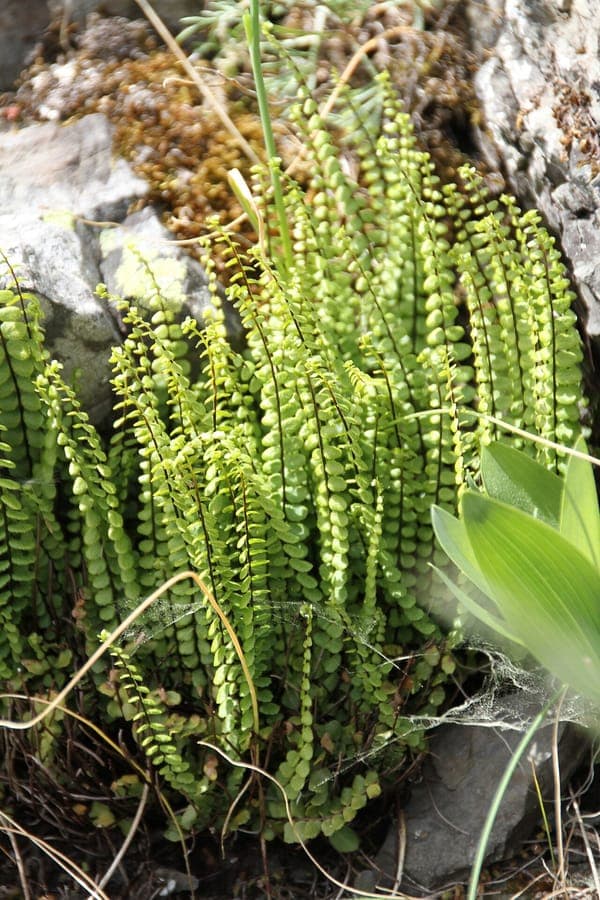
Bjoertvedt / CC BY-SA 3.0, via Wikimedia Commons
Maidenhair spleenwort: complete guide
Asplenium trichomanes
Want to see Maidenhair spleenwort: complete guide in your garden?
1 minute, no credit card
Overview
Maidenhair spleenwort, or Asplenium trichomanes, is a petite, elegant fern that thrives in the most unlikely spots - cracks in stone walls, rocky crevices, and shaded ledges. Native to a wide range of regions including parts of North America, Europe, and Asia, this hardy perennial is built for resilience. In the garden, it brings a soft, natural texture without demanding much attention. It's the kind of plant that slips into neglected corners and surprises you with quiet beauty. If you're planning a rock garden or revamping a stone feature, consider how this fern could enhance the look. On gardenworld.app, you can design a layout that integrates Asplenium trichomanes seamlessly into your hardscape.
Appearance & bloom cycle
This fern doesn't bloom - like all ferns, it reproduces via spores. The fronds are typically 5–20 cm long, with finely divided, bright to deep green pinnae that give a lacy, airy look. The stalks (stipes) are thin, wiry, and dark - almost black - creating a striking contrast against the foliage. In late summer, rows of spore cases (sori) form on the undersides of the leaflets, turning from green to dark brown as they mature. These release spores in autumn, potentially self-seeding in suitable crevices. The plant has a clumping habit, slowly forming small colonies over time. Its delicate form works well in close-up views, especially in rock walls or between stepping stones.
Ideal location
Plant maidenhair spleenwort in partial to full shade, away from hot afternoon sun. It grows best in north- or east-facing walls, under deciduous trees with dappled light, or tucked into rockeries where moisture lingers. It loves vertical spaces - old stone walls, mortared joints, or gaps in retaining walls are ideal. Avoid dry, exposed sites. It's perfect for cottage gardens, woodland edges, or modern minimalist designs with natural stone. If you're unsure where to place it, gardenworld.app offers visual planning tools to test different placements before you plant.
Soil requirements
This fern doesn't need rich soil. In fact, it prefers lean, mineral-based substrates with excellent drainage. For the typical trichomanes subspecies, a slightly alkaline to neutral pH (6.5–8.0) works best - think limestone-rich mortar or chalky rubble. The quadrivalens subspecies tolerates more acidic, siliceous rock. Use a gritty mix of loam, sand, and crushed stone or perlite. Avoid compost-heavy mixes - too much organic matter can rot the rhizome. Minimal soil volume is fine; this plant evolved to grow in mere dust and moisture trapped in rock fissures.
Free design
Want to see Maidenhair spleenwort: complete guide in your garden? Make a free design now.
Watering
Water sparingly but consistently during the growing season (April to September). The soil should never dry out completely, but it must never be soggy. In dry spells, misting the foliage helps maintain humidity, especially in urban gardens where air is drier. In winter, reduce watering to nearly zero - the plant goes semi-dormant and wet roots in cold soil invite rot. Rainwater is ideal, but tap water is acceptable if not too hard.
Pruning
No pruning is needed. Simply remove dead or damaged fronds in early spring with clean scissors. This keeps the plant tidy and allows new growth to emerge. Because it grows slowly, maintenance is minimal. Avoid disturbing the rhizome or spore-bearing fronds if you want to encourage natural reseeding in your garden.
Maintenance calendar
- Jan: Check for frost damage; keep dry
- Feb: Dormant; no action required
- Mar: Remove dead fronds; watch for new fiddleheads
- Apr: Begin light watering; monitor humidity
- May: Keep soil slightly moist; no feeding
- Jun: Mist in dry weather; protect from hot sun
- Jul: Spores developing; avoid overhead watering
- Aug: Continue light care; watch for drying
- Sep: Reduce watering gradually
- Oct: Let old fronds remain for winter protection
- Nov: Stop watering; protect container plants
- Dec: Full dormancy; minimal care
Winter hardiness
Maidenhair spleenwort is hardy in USDA zones 5 to 9 (-20°C to -1°C). It usually survives winter with little help, especially when growing in sheltered crevices. The fronds may die back in harsh winters, but the rhizome often persists. In containers, move pots against a sheltered wall or wrap with bubble wrap. Avoid wet, frozen soil - good drainage is key.
Companion plants
Pair with other wall- and rock-loving plants: common polypody (Polypodium vulgare), wall forget-me-not (Myosotis ramosissima), mosses, or small saxifrages. Creeping thyme or ajuga can provide ground cover without overwhelming it. Avoid vigorous growers that crowd it out. Combine textures for visual interest - the fine fronds contrast beautifully with bold hostas or spiky sedums in shaded areas.
Closing
Maidenhair spleenwort won't grab attention, but it earns admiration over time. It's a quiet achiever - low maintenance, long-lived, and perfectly adapted to tricky spots. Whether you're restoring an old wall or building a new rock garden, this fern adds a touch of wild charm. You might find it at local garden centres, especially those specialising in alpines or ferns. For a tailored planting plan, visit gardenworld.app and design a space where Asplenium trichomanes can thrive naturally.
Want to see Maidenhair spleenwort: complete guide in your garden? Make a free design now.
Upload a photo, pick a style, and get a photorealistic design with plant list in under a minute.
No credit card required


Similar plants
Mountain spleenwort: complete guide
Asplenium montanum
Everything about mountain spleenwort fern: cultivation, care, growing conditions and proper maintenance for your garden
Western spleenwort: complete guide
Asplenium vespertinum
The Western spleenwort (Asplenium vespertinum) is a delicate fern from California with fine, feathery fronds. Learn about care, location, and overwintering in this comprehensive guide.
Asplenium cirrhatum: complete guide
Asplenium cirrhatum
Discover the chestnut scale spleenwort, a tropical fern full of elegance. Learn how to care for this exotic plant at home.