
Wikimedia Commons / CC BY-SA 3.0, via Wikimedia Commons
Blue woodruff: complete guide
Asperula arvensis
Want to see Blue woodruff: complete guide in your garden?
1 minute, no credit card
Overview
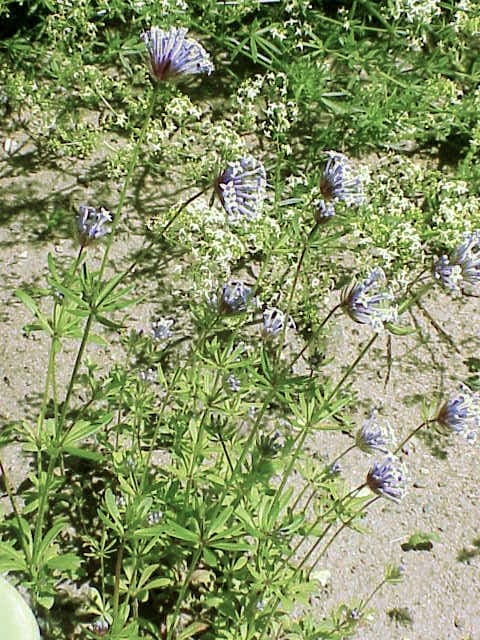
Blue woodruff (Asperula arvensis) is an upright, annual forb in the Rubiaceae family, native to southern Europe but increasingly popular in cottage and xeriscape gardens. Reaching 20–40 cm in height, it features slender, square stems and whorled leaves in groups of four - a classic trait of its family. Though not widely cultivated in the UK or North America, it thrives in dry, open habitats and adds soft structure and subtle colour in spring. It's self-seeding, so once established, it returns yearly with minimal input.
On gardenworld.app, you can design a drought-tolerant border where blue woodruff fits perfectly among gravel gardens or rock crevices. Its upright form and airy texture contrast beautifully with succulents or mounding herbs.
Appearance & bloom cycle
Flowering from April through June, blue woodruff produces clusters of tiny, star-shaped blue flowers at the stem tips. Each bloom is about 5–8 mm wide, with a pale azure hue that stands out against the bright green foliage. The leaves are narrow, slightly rough to the touch, and arranged in whorls of four around the stem. After blooming, the plant develops small, burr-like fruits that attach to clothing or fur, aiding seed dispersal - a trait that inspired its German name "Râpette", meaning "scraper".
While it's an annual, it reliably reappears if conditions are right. Deadheading can encourage a second flush in early summer, though less dense than the initial bloom.
Ideal location
Blue woodruff needs full sun to light shade - aim for a 7 out of 10 on the light scale. It performs best in south- or west-facing borders, rock gardens, or dry slopes. Avoid shaded corners or areas under dense tree canopies. It's ideal for gravel gardens, herb gardens, or as a filler in mixed perennial beds where competition is low.
Use gardenworld.app to simulate sun exposure in your garden and find the optimal spot. This prevents wasted effort and ensures strong establishment.
Soil requirements
The soil must be well-drained, preferably sandy or loamy, with a pH between 7.5 and 8.0. Chalky or limestone-rich soils are perfect. Avoid heavy clay or water-retentive substrates, as these lead to root rot. If your soil is acidic, amend it with ground limestone at 100 g/m² in autumn, or grow in raised beds with a custom mix.
A good planting mix: 2 parts loam, 1 part sand, 1 part compost, and a sprinkle of garden lime. This ensures drainage while providing enough nutrients for early growth.
Free design
Want to see Blue woodruff: complete guide in your garden? Make a free design now.
Watering
Once established, blue woodruff is drought-tolerant and rarely needs supplemental watering. During germination and the first month after planting, keep the soil lightly moist - not soggy. After that, rely on rainfall. In prolonged dry spells (over 14 days without rain), give a light soak at the base, preferably in the morning.
Avoid overhead watering to reduce fungal risks. Wet foliage in cool weather can trigger powdery mildew or leaf spot, especially in crowded plantings.
Pruning
No routine pruning is needed. However, cutting back spent flower stems in late June can promote tidiness and sometimes a second bloom. If you want to prevent self-seeding, cut the entire plant to 5 cm in July before seeds mature. For a neater appearance in formal beds, shear the whole patch back by half after flowering - it rebounds quickly.
Maintenance calendar
- February–March: Start seeds indoors in trays with gritty compost. Keep at 18–20°C with bright, indirect light.
- April: Harden off and plant out after frost risk passes. Space 20 cm apart.
- May–June: Monitor bloom. Remove spent flowers if desired. Watch for aphids on new growth.
- July: Assess reseeding. Cut back if needed. Water only in extreme drought.
- August–September: Allow some plants to set seed; remove others to control spread.
- October–January: No action. The plant completes its cycle and dies back.
Winter hardiness
As an annual, blue woodruff doesn't survive winter. It's suited to USDA hardiness zones 7–9. In colder zones (6 and below), the seed bank may not persist unless protected by mulch or snow cover. In milder areas, seeds overwinter naturally and germinate in spring.
No winter care required - let nature take its course.
Companion plants
Pair blue woodruff with drought-tolerant perennials like Sedum 'Autumn Joy', Eryngium bourgatii, or Nepeta racemosa. It also works well with thyme, oregano, or dwarf Lavandula angustifolia. Avoid aggressive spreaders like mint or ground elder, which will smother it.
In a wildlife garden, it supports small pollinators - hoverflies, bees, and hover wasps visit the flowers. Combine with native grasses like Stipa tenuissima for movement and texture.
Closing
Blue woodruff is an underrated gem for sunny, dry gardens. It's low-maintenance, attractive to pollinators, and brings a soft blue accent when few other plants bloom. You won't find it at every garden centre, but it's available from specialty seed suppliers or online. Check local retailers like OBI or Hornbach in Europe, or look for it at independent garden centres in the UK. With the right conditions - easily checked on gardenworld.app - it becomes a self-sustaining part of your garden's rhythm. Once you grow it, you'll wonder why you didn't try it sooner.
Want to see Blue woodruff: complete guide in your garden? Make a free design now.
Upload a photo, pick a style, and get a photorealistic design with plant list in under a minute.
No credit card required


Similar plants
Oregon bedstraw: complete guide
Galium oreganum
Everything about Oregon bedstraw (Galium oreganum): shade planting, soil requirements, care and use as a low groundcover in woodland and shade gardens.
Awned woodruff: complete guide
Asperula aristata
Full guide to growing Asperula aristata, the awned woodruff: sunny location, alkaline soil, minimal watering, and companion plants for dry or rock gardens.
Purple woodruff: complete guide
Asperula purpurea
Full guide to Asperula purpurea, purple woodruff: sunny sites, chalky soil, watering, pruning, winter hardiness and companion plants for rock and dry gardens.