
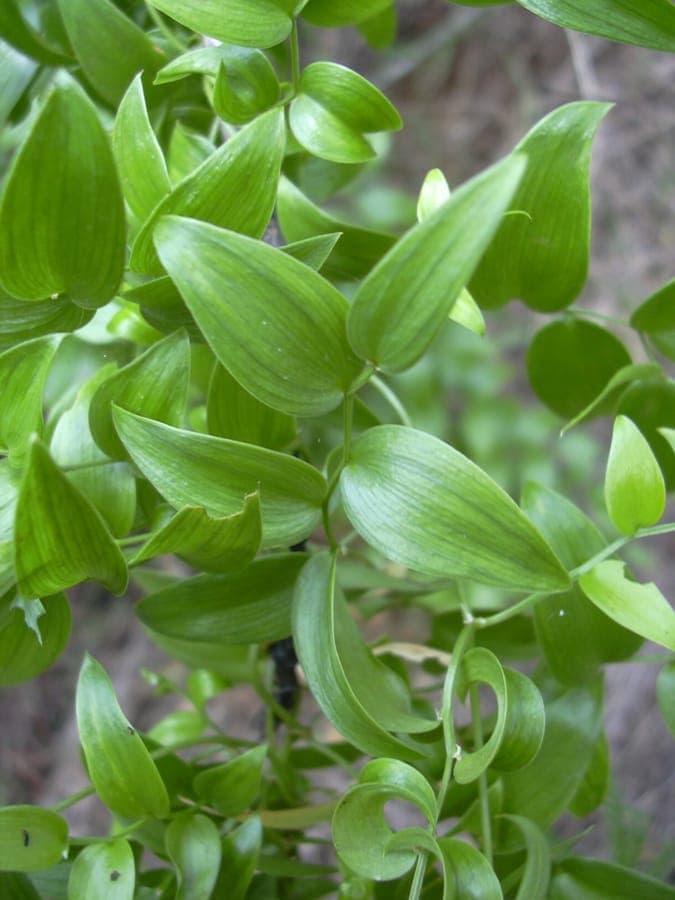
Forest & Kim Starr / CC BY 3.0, via Wikimedia Commons
Bridal-creeper: complete guide
Asparagus asparagoides
Want to see Bridal-creeper: complete guide in your garden?
1 minute, no credit card
The Bridal-creeper, scientifically known as Asparagus asparagoides, is a graceful ornamental plant distinguished primarily by its delicate, feathery foliage. This plant originates from South Africa, where it inhabits natural woodland margins and hillsides.
Overview The Bridal-creeper belongs to the Asparagaceae family and is chosen mainly for its decorative foliage and elegant growth pattern. Although related to edible asparagus, this species produces no edible parts. Instead, it offers lush, silky appearance perfect for floral arrangements, interior design, and garden decoration.
Appearance and Bloom The Bridal-creeper has thin, delicate stems densely covered with minute, needle-like leaves resembling feathery plumes. This unique texture creates an almost cloud-like appearance. The color is a bright, fresh green. While this plant produces small flowers, these are not the highlight; the foliage takes center stage. Flowers are small and white, followed by small red berries providing additional visual interest.
Ideal Location The Bridal-creeper thrives best in a location with bright, indirect light. Indoors, a spot near a window (but not in direct sunlight) works excellently. Outdoors, the plant can be kept in light shade. Avoid extreme temperatures; the plant prefers temperatures between 15 and 25 degrees Celsius. Protect from cold drafts and direct heat sources.
Soil For container cultivation, use light, well-draining potting mix, such as a blend of garden soil with perlite and peat moss. Good drainage holes are essential. The plant cannot tolerate waterlogging. A pH between 6.5 and 7.5 is ideal. In gardens, plant in well-draining soil, though container cultivation is usually preferred.
Watering The Bridal-creeper prefers regularly moist soil but not waterlogged. Water when the top of the potting soil feels dry. Generally this means once or twice weekly, depending on season and environmental conditions. Summer requires more water, winter less. Ensure excess water drains from the pot. In very dry environments, regular misting of foliage is beneficial.
Pruning Pruning mainly aims to maintain shape and encourage dense growth. Thin, weak, or dying branches can be removed. After flowering, long shoots can be shortened to promote a more compact appearance. Old, tangled branches can be cut near the base. Pruning in early spring works best; it stimulates new, full growth.
Maintenance Calendar March-April: Light pruning; begin regular feeding. May-August: Keep moisture levels high; mist regularly in dry periods. September-October: Gradually reduce feeding. November-February: Minimal watering; no feeding; maintain cool temperatures.
Winter Hardiness The Bridal-creeper is not frost-hardy and cannot tolerate freezing. In countries with harsh winters, the plant must be kept indoors in a warm environment. Minimum temperature is approximately 10 degrees Celsius.
Companion Plants In bouquets, the Bridal-creeper combines beautifully with roses, tulips, chrysanthemums, and other cut flowers. In container cultivation, combine with other fine-leafed plants like ferns or asparagus fern for extra textural contrast.
Closing Thoughts The Bridal-creeper is a choice for those who value elegance and fine texture in plant and interior design. With its lush, feathery foliage and easy care, it is a wonderful addition to home or garden. Available at local garden centres.
GardenWorld helps you design your space. Visit gardenworld.app to transform your front yard into a dream garden!
Want to see Bridal-creeper: complete guide in your garden? Make a free design now.
Upload a photo, pick a style, and get a photorealistic design with plant list in under a minute.
No credit card required


Similar plants
Narrow-leaved dracaena: complete guide
Dracaena angustifolia
Everything about Dracaena angustifolia - the narrow-leaved dracaena: location, care, overwintering and use as a houseplant or patio plant.
Chaparral yucca: complete guide to Hesperoyucca whipplei
Hesperoyucca whipplei
Hesperoyucca whipplei (Our Lord's candle) is a dramatic rosette-forming plant from California that produces a towering flower spike, ideal for dry and gravel gardens.
False lily-of-the-valley: complete guide
Maianthemum dilatatum
Everything about Maianthemum dilatatum, the false lily-of-the-valley. Care, shade location, propagation and garden combinations for this popular shade ground cover.