
Wikimedia Commons / CC BY-SA 3.0, via Wikimedia Commons
Lesser asparagus: complete guide
Asparagus acutifolius
Want to see Lesser asparagus: complete guide in your garden?
1 minute, no credit card
Overview
Asparagus acutifolius, commonly known as Lesser asparagus, is an evergreen subshrub native to the Mediterranean basin, found naturally in countries like Greece, Italy, France and Cyprus. Unlike its edible cousin, this species is grown purely for ornamental value, bringing fine texture and subtle summer interest to gardens. It's a slow-spreading perennial that forms clumps up to 60 cm tall and 50 cm wide over time, making it ideal for small spaces or naturalistic planting schemes. While not widely available in every garden centre, it's gaining traction among gardeners seeking drought-resistant, low-effort plants. You can explore ideal placement options on gardenworld.app to match this plant with your garden's microclimate.
Appearance & bloom cycle
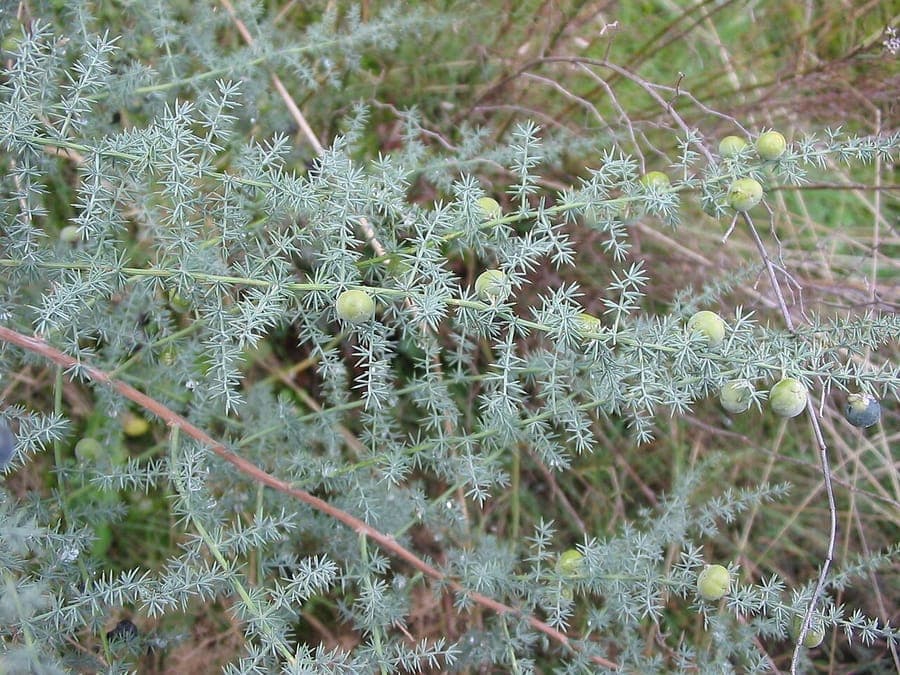
Lesser asparagus features delicate, needle-like foliage that's actually modified stems called cladodia. These give the plant a soft, feathery appearance, despite the sharp tips that can prick bare skin. From July to September, it produces small, star-shaped yellow flowers in clusters along the stems. These are followed by round berries that ripen to a deep purple-black by autumn – but beware: these berries are toxic if ingested by humans or pets. The plant remains evergreen in mild winters but may die back in colder zones, resprouting from the roots in spring. Its airy structure adds year-round visual interest, especially when backlit by low sun.
Ideal location
This plant thrives in partial sun to light shade, scoring a 5 out of 10 on the light scale. That means it prefers morning sun with afternoon shade, or dappled light under open tree canopies. Full midday sun in hot summers can stress young plants, so a spot on the east or southeast side of a wall or shrub border works well. It's perfect for rock gardens, dry banks, or gravel beds where moisture is limited. Avoid dark, heavily shaded corners. If you're designing a drought-tolerant garden, use gardenworld.app to map out zones where Lesser asparagus will thrive with minimal irrigation.
Soil requirements
Well-drained soil is essential. Asparagus acutifolius suffers in heavy clay and prefers sandy or loamy soils with a pH between 6.5 and 7.0. If your soil is dense, amend the planting hole with grit or coarse sand to improve drainage. It tolerates poor, rocky soils and even calcareous (chalky) conditions, reflecting its native habitat. Avoid rich, heavily amended soils – this plant doesn't need high fertility and may become leggy or floppy if overfed. A thin layer of compost at planting is sufficient.
Free design
Want to see Lesser asparagus: complete guide in your garden? Make a free design now.
Watering
Once established, Lesser asparagus is highly drought-tolerant. Water weekly during the first growing season to help roots settle. After that, supplemental irrigation is rarely needed, except during prolonged dry spells. Always water at the base to avoid wet foliage, which can encourage fungal issues. Overwatering is a common mistake – this plant hates soggy roots. In containers, ensure drainage holes are clear and empty saucers after rain.
Pruning
Pruning isn't required for health, but in early spring, you can tidy up by removing any dead or damaged stems. Wear thick gloves – the sharp tips can be painful. Cut back selectively to maintain shape, but avoid heavy cutting as the plant grows slowly. It naturally forms an open, upright habit that fits well in informal plantings.
Maintenance calendar
- Jan: Check for winter damage, remove any dead stems.
- Feb: No action needed.
- Mar: Light cleanup pruning if necessary.
- Apr: Observe new growth emerging.
- May: Monitor for drought stress in young plants.
- Jun: Reduce watering as plant establishes.
- Jul: Flowers appear, keep soil on the dry side.
- Aug: Peak bloom, no fertilising.
- Sep: Berries develop, avoid handling if children or pets are present.
- Oct: No care needed, leave debris for winter structure.
- Nov: Protect container-grown plants from freezing.
- Dec: Dormant period, minimal intervention.
Winter hardiness
Hardy in USDA zones 7 to 9, Asparagus acutifolius survives winter temperatures down to -12°C. In zone 7, mulch lightly around the base for root protection. In colder areas, it may die back completely but often returns in spring. Container plants should be moved to a sheltered spot or wrapped to prevent root freeze. In milder UK and Pacific Northwest climates, it typically stays evergreen.
Companion plants
Pair with other Mediterranean perennials like Lavandula, Thymus, or Eryngium. These share similar needs for sun and drainage. Salvia officinalis and Phlomis fruticosa also work well, offering contrasting foliage and bloom times. Avoid moisture-loving plants like Hosta or Astilbe. For texture contrast, combine with succulents like Sedum or low grasses such as Festuca glauca. It fits beautifully in gravel gardens or between stepping stones in a natural patio.
Closing
Lesser asparagus is a hidden gem for low-maintenance, eco-friendly gardens. With fine texture, seasonal flowers and resilience to dry conditions, it's ideal for modern landscapes where water conservation matters. You'll find it at specialist garden centres or online retailers; check larger garden centres in summer for availability. When planning your layout, consider using gardenworld.app to visualise how this plant complements other drought-tolerant species. Whether in a rockery or mixed border, Asparagus acutifolius brings understated elegance and year-round structure with minimal effort.
Want to see Lesser asparagus: complete guide in your garden? Make a free design now.
Upload a photo, pick a style, and get a photorealistic design with plant list in under a minute.
No credit card required


Similar plants
Narrow-leaved dracaena: complete guide
Dracaena angustifolia
Everything about Dracaena angustifolia - the narrow-leaved dracaena: location, care, overwintering and use as a houseplant or patio plant.
Chaparral yucca: complete guide to Hesperoyucca whipplei
Hesperoyucca whipplei
Hesperoyucca whipplei (Our Lord's candle) is a dramatic rosette-forming plant from California that produces a towering flower spike, ideal for dry and gravel gardens.
False lily-of-the-valley: complete guide
Maianthemum dilatatum
Everything about Maianthemum dilatatum, the false lily-of-the-valley. Care, shade location, propagation and garden combinations for this popular shade ground cover.