
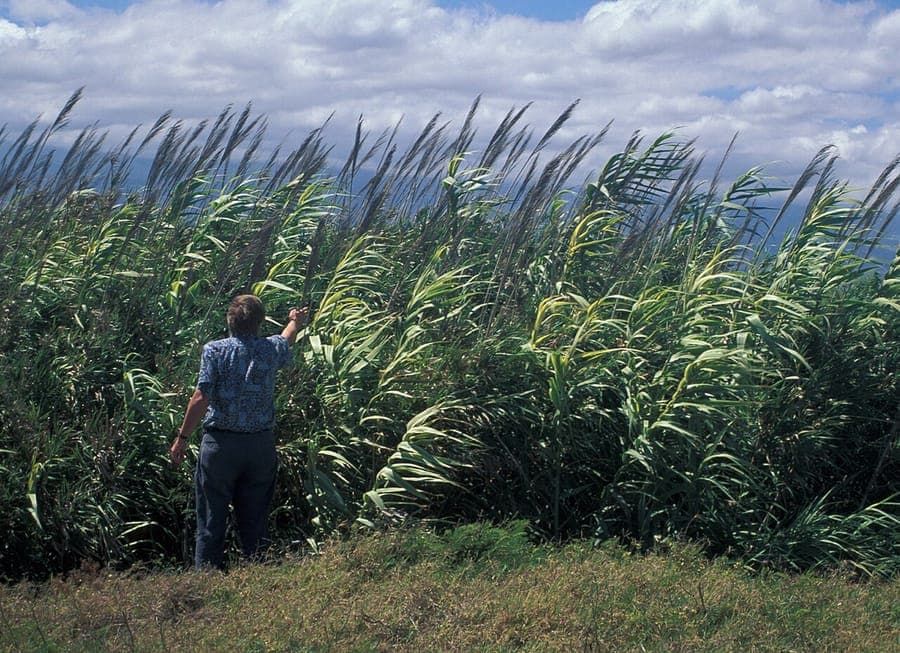
Forest and Kim Starr / Public domain, via Wikimedia Commons
Giant-reed: complete guide
Arundo donax
Want to see Giant-reed: complete guide in your garden?
1 minute, no credit card
Overview
Giant-reed (Arundo donax) is a bold, fast-growing grass that brings drama and height to any garden. Native to parts of Asia and the Mediterranean, it thrives in temperate climates and adapts well to UK and US gardens in USDA zones 6–10. Reaching heights of 3 to 6 meters, it's one of the tallest ornamental grasses you can grow without planting trees. It behaves like a perennial subshrub-dying back in winter and resprouting from thick rhizomes each spring.
While it's visually stunning, Giant-reed can be invasive through its spreading rhizomes, especially in moist, fertile soils. Always consider installing a root barrier at least 60 cm deep to keep it in check. This is especially important near ponds or naturalized areas where it might outcompete native species.
On gardenworld.app, you can design a custom garden layout that factors in the mature spread and height of Giant-reed, helping you avoid future overcrowding.
Appearance & bloom cycle
Giant-reed has broad, cane-like stems and long, strap-shaped leaves that can reach 60 cm in length and 4–8 cm in width. The foliage is rich green, sometimes with a silvery sheen, and arranged in a feathery, upright habit. In September and October, it produces large, plume-like inflorescences up to 60 cm long. These start green and mature to a soft silvery-grey, catching the wind and light beautifully.
The flowers aren't flashy like those of perennials, but they add texture, movement, and winter interest. The plumes often persist into late winter, providing visual structure when most plants have died back.
Note: In cooler climates like the UK, Arundo donax rarely sets viable seed, so spread is almost entirely via rhizomes. This makes it easier to manage-but only if you're vigilant.
Ideal location
Giant-reed thrives in full sun-aim for 8 to 10 hours daily. A light rating of 9 out of 10 means it performs best in open, unshaded spots. In shade, stems become weak, floppy, and produce fewer plumes.
Ideal spots include pond margins, large mixed borders, or as a tall screen for privacy. It also works in large containers on sunny patios, where its growth is naturally limited by root space. Just ensure the pot is at least 40–50 cm in diameter and depth.
You can find young plants at garden centres in spring, often in 5-liter pots. Look for healthy, firm stems with no signs of rot or drought stress. OBI and Hornbach in Germany, Truffaut in France, and local garden centres in the UK and US are reliable sources.
Free design
Want to see Giant-reed: complete guide in your garden? Make a free design now.
Soil requirements
Arundo donax isn't picky about soil type but grows best in moist, humus-rich soil with a pH between 4.8 and 7. It tolerates slightly acidic to neutral conditions, making it suitable for most garden soils. On sandy soils, amend with compost to improve moisture retention.
It loves moisture and handles temporary flooding well, but also survives short dry spells thanks to deep rhizomes. For best results, keep the soil consistently moist, especially in the first two growing seasons.
Avoid dry, sandy slopes without irrigation-growth will be stunted, and plants may die.
Watering
From March to August, water deeply at least once a week. Young plants need consistent moisture to establish. On sandy soils, you may need to water two to three times a week during hot spells.
In containers, check the top 5 cm of soil-if dry, water thoroughly. Use rainwater when possible, as tap water with high lime content can build up and affect long-term health.
Pruning
Cut back all stems to 20–30 cm above ground in late winter, just before new growth emerges (February–March). Use sturdy shears or a brush cutter-the stems are tough and hollow. Cutting back keeps the plant tidy and encourages strong, upright new growth.
Leave the plumes intact through winter for visual interest and movement. Only remove old growth once new shoots appear at the base.
Maintenance calendar
- Jan: inspect for winter damage
- Feb: begin pruning old stems
- Mar: complete pruning, apply compost
- Apr: rapid growth begins, increase watering
- May: monitor for rhizome spread, install barrier if needed
- Jun: foliage fills out, minimal care
- Jul: water during dry periods
- Aug: check stem stability, stake if needed
- Sep: plumes emerge
- Oct: peak ornamental value
- Nov: prepare for winter, no pruning
- Dec: structural interest in garden
Winter hardiness
Hardy in USDA zones 6–10, Giant-reed survives most UK and US winters without protection. Top growth dies back, but rhizomes survive below ground. In zone 6, a thick mulch of straw or leaf litter can help protect young plants during harsh freezes.
Potted plants are more vulnerable-move to a sheltered spot or insulate the container.
Companion plants
Pair with moisture-loving plants like Iris pseudacorus, Carex elata 'Aurea', or Rodgersia. For contrast, plant dark-leaved Phormium or Euphorbia mellifera behind it for height and texture variation.
Avoid drought-tolerant species like Lavandula or Sedum-they won't thrive in the damp microclimate Giant-reed creates.
Closing
Giant-reed isn't for every garden-it's bold, fast, and needs space. But if you've got sun, moisture, and room to grow, it's one of the most dramatic architectural plants you can grow. Use it for screening, focal points, or waterside planting.
On gardenworld.app, you can simulate how Giant-reed will look in your garden over time, including seasonal changes and mature spread, so you can plan ahead with confidence.
Want to see Giant-reed: complete guide in your garden? Make a free design now.
Upload a photo, pick a style, and get a photorealistic design with plant list in under a minute.
No credit card required


Similar plants
Sporobolus pungens: complete guide
Sporobolus pungens
Sporobolus pungens is a stoloniferous Mediterranean coastal grass with outstanding salt and drought tolerance, perfect for seaside and dry gardens.
Mediterranean aegilops: complete guide
Aegilops biuncialis
Everything about Aegilops biuncialis, a Mediterranean annual grass with ornamental spikes and outstanding drought tolerance for dry gardens.
Silver bluestem: complete guide
Bothriochloa saccharoides
Full guide to Bothriochloa saccharoides (silver bluestem): site, soil, watering, winter hardiness, pruning, and garden companions.