
Walter Siegmund (talk) / CC BY-SA 3.0, via Wikimedia Commons
Goat's-beard: complete guide
Aruncus dioicus
Want to see Goat's-beard: complete guide in your garden?
1 minute, no credit card
Overview
Goat's-beard (Aruncus dioicus) is a bold, architectural perennial that thrives in cool, shaded corners of the garden. Native to woodlands across North America, Europe, and parts of Asia, it brings a lush, almost tropical feel to temperate borders. Reaching 4 to 6 feet tall and 3 feet wide, it forms a dense, bushy clump that adds structure and texture from late spring through fall. It's fully hardy in USDA zones 4 to 8, making it a reliable choice for gardens across the UK, northern US, and much of Canada.
As a member of the Rosaceae family, Goat's-beard shares lineage with roses and spireas, though its appearance is far more fern-like. The plant is dioecious, meaning male and female flowers grow on separate plants. Male plants produce larger, showier plumes, while female versions have slightly looser, less dense flowering spikes. For maximum impact, stick to male cultivars or source labeled specimens.
Appearance & bloom cycle
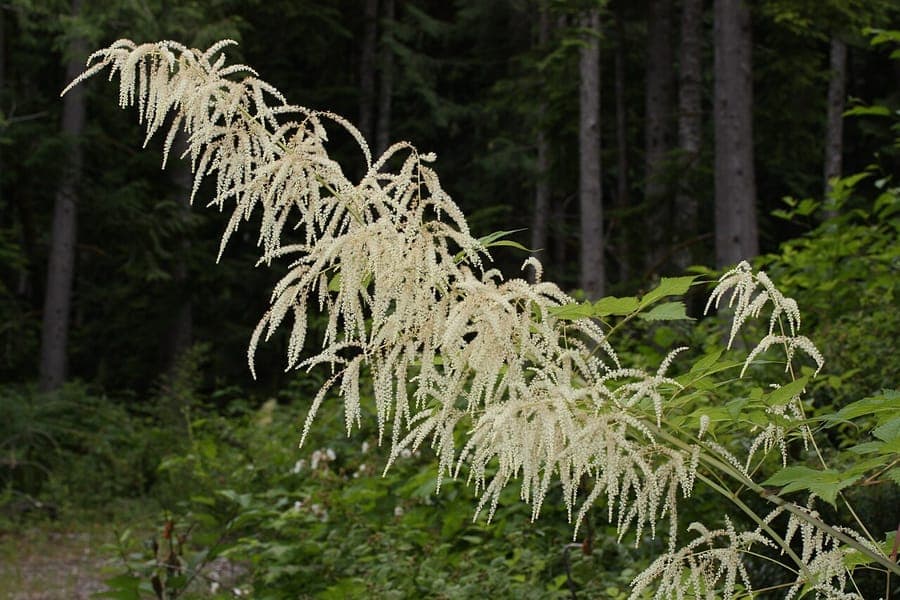
From late June to early July, Goat's-beard sends up tall, branching plumes of tiny, creamy-white flowers. These feathery panicles can reach 20 to 25 cm in length and rise above a mound of deeply cut, compound leaves. The foliage is a rich, dark green with a soft matte finish, and individual leaves can stretch up to 30 cm long. The overall effect is airy and elegant, with the blooms seeming to float above the foliage.
After flowering, the plumes dry in place and remain attractive into autumn, adding subtle interest to the fading garden. In fall, the leaves turn a soft yellow before dying back completely in winter. The plant re-emerges in spring with fresh, bright green shoots that quickly mature into a full, leafy presence.
Ideal location
Goat's-beard prefers partial to full shade. While it can tolerate morning sun, hot afternoon sun will scorch the leaves and stress the plant, especially in warmer zones. The best results come from planting it under deciduous trees, along the north side of a house, or in a woodland garden where dappled light filters through the canopy.
Give it space - plant at least 90 cm apart to allow for full spread. It works well as a specimen plant, in groupings of three or more, or as a backdrop for shorter shade lovers. On gardenworld.app, you can design a shaded border layout that positions Goat's-beard for maximum visual impact without overcrowding.
Soil requirements
This plant thrives in moist, well-drained soil rich in organic matter. The ideal pH is slightly acidic to neutral (5.5–7.0). Avoid dry, sandy soils - Goat's-beard hates drought and will quickly show signs of stress with brown leaf edges. Amend the planting hole with compost, leaf mold, or well-rotted manure to improve moisture retention and fertility.
If planting in dry shade under tree roots, consider building a raised bed or amending a wide area to ensure the plant gets enough water and nutrients. A deep planting hole (50x50x50 cm) filled with a loam-compost mix can make all the difference in the establishment phase.
Free design
Want to see Goat's-beard: complete guide in your garden? Make a free design now.
Watering
Consistent moisture is key. Water deeply once or twice a week during the first growing season, especially in dry spells. Once established, Goat's-beard is more resilient but still appreciates regular watering in summer. Drip irrigation or a soaker hose works well to keep the root zone evenly moist.
Rainwater is ideal, particularly in areas with hard tap water. Chlorine and lime can build up in the soil over time, leading to leaf browning. Mulch with leaf litter or compost in spring to help retain moisture and suppress weeds.
Pruning
Pruning is minimal. Cut back all top growth in early spring, just as new shoots emerge from the crown. This keeps the plant tidy and encourages fresh, vigorous growth. Use clean, sharp shears and remove any dead or damaged stems. Avoid cutting in fall - the old stems help insulate the crown during winter and catch snow, which acts as natural insulation.
If you want to prevent self-seeding (rare but possible), snip off spent flower plumes before they set seed.
Maintenance calendar
- January: Check for winter damage
- February: None needed
- March: Cut back; apply compost or slow-release fertilizer
- April: Monitor for aphids; ensure soil stays moist
- May: Increase watering as temperatures rise
- June: Peak bloom; avoid disturbing the plant
- July: Flowers fade; trim if desired
- August: Watch for powdery mildew in humid conditions
- September: Reduce watering gradually
- October: Leave foliage as natural mulch
- November: No care required
- December: Dormant period
Winter hardiness
Goat's-beard is fully winter-hardy in its range (zones 4–8). The top growth dies back completely, but the roots survive freezing temperatures with no protection. Snow cover helps, but even without it, the plant reliably returns each spring. No mulching is required unless you're in an exposed, windy site with little snow.
Companion plants
Pair Goat's-beard with other shade-tolerant perennials like Hostas, Ferns, Astilbes, and Hellebores. Its upright form contrasts beautifully with the broad leaves of Hosta or the glossy foliage of Bergenia. Use low-growers like Lungwort (Pulmonaria) or Foamflower (Tiarella) in the front of the border.
For a naturalistic look, plant among native ferns or under birch and maple trees. Combining textures is key - try it with the fine fronds of Ostrich fern or the bold leaves of Rodgersia. gardenworld.app offers design tools to mix and match companion plants based on height, bloom time, and soil needs.
Closing
Goat's-beard is a quiet powerhouse in the shade garden. It doesn't shout, but it delivers year after year with lush foliage, elegant blooms, and zero fuss. Give it moist soil, a cool spot, and room to breathe, and it will become a trusted cornerstone of your garden. Don't underestimate its presence - a few well-placed plants can transform a dull corner into a serene, green sanctuary.
Want to see Goat's-beard: complete guide in your garden? Make a free design now.
Upload a photo, pick a style, and get a photorealistic design with plant list in under a minute.
No credit card required


Similar plants
Siberian crab apple: complete guide
Malus x robusta
Complete guide to the Siberian crab apple (Malus x robusta): location, soil, pruning, winter hardiness and the best companion plants for your garden.
Chinese flowering crabapple (Malus x spectabilis): complete guide
Malus x spectabilis
Meet the Chinese flowering crabapple (Malus x spectabilis): a classic spring bloomer with carmine buds and pink blossom.
Potentilla crassinervia: complete guide
Potentilla crassinervia
Potentilla crassinervia, the Corsican cinquefoil, grows wild on Corsica and Sardinia's peaks. Discover how to grow this hardy alpine rock garden gem.