
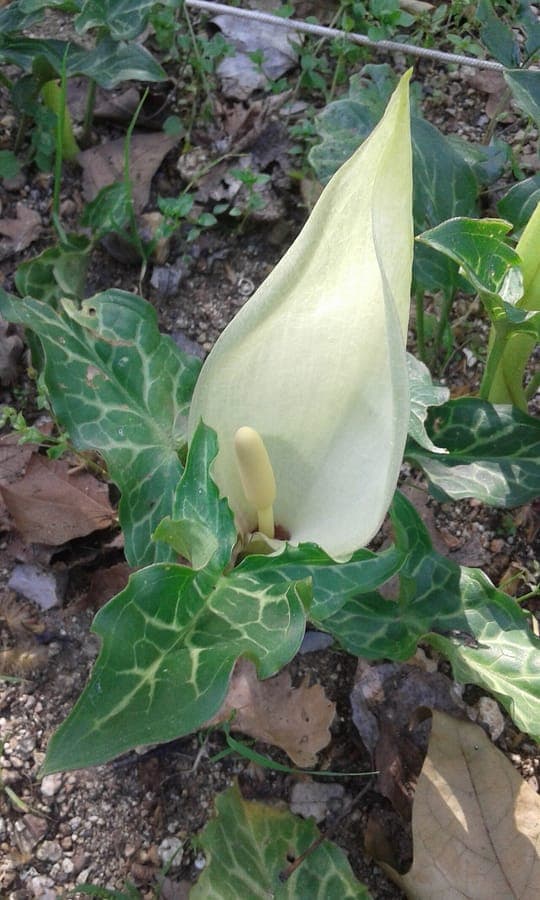
Consultaplantas / CC BY-SA 4.0, via Wikimedia Commons
Italian arum: complete guide
Arum italicum
Want to see Italian arum: complete guide in your garden?
1 minute, no credit card
Overview
Italian arum (Arum italicum) is a striking, clump-forming perennial that brings subtle drama to shady corners of the garden. Native to southern Europe and parts of North Africa, this herbaceous plant from the Araceae family has adapted well to temperate climates, including USDA zones 6–9. It's particularly valued for its bold foliage and seasonal interest, making it a favourite among gardeners looking for low-effort, high-impact plants. With its arrow-shaped leaves, white hooded flowers, and bright orange berries, it adds structure and intrigue without dominating the border.
In the UK and other mild climates, Italian arum thrives in woodland settings, under trees, or in sheltered borders. It's not a plant that demands attention - give it the right spot and it'll return year after year with minimal fuss. On gardenworld.app you can design a garden layout that highlights Italian arum's seasonal rhythm, especially when paired with other shade-loving perennials.
Appearance & bloom cycle
Italian arum follows a distinct seasonal pattern. From April to May, it produces striking white spathe flowers - hooded structures that encase a central spadix. These blooms rise 20–30 cm above the foliage and last several weeks. After flowering, the leaves remain attractive, growing up to 35 cm long, with a deep green surface and a silvery central vein that catches the light.
By July, the flowers give way to upright spikes of bright orange-red berries, which are highly toxic if ingested. Keep them away from pets and small children. The berries persist into autumn, adding vivid colour before the foliage eventually dies back in late winter. New growth emerges in February, making it one of the first plants to signal spring's arrival.
Ideal location
Italian arum prefers partial to full shade, thriving at a light level of 5 on a 1–10 scale. This means dappled light or areas that receive no direct sun for more than a couple of hours a day. North-facing borders, under deciduous trees like birch or hornbeam, or beneath shrubs such as rhododendron are perfect. Avoid full sun, especially in warmer zones, as it leads to scorched leaves and moisture stress.
It also struggles in deep, dry shade - think under dense evergreens like yew. The plant needs some moisture and organic matter to establish. In urban gardens, it works well in narrow side beds or between paving, provided the soil stays cool and damp. Try using gardenworld.app to visualise how Italian arum fits into a shaded garden scheme.
Free design
Want to see Italian arum: complete guide in your garden? Make a free design now.
Soil requirements
This plant likes rich, humus-rich soil that retains moisture but drains well. A pH between 6.5 and 7.0 is ideal - slightly acidic to neutral. Heavy clay soils work well if they're not waterlogged, while sandy soils need amending with compost or leaf mould to improve water retention.
Plant the tubers 10–15 cm deep and space them 30 cm apart to allow room for spreading. Avoid compacted or stony ground, as the roots need space to develop. Incorporate well-rotted manure or compost at planting time to give the roots a nutrient boost.
Watering
Water regularly during active growth (February to June), especially in dry springs. The soil should stay consistently moist but never soggy. Once the leaves die back in summer, reduce watering - the plant enters dormancy and relies on natural rainfall.
Mulching with leaf litter or compost in early spring helps retain moisture and suppress weeds. Avoid overhead watering if possible, as wet foliage in cool weather can encourage fungal issues.
Pruning
No pruning is needed. Allow the foliage to die back naturally - it helps feed the tuber for next year's growth. If you find the berries unsightly or a safety risk, cut the fruiting stalks down after they form, wearing gloves to avoid skin irritation.
Remove any damaged or diseased leaves with clean secateurs to prevent the spread of rot or mildew.
Maintenance calendar
- Jan: check for emerging shoots, no action needed
- Feb: new leaves appear, watch for slugs
- Mar: active growth begins, apply mulch
- Apr: flowering starts, keep soil moist
- May: flowers fade, berries begin to form
- Jun: growth slows, reduce watering
- Jul–Sep: berries visible, avoid handling
- Oct: foliage may yellow, no feeding
- Nov–Dec: fully dormant, no care required
Winter hardiness
Italian arum is hardy down to -15°C (USDA zone 6). In the UK and most of Europe, it survives winter without protection. The top growth may die back, but the tubers remain viable underground. In areas with prolonged wet winters, ensure good drainage to prevent rot.
Companion plants
Pair Italian arum with hostas, hellebores, epimedium, or ferns like Dryopteris. These combinations create a layered, woodland effect. It also works well with early bulbs such as snowdrops or bluebells, which bloom before the arum's foliage fully expands.
Avoid aggressive self-seeders or fast-spreading groundcovers that might outcompete it.
Closing
Italian arum is a reliable, elegant plant that asks for little and gives much. With its seasonal shifts - from white flowers to orange berries to lush foliage - it brings year-round interest to shaded areas. Plant it in spring or autumn at garden centres across the UK. For design inspiration, explore planting schemes on gardenworld.app that feature Italian arum as a structural element in shaded borders.
Want to see Italian arum: complete guide in your garden? Make a free design now.
Upload a photo, pick a style, and get a photorealistic design with plant list in under a minute.
No credit card required


Similar plants
Arrowhead vine: complete guide
Syngonium auritum
Everything about Syngonium auritum, the tropical five-fingers houseplant. Care, location, watering, and pruning explained clearly for beginners and enthusiasts.
Minute duckweed: complete guide to Lemna perpusilla
Lemna perpusilla
Everything about Lemna perpusilla, the minute duckweed: ecology, pond management, water quality and care in garden water features.
Dead horse arum lily: complete guide
Helicodiceros muscivorus
Everything about the dead horse arum lily (Helicodiceros muscivorus): growing conditions, spectacular bloom, thermogenesis, and care for this Mediterranean aroid.