
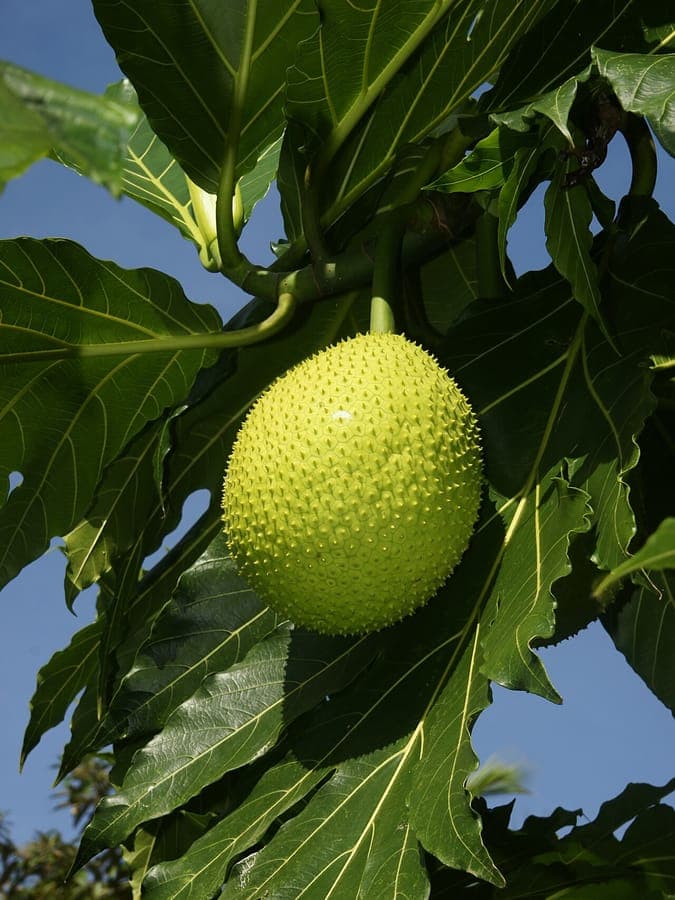
Hans Hillewaert / CC BY-SA 3.0, via Wikimedia Commons
Artocarpus altilis: complete guide
Artocarpus altilis
Want to see Artocarpus altilis: complete guide in your garden?
1 minute, no credit card
Overview
Artocarpus altilis, commonly known as Breadfruit or Breadfruit Tree, is an impressive tropical fruit tree from the Moraceae family. This fast-growing, majestic tree originates from Pacific islands and remains an essential food crop in many tropical regions. With its large, impressive foliage and nutritious fruits, it's both functionally and aesthetically valuable in tropical gardens.
The breadfruit tree is still among the world's most nutritious fruit trees. Its fruits are rich in carbohydrates, vitamins, and minerals, making it a perfect food crop for public health in tropical areas.
Appearance and Bloom
Artocarpus altilis grows into a strong, upright tree reaching 20-30 meters in ideal conditions, though typically smaller in gardens. The leaves are extremely large, deeply lobed, giving the tree a tropical, lush appearance.
Flowers are inconspicuous, appearing in very long, green inflorescences. The fruits, however, are spectacular - large, round, knobby structures that turn green or yellow as they ripen. Each fruit can reach 20-25 centimeters in diameter and weigh several kilograms.
The fruits contain creamy, potato-like pulp that can be cooked numerous ways. Roasted, fried, or as nutritional supplement, it's genuinely a food of global significance.
Ideal Location
Artocarpus altilis thrives best in warm, tropical to subtropical climates with temperatures above 20 degrees Celsius. The tree dislikes frost and performs poorly or dies when temperatures drop below 10 degrees Celsius.
The plant prefers full sun but tolerates partial shade, though fruiting may be less robust. In very hot, dry areas, some afternoon shade provides benefit.
Wind protection is beneficial, especially as the tree grows large and carries heavy fruits that may drop in strong winds.
Soil
Artocarpus altilis grows best in well-drained, fertile soils with substantial organic matter. The plant tolerates diverse soil types, from sand to clay, provided drainage is good.
The ideal soil composition consists of 40% garden/potting soil, 40% organic material (mulch, compost), and 20% sand or perlite for extra drainage. The plant thrives in soils with pH between 6-7.
Fertility is important. Regular feeding, especially with potassium and phosphorus, promotes robust flowering and fruiting.
Free design
Want to see Artocarpus altilis: complete guide in your garden? Make a free design now.
Watering
Artocarpus altilis requires regular, consistent watering, especially during dry periods and active growth. Soil should remain moist but not waterlogged. Water 1-2 times weekly during growing season, depending on local rainfall.
During fruiting, consistent water is critical for optimal fruit development. Watering interruption can lead to fruit loss. In winter, when growth slows, water more cautiously.
Mulching helps retain moisture and improve consistency, especially in warm climates.
Pruning
Artocarpus altilis responds well to pruning to maintain structure and adjust form. Young trees can be pruned to encourage multiple trunks or broader crowns.
Remove low-hanging branches for better passage and improved disease prevention. Dead or damaged branches should be removed.
Formal pruning should be cautious, as aggressive pruning reduces fruiting. Allow the tree its natural form where possible.
Maintenance Calendar
Spring (March-May): Active growth begins. Water regularly. Apply feeding for growth.
Summer (June-August): Flowering and fruiting. Consistent high watering important. Apply supplemental feeding as needed.
Autumn (September-October): Fruit ripening. Watering can be cautiously reduced.
Winter (November-February): Growth slows. Minimal watering. Apply lighter feeding.
Winter Hardiness
Artocarpus altilis is very frost-sensitive and doesn't grow outdoors in climates with regular freezing. Temperatures below 10 degrees Celsius can cause damage or death.
In Mediterranean areas, the tree can grow in pots and be moved to shelter in winter. In subtropical regions with cool winters, frost protection is essential.
The tree truly is a plant for warm climates - genuine tropics and frost-free subtropical regions.
Companion Plants
Artocarpus altilis is a large tree requiring more space than most garden plants. Beneath it can grow shade-tolerant tropical plants like Alocasia, Anthurium, and other rainforest-like species.
Other fruit trees like Mango (Mangifera indica), Avocado, and Papaya work well in the same tropical garden.
The tree itself provides shelter for smaller plants.
Conclusion
Artocarpus altilis offers gardeners in tropical climates a classic, useful choice. This is not merely a aesthetically beautiful tree with impressive foliage, but also a source of nutritious food. Whether you're having a gardenworld.app design created for a tropical setting or gardening independently, a breadfruit tree certainly deserves consideration if you can meet its climate and space requirements.
Want to see Artocarpus altilis: complete guide in your garden? Make a free design now.
Upload a photo, pick a style, and get a photorealistic design with plant list in under a minute.
No credit card required


Similar plants
Morus macroura: complete guide
Morus macroura
Himalayan mulberry with long fruits. Fast-growing, edible berries, winter hardy. Suitable for large gardens and landscapes.
Brosimum guianense: complete guide
Brosimum guianense
Guiana snakewood: exotic tree from South America with valuable timber. Cultivation and care for warm-climate gardens.
Maclura tinctoria: complete guide
Maclura tinctoria
Learn how to grow Maclura tinctoria or Cubanwood. This beautiful tree offers shade, food and dye possibilities in your garden.