
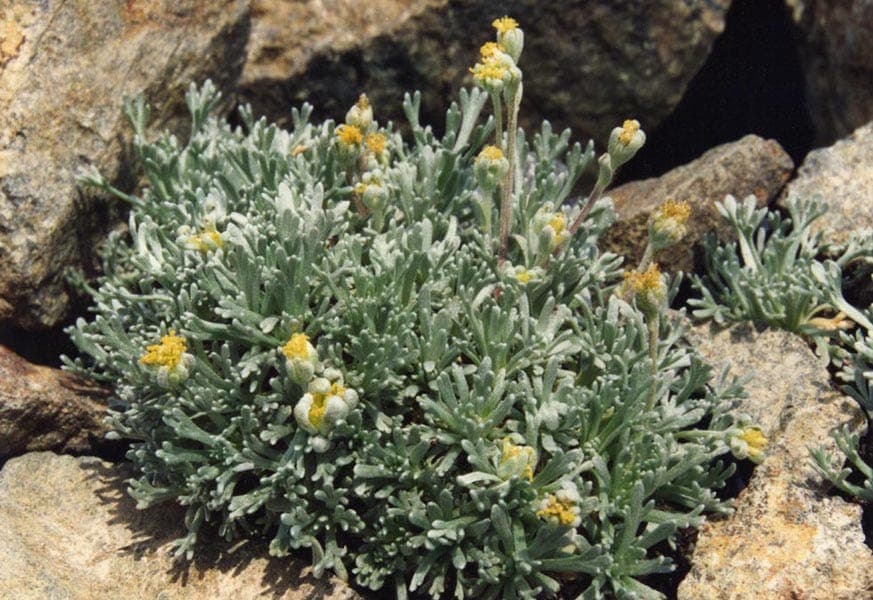
Ghislain118 (AD) http://www.fleurs-des-montagnes.net / CC BY-SA 3.0, via Wikimedia Commons
Artemisia umbelliformis: complete guide
Artemisia umbelliformis
Want to see Artemisia umbelliformis: complete guide in your garden?
1 minute, no credit card
Overview
Artemisia umbelliformis, commonly known as Alpine wormwood, Edelraute, or Geneipi, is a fascinating alpine plant from the Asteraceae family. This mountain beauty grows naturally in the European Alps and is a cultural heritage plant throughout many alpine regions. The plant is especially renowned for its fine, aromatic foliage and compact growth habit.
The foliage of Artemisia umbelliformis possesses wonderful aromatic qualities. Local mountain dwellers have traditionally used this herb for brewing Geneipi, a famous Alpine liqueur. This historic use demonstrates this plant's cultural significance in European heritage.
Appearance and Bloom
Artemisia umbelliformis grows as a compact, clustering plant, typically 10-30 centimeters in height. The foliage is fine, almost fluffy, displaying a bluish-green color with silvery sheen. This gives the plant striking appearance in rocky settings.
Flowers appear in July-August as small, inconspicuous yellow flowers crowded in tight panicles. The flowers themselves aren't particularly spectacular, but contribute to the plant's overall botanical interest.
The scent of crushed foliage is strong and aromatic, almost pungent in intensity. Some people find this intensely pleasant, others overwhelming. However, this is a characteristic feature of alpine Artemisia species.
Ideal Location
Artemisia umbelliformis thrives best in fully sunny locations with very good drainage. This is a plant of steep rocky slopes in the Alps where minimal soil exists. Ensure your garden provides a sunny spot in a rock garden setting.
The plant performs poorly in partial shade and cannot tolerate shade at all. In cooler mountainous regions, it may tolerate slightly more sun protection.
Wind poses no problem for this strong alpine plant. In fact, good air circulation helps keep the plant healthy and prevents root rot.
Soil
This is arguably the most important aspect: Artemisia umbelliformis requires very well-draining soil. The soil must be literally stone-like, comparable to what you'd find in mountain areas. Use sand, small rocks and minimal organic material.
An ideal soil composition consists of 50% garden soil or pure sand, 30% gravel or small rocks, and 20% organic material. The plant actually prefers poor soil to rich soil.
A slightly acidic to neutral pH (approximately 6-7) is ideal. Limestone can be added but isn't essential like in some other Artemisia species.
Free design
Want to see Artemisia umbelliformis: complete guide in your garden? Make a free design now.
Watering
Watering must be approached extremely carefully. Artemisia umbelliformis is drought-tolerant and grows much better with insufficient water than with too much. Once established, the plant thrives with natural rainfall.
During the initial growth period, water carefully to establish roots. Following establishment, provide practically no additional water. In very dry periods, you can water cautiously, but this is rarely necessary.
Winter: practically no water. The plant naturally enters semi-dormancy and requires very little moisture during this period.
Pruning
Artemisia umbelliformis requires minimal pruning. The plant grows compactly and naturally forms a neat shape. However, remove withered flowers after blooming for a neater appearance.
Damaged leaves can be carefully removed. In spring, you can remove dead parts from previous winter.
Formal pruning isn't necessary. This plant thrives through its natural, rocky appearance.
Maintenance Calendar
Spring (April-May): Plant emerges from winter dormancy. Water carefully to stimulate growth.
Summer (June-August): Blooming period. Provide minimal watering. Yellow flowers may appear inconspicuous.
Autumn (September-October): Plant strengthens. Remove withered flowers.
Winter (November-March): Plant rests. Virtually no water. Plant may lose considerable foliage.
Winter Hardiness
Artemisia umbelliformis is extremely hardy, tolerating temperatures down to -30 degrees Celsius or lower. This is a plant of rocky, cold mountain peaks, so cold poses no problem.
The real winter danger is wet conditions. Ensure good drainage. In very wet, warm winters, the plant sometimes struggles. Mulching isn't necessary and can actually be harmful.
In all European climates, this plant can grow outdoors. Even in arctic conditions, it can function with good drainage.
Companion Plants
Artemisia umbelliformis works exceptionally well in rock gardens with other alpine plants. Saxifraga species (rockfoils), Androsace species (rockjasmine), and other alpine dwarf companions are excellent partners.
It also works well with Sempervivum species (houseleeks) and other succulent alpines. This combination creates authentic alpine landscape.
In containers, it pairs well with other alpine primrose-like plants.
Conclusion
Artemisia umbelliformis offers gardeners who love alpine plants a wonderful choice. Whether you're designing a rock garden or having a gardenworld.app design created with alpine elements, this plant certainly deserves consideration. With its aromatic foliage, compact growth, and cultural significance, it's a fascinating addition to any garden with alpine character.
Want to see Artemisia umbelliformis: complete guide in your garden? Make a free design now.
Upload a photo, pick a style, and get a photorealistic design with plant list in under a minute.
No credit card required


Similar plants
Calendula stellata: complete guide
Calendula stellata
Complete guide to Calendula stellata, the star-flowered marigold from Sicily: location, soil, watering and companion planting tips.
Korean chrysanthemum: complete guide
Chrysanthemum x rubellum
Chrysanthemum x rubellum is a hardy autumn perennial with single pink to copper flowers from August to November. Care and combinations.
Helianthus divaricatus: complete guide
Helianthus divaricatus
Helianthus divaricatus is a North American woodland sunflower with yellow summer blooms, ideal for naturalistic borders and shady edges.