
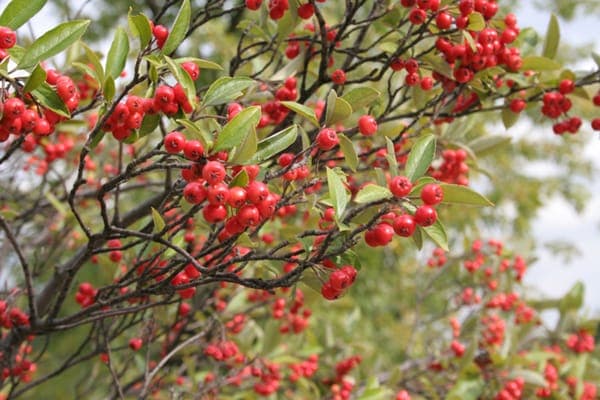
No machine-readable author provided. Abrahami assumed (based on copyright claims). / CC BY-SA 2.5, via Wikimedia Commons
Red chokeberry: complete guide
Aronia arbutifolia
Want to see Red chokeberry: complete guide in your garden?
1 minute, no credit card
Overview
Aronia arbutifolia, commonly known as red chokeberry, is a tough, adaptable shrub that's gaining popularity in modern garden designs across temperate regions. Native to the eastern United States - from Alabama to Connecticut - it thrives in USDA hardiness zones 4 to 8, making it ideal for gardens in the UK, northern Europe, and much of North America. This deciduous shrub stands out for its striking seasonal changes: glossy green foliage in summer, brilliant red fall color, and clusters of vivid red berries that persist well into winter.
The berries are technically edible but extremely astringent when raw, so they're best used in jams, syrups, or dried for tea. Birds, however, love them, especially during late winter when food is scarce. On gardenworld.app, you can design a wildlife-friendly garden layout that leverages red chokeberry as a key structural and ecological plant.
Appearance & bloom cycle
In late spring, around May to June, red chokeberry produces flat-topped clusters of small white to pale pink flowers, roughly 5–8 cm across. These are mildly fragrant and attract pollinators like bees and hoverflies - a real bonus in any pollinator garden. After flowering, green berries form and gradually ripen to a glossy crimson by September or October. Each berry is about 8 mm in diameter and hangs in dense clusters along the stems.
The leaves are lance-shaped, 5–8 cm long, with finely toothed margins and a shiny upper surface. In autumn, they transform into a fiery display of red, orange, and deep burgundy - often among the last shrubs to drop their leaves. Mature plants reach 1.5 to 2.5 meters in height with a spread of about 1.2 meters, forming a dense, upright thicket over time.
Ideal location
Red chokeberry grows best in full sun but tolerates partial shade. For optimal berry production and fall color intensity, aim for at least 6 hours of direct sunlight per day. In shadier spots, the plant may become leggy and produce fewer flowers and fruit.
It's especially valuable in damp or boggy areas where many shrubs struggle. Think pond margins, low-lying garden corners, or rain gardens. It's not suited for hot, dry, sandy soils unless irrigated regularly. In urban gardens, it handles air pollution and compacted soils better than most ornamental shrubs.
Soil requirements
This shrub isn't picky about soil type but prefers moist, humus-rich, slightly acidic soils with a pH between 5.0 and 6.5. It tolerates clay and even periodically waterlogged conditions, as long as drainage improves over time. Avoid highly alkaline soils (pH above 7.5), which can cause chlorosis - yellowing of young leaves due to iron deficiency.
When planting, amend the soil with well-rotted compost or leaf mould to boost organic content. If your soil is heavy clay, mix in some sharp sand or fine grit to improve aeration. On gardenworld.app, you can run a soil analysis simulation to check if your garden bed suits red chokeberry's preferences.
Free design
Want to see Red chokeberry: complete guide in your garden? Make a free design now.
Watering
During the first year after planting, water weekly during dry spells - about 10 liters per shrub. Once established, red chokeberry is surprisingly drought-tolerant, thanks to its deep root system. However, it performs best with consistent moisture, especially in full sun.
Avoid letting the soil dry out completely in summer, as this can stress the plant and reduce berry set. Conversely, prolonged standing water (more than 48 hours) can lead to root rot. If you're planting near a pond or stream, ensure the root zone isn't submerged.
Pruning
Pruning is minimal. The natural form is upright and attractive, so heavy cutting isn't needed. However, you can tidy it up in late winter (February) by removing dead, damaged, or crossing branches. For rejuvenation, cut out one-fifth of the oldest stems at ground level each year. This encourages vigorous new growth and keeps the shrub looking fresh.
Use sharp, clean secateurs to prevent disease spread. Avoid pruning in late summer or early autumn, as this can stimulate tender new growth vulnerable to frost.
Maintenance calendar
- January: Check for winter damage. No action needed.
- February: Light pruning. Remove dead wood.
- March: Apply a slow-release organic fertilizer or compost mulch.
- April: New growth begins. Watch for aphids or powdery mildew.
- May: Flowers appear. Ensure consistent moisture.
- June: Bloom ends. Berries start developing.
- July–August: Water during dry periods. No feeding.
- September: Berries ripen. Fall color begins.
- October: Peak berry display. Leave for birds.
- November: Leaves drop. Clear fallen debris if diseased.
- December: Fully dormant. No care required.
Winter hardiness
Red chokeberry is extremely cold-hardy, surviving temperatures down to -34°C (USDA zone 4). It requires no winter protection, even in harsh climates. The persistent berries add visual interest to winter gardens and provide late-season food for birds like robins and cedar waxwings.
Companion plants
Pair red chokeberry with moisture-loving perennials like Joe-Pye weed (Eutrochium maculatum), cardinal flower (Lobelia cardinalis), or native sedges (Carex spp.). For a structured look, plant with inkberry (Ilex glabra) or winterberry (Ilex verticillata). In informal hedges, space plants 80 cm apart for a dense screen.
Closing
Red chokeberry is a reliable, low-fuss shrub that delivers year-round interest. From spring blooms to winter berries, it's a workhorse in the garden. It's disease-resistant, deer-resistant, and supports local wildlife. Buy young plants in late winter or early spring from garden centres like B&Q, Waitrose Garden, or online nurseries. Plant in a moist, sunny spot, and let it grow with minimal intervention. With its bold fall color and ecological benefits, Aronia arbutifolia earns its place in any modern, sustainable garden.
Want to see Red chokeberry: complete guide in your garden? Make a free design now.
Upload a photo, pick a style, and get a photorealistic design with plant list in under a minute.
No credit card required


Similar plants
Siberian crab apple: complete guide
Malus x robusta
Complete guide to the Siberian crab apple (Malus x robusta): location, soil, pruning, winter hardiness and the best companion plants for your garden.
Chinese flowering crabapple (Malus x spectabilis): complete guide
Malus x spectabilis
Meet the Chinese flowering crabapple (Malus x spectabilis): a classic spring bloomer with carmine buds and pink blossom.
Potentilla crassinervia: complete guide
Potentilla crassinervia
Potentilla crassinervia, the Corsican cinquefoil, grows wild on Corsica and Sardinia's peaks. Discover how to grow this hardy alpine rock garden gem.