
Pethan / CC BY-SA 3.0, via Wikimedia Commons
Horse-radish: complete guide
Armoracia rusticana
Want to see Horse-radish: complete guide in your garden?
1 minute, no credit card
Overview
Horseradish (Armoracia rusticana) is a hardy perennial in the Brassicaceae family, valued for its pungent taproot and bold foliage. Native to southern Russia and Ukraine, it thrives in temperate climates and adapts well to kitchen gardens across Europe and North America. While primarily grown for culinary use, horseradish also adds visual interest with its vigorous growth and mid-summer bloom. It's a low-maintenance plant once established, but its aggressive spreading habit means careful placement is essential.
On gardenworld.app you can design a garden layout that maximizes horseradish's potential-ideal for root crop rotation or border edging in mixed beds.
Appearance & bloom cycle
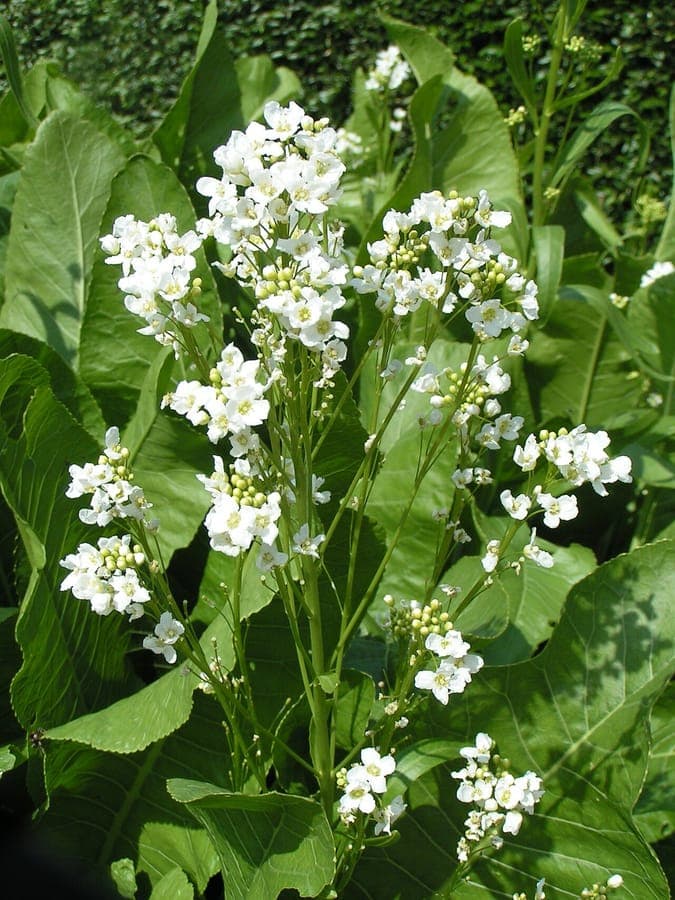
Horseradish forms a rosette of large, coarse, dark green leaves that can reach up to 40 cm in length. The foliage emerges early in spring and grows rapidly, forming a dense mound by late May. From May through July, tall flowering stalks rise above the leaves, bearing clusters of small, four-petaled white flowers. These are not fragrant but attract pollinators like hoverflies and bees. After flowering, seed pods may form, but most propagation happens vegetatively through root cuttings. The plant's real value lies underground: a thick, white taproot that develops its signature heat when grated.
Ideal location
Horseradish prefers full sun to light shade, scoring a 7 on the light scale-meaning it needs 5–6 hours of direct sunlight daily. Full sun enhances root pungency, ideal for culinary use. Avoid deep shade, as this leads to weak, leggy growth and poor root development. Plant it at the edge of your vegetable plot where it won't compete with shallow-rooted crops. Give it space-both horizontally and vertically-since roots can grow 60 cm deep and spread quickly through lateral shoots.
Soil requirements
This plant demands loose, well-drained soil to develop straight, long roots. Heavy clay should be amended with sand and compost to improve structure. The ideal pH range is 5.5 to 6.5. Avoid overly rich soils; excessive nitrogen promotes leafy top growth at the expense of root development. Horseradish tolerates poorer soils, making it a good candidate for areas where other vegetables struggle. A slightly acidic to neutral soil ensures optimal nutrient uptake.
Watering
Once established, horseradish is drought-tolerant, but consistent moisture during the growing season (April to September) supports healthy root formation. Water deeply once a week-about 15–20 liters per m²-during dry spells. Avoid waterlogging, which can cause root rot. Mulching with straw or wood chips helps retain moisture and suppress weeds. In containers, ensure drainage holes are unblocked.
Free design
Want to see Horse-radish: complete guide in your garden? Make a free design now.
Pruning
No formal pruning is needed, but removing yellowed or damaged leaves improves airflow and reduces disease risk. Cut off flower stalks if you want to redirect energy to root development. If saving seeds, leave a few stalks to mature until late July, when seeds turn brown and dry. Wear gloves when handling foliage-some people experience skin irritation from the sap.
Maintenance calendar
- January: Dormant; no action needed
- February: Check for heaved roots after frost
- March: Prepare new planting sites
- April: Plant root cuttings (10–15 cm long) at a 45° angle, 30 cm apart
- May: Water regularly, remove weeds
- June: Monitor for aphids, deadhead flowers if desired
- July: Harvest seeds, inspect foliage
- August: Light side-dressing with compost
- September: Reduce watering as growth slows
- October: Begin root harvest
- November: Cut back foliage after frost
- December: Full dormancy
Use gardenworld.app to generate a custom monthly care schedule for horseradish and other perennial vegetables in your garden.
Winter hardiness
Horseradish is extremely cold-hardy (USDA zones 3–9), surviving temperatures down to -30°C. Top growth dies back after frost, but the root survives underground. In areas with little snow cover or sandy soil, apply a 5–10 cm layer of straw or leaf mulch for insulation. The plant resprouts vigorously in spring. Be cautious: it spreads via root fragments, so consider planting in a buried container or using a root barrier to prevent unwanted spread.
Companion plants
Horseradish pairs well with potatoes, carrots, and rhubarb. Its strong scent deters pests like aphids and Colorado potato beetles. Avoid planting near delicate herbs like chervil or cilantro-its aggressive growth will overshadow them. Some gardeners plant it near apple trees, believing it improves fruit health, though this is anecdotal. In mixed borders, it works well as a structural plant with bold texture.
Closing
Horseradish is a resilient, productive perennial that earns its place in any edible garden. With minimal care, it delivers spicy roots and attractive foliage. Once planted, it's nearly impossible to fully remove, so choose its location wisely. Harvest roots in late autumn or early winter for peak flavor. Available at most garden centres, including OBI and Hornbach in Germany, Truffaut and Jardiland in France, and general garden centres across the UK and US. When planning your layout, remember: horseradish isn't just a crop-it's a long-term garden feature.
Want to see Horse-radish: complete guide in your garden? Make a free design now.
Upload a photo, pick a style, and get a photorealistic design with plant list in under a minute.
No credit card required


Similar plants
Brassica cretica: complete guide
Brassica cretica
Brassica cretica, the Cretan cabbage, grows wild on Aegean cliffs. Discover how to grow this drought-tolerant, yellow-flowered Mediterranean perennial.
Corsican cabbage: complete guide
Brassica insularis
Corsican cabbage is a rare Mediterranean rock cabbage with white flowers and blue-green leaves. Location, soil and winter protection.
Prostrate cabbage: complete guide
Brassica procumbens
Prostrate cabbage is a creeping North African cliff plant with yellow flowers. Discover location, soil type and winter protection.