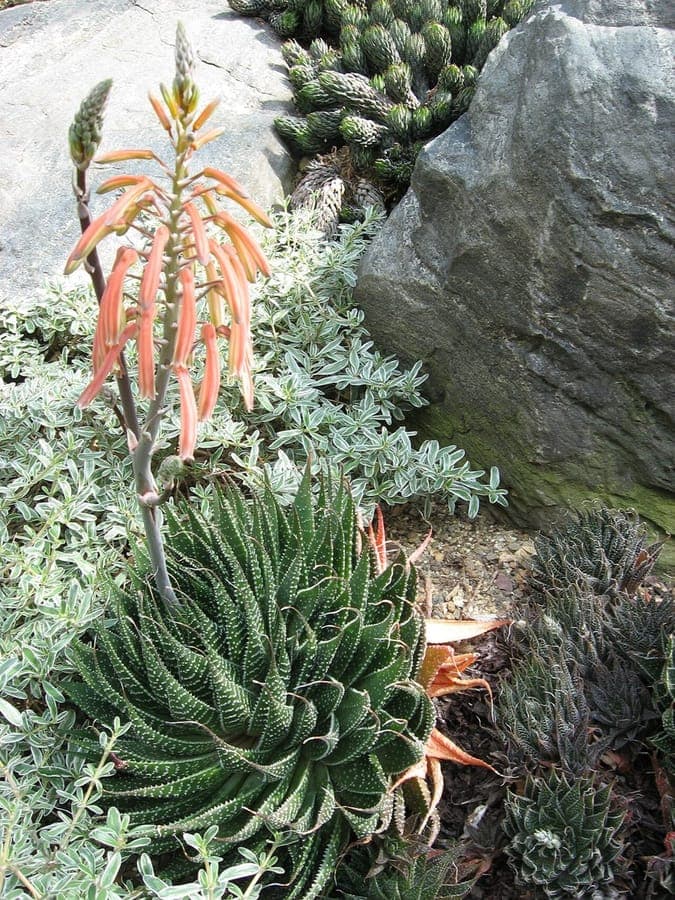
Chhe (talk) / Public domain, via Wikimedia Commons
Lace aloe (Aristaloe aristata): care and winter rest
Aristaloe aristata
Want to see Lace aloe (Aristaloe aristata): care and winter rest in your garden?
Full design in HD: €7.99
Look after your Lace aloe with the GardenWorld app
Identify plants with your camera and get a care calendar with reminders for this plant.


Overview
Aristaloe aristata is a small, stemless succulent from South Africa and Lesotho that was known for many years as Aloe aristata, the name still printed on plenty of labels. In 2014 DNA studies gave it a genus of its own, Aristaloe, in which it is the only species. It remains a close relative of the aloes and belongs to the family Asphodelaceae. In English it goes by several names, the most familiar being lace aloe, torch plant and guinea-fowl aloe.
The species name aristata means "bearing an awn": every leaf ends in a long, thin, whitish thread, as though someone had glued a hair to the tip. That detail, together with the white spots and the soft white teeth along the margins, makes the plant easy to recognise.
Unlike many succulents, it grows in the wild up into the mountains, at considerable altitude, where winters are cold and dry. As a result it tolerates more cold than most aloes. Even so, in north-west Europe it is not a plant for the open garden all year round. It belongs on a windowsill, in a cold greenhouse or in a pot on the patio. If you move it outdoors in summer, gardenworld.app can draw up a garden design that gives a sunny, dry corner of gravel and stone a permanent place.
Appearance and flowering
The rosettes grow 10 to 20 cm across and about as tall. The leaves are narrowly triangular, deep green and densely covered with white, slightly raised spots arranged in irregular bands. The margins carry fine white teeth that feel soft rather than sharp. After a few years offsets appear around the mother plant, forming a tight group.
Flowering is its great advantage over the haworthias it is often confused with. In late spring or early summer a sturdy, sometimes branched stem 30 to 50 cm tall appears, hung with tubular flowers in orange-red to salmon. In its homeland sunbirds visit them. The photo shows such a plant in flower in a rock garden: a deep green, white-speckled rosette at the foot of a large grey boulder, with a tall stem of orange tubular flowers, surrounded by a ground cover with grey-green, white-edged leaves and a few smaller spiky rosettes.
A flower stem takes a lot of the plant's energy. Cut it off at the base once flowering is over, unless you want to collect seed.
Position and light
Aristaloe aristata wants more light than haworthias. Indoors it belongs on a south or west-facing windowsill, or right behind a large east window. Too little light makes the rosette loose and pale, and then it will not flower. Only on a very hot south-facing sill behind double glazing can it get too warm in July; if so, move it back a little.
From mid-May to late September it enjoys being outdoors. Give it two weeks in part shade first so it can adjust, otherwise the leaves scorch into brown patches. After that it takes full sun, although a spot with a little shade at the hottest time of day is ideal. The leaves turn bronze-red in strong light, which does no harm. Stand the pot where rainwater drains away quickly, for example on a raised surface or under the eaves.
Watering and rest
In the wild, rain falls mainly in summer and winter is dry and cold. Follow that rhythm. From April to September water thoroughly as soon as the compost is completely dry: roughly once a week in a warm summer, less often in cooler weather. Never leave water standing in the saucer.
Cut back from October. From November to February keep the plant almost dry in a cool, bright place at 5 to 12 °C. A little water once a month is enough. This cool, dry rest is the best guarantee of flowers the following spring. In a warm living room the plant keeps growing through winter but becomes soft and flowers less freely.
Water around the edge of the pot where possible. Water that lingers in the heart of the rosette can cause rot, especially in cool weather. Feed every four weeks from May to August with cactus fertiliser at half strength.
Free preview
Want to see Lace aloe (Aristaloe aristata): care and winter rest in your garden? Make a free preview of your design.
Compost and repotting
Use cactus compost mixed with roughly a third to a half of coarse material such as pumice, lava grit or coarse gravel. A layer of grit on the surface keeps the neck of the plant dry. A terracotta pot with a good drainage hole is ideal: it dries quickly and lets air reach the fleshy roots.
Repot every two years in spring, or when the group of offsets fills the pot. Choose a pot that is wider than it is deep, because the plant spreads outwards. Leave it dry for a week after repotting.
Propagation by offsets and seed
The easiest route is division. In spring, separate offsets that have their own roots from the mother plant and pot them straight into dry cactus compost. Offsets without roots should dry for two or three days so the wound can callus, then go onto barely moist compost. They usually root within a month.
Seed is another option. Sow in spring in a warm place on fine, well-drained seed compost and barely cover. Seedlings grow slowly and take a few years to flower.
Maintenance calendar
March and April: Gradually increase watering. Repot and divide where needed.
May: Harden the plant off to outdoor light from mid-May. Start feeding every four weeks. Flower stems appear around this time.
June to August: Flowering, growth and full sun outdoors. Water regularly once the compost is dry. Cut off spent stems.
September: Stop feeding. Bring the plant indoors or into the cold greenhouse before the end of the month or as soon as frost threatens.
October to February: Cool and dry. Almost no water, but plenty of light.
Winter hardiness
Aristaloe aristata is one of the most cold-tolerant of the aloe relatives. Kept bone dry, it survives a few degrees of frost for short periods; growers report plants coming through around -5 °C undamaged when completely dry. Cold combined with wet, on the other hand, quickly kills it: the leaves turn glassy and the roots rot.
In Britain, Belgium and the Netherlands that means it is not a plant to leave in open ground all year. Overwinter it in a cold greenhouse, an unheated conservatory or a bright garage kept above freezing, or indoors in a cool room. If you want to try it outside, choose a spot under the eaves in very sharp gravel, and keep a spare plant indoors.
Toxicity to pets
There is little reliable data on Aristaloe aristata itself. It is, however, an aloe relative, and the leaf sap of several aloe species contains substances that can cause vomiting, diarrhoea and lethargy in cats and dogs. The ASPCA, for example, lists Aloe vera as toxic. Treat this plant as potentially harmful to pets and keep it out of reach of cats that like to nibble greenery.
If your pet vomits or has diarrhoea after chewing it, contact your vet and take the label with you. In people, the sap can mildly irritate the skin.
Companion plants
Outdoors in summer, Aristaloe aristata looks good in a shallow pan or among stones with other sun-loving succulents. Sempervivum tectorum forms grey-green rosettes that suit it well, and Delosperma cooperi adds pink flowers in the same sunny spot. Echeveria elegans brings blue-grey into the mix. Other small aloes, such as Aloe humilis and Aloe brevifolia, also go well with it and need the same care.
Bear in mind that such groupings have to be split up for winter if not every plant is equally hardy: the houseleek can stay outside, the others come in.
Final thoughts
Aristaloe aristata is a small aloe relative with a lot of character: white spots, soft teeth, a hair at every leaf tip and a burst of orange flowers in early summer. Give it sun, a gritty compost, water in summer and a cool, dry winter, and it will build into a larger group year after year. Wondering when to move it outside, repot it or bring it in? The plant calendar on gardenworld.app lists those jobs for your plants month by month.
Frequently asked questions about Lace aloe
Is Lace aloe winter hardy?
Aristaloe aristata is one of the most cold-tolerant of the aloe relatives. Kept bone dry, it survives a few degrees of frost for short periods; growers report plants coming through around -5 °C undamaged when completely dry.
How much water does Lace aloe need?
In the wild, rain falls mainly in summer and winter is dry and cold. Follow that rhythm.

See it in your garden
See Lace aloe in your garden
One photo of your garden and a few questions. You see the result in about a minute.
Try it with a photoIdentify this plant in your own garden. Identify a plant
Similar plants
Dwarf hedgehog aloe: complete guide
Aloe humilis
Discover dwarf hedgehog aloe (Aloe humilis), a compact South African succulent with red-tinted foliage and yellow flowers. Care and growing guide.
Aloe brevifolia: complete guide
Aloe brevifolia
Discover the Short Aloe, a compact succulent from South Africa with striking red blooms. This jewel-like plant is perfect for pots and small-space xeriscaping.
Houseleek: complete guide
Sempervivum tectorum
Houseleek is the classic succulent for roofs and rock gardens - hardy, drought-tolerant, and maintenance-free. Learn cultivation, propagation, and care.
