
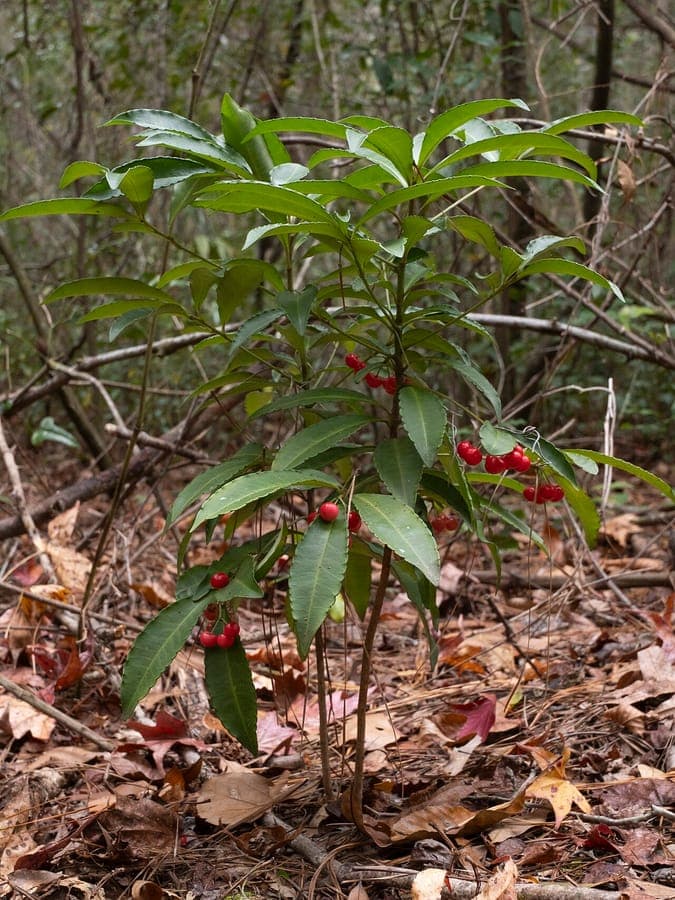
Alex Abair / CC BY 4.0, via Wikimedia Commons
Coralberry: complete guide
Ardisia crenata
Want to see Coralberry: complete guide in your garden?
1 minute, no credit card
Coralberry or Spiceberry (Ardisia crenata) is a pleasantly compact tropical shrub native to northeastern India, China, Japan, and the Philippines. This plant combines elegant foliage, charming white flowers, and striking red berries that persist for months.
The plant reaches 60 to 120 cm height in indoor culture, with naturally compact, well-formed growth. The leaves are dark green, glossy, and finely crenulated (minutely scalloped edges), justifying its crenata epithet. The foliage feels delicate and provides an elegant backdrop to fragrant flowers.
From late spring through summer, small pink or white flowers appear in dense spikes. These flowers emit pleasant fragrance, attracting butterflies and bees. After pollination, pea-sized red berries develop. These ripen to vivid red and persist 2 to 4 months on the plant, ensuring extended seasonal interest.
A white-fruiting variant (Ardisia crenata alba) exists, bearing white berries. This is less common but interesting for gardeners seeking variation.
Indoors, this plant thrives in indirect light. Direct midday sun causes leaf scorch. For optimal flowering and fruiting: provide at least 4 to 6 hours of indirect daylight daily. Insufficient light suppresses flowering.
The critical requirement is consistent moisture without waterlogging. During growing season (April to October): keep soil constantly moist but never soggy. Ensure drainage holes function freely. In winter: reduce watering slightly, but never allow soil to dry completely. Dry air encourages spider mites.
Temperature between 15 to 24 degrees Celsius is ideal. The plant dislikes temperature fluctuations and cold drafts. Below 10 degrees Celsius, growth stalls; below 0 degrees, above-ground growth dies back.
Feeding during growing season: apply balanced fertilizer every two weeks. Withhold feeding in winter. Excessive feeding promotes foliage at the expense of flowers.
Humidity requirement: this plant prefers 50 to 70 percent relative humidity. In dry indoor environments, mist regularly. Place pot on damp pebbles in a saucer (water not touching pot base) for humidity regulation.
Repotting: every 2 to 3 years into pots two sizes larger. Use moisture-retentive, free-draining potting mix. Adding peat moss aids moisture retention.
Pruning: after flowering, light pruning promotes compact branching. Remove dead wood and weak shoots. Annual light maintenance pruning suffices.
Pests and diseases: aphids, spider mites, and scale insects pose risks. In high humidity with poor air circulation: fungal issues arise. Quarantine affected plants; treat with biological insecticides.
Propagation: sow ripe seed from red berries in warm, humid propagator (20 to 25 degrees Celsius). Germination: 3 to 6 weeks. Seedlings grow slowly. Cuttings also work: 7 to 10 cm terminal cuttings in humid rooting medium under propagator.
In the UK and northern Europe, plant centers stock Ardisia crenata year-round, typically in 12 to 14 cm pots. Prices range from 5 to 15 euros depending on specimen size. Online nurseries offer seed.
On frost-free patios or in greenhouses: this plant thrives better in controlled, humid indoor conditions than in open garden. Ideal as container plant on warm patios, but requires frost protection.
An excellent choice for those seeking a compact, long-flowering houseplant with showy fruit ornament.
Want to see Coralberry: complete guide in your garden? Make a free design now.
Upload a photo, pick a style, and get a photorealistic design with plant list in under a minute.
No credit card required


Similar plants
Primula incana: complete guide to silvery alpine primrose
Primula incana
Silvery primrose (Primula incana), a delicate alpine flower with white blooms and powdered grey-green leaves. Growing, care, and cultivation guide.
Mealy cowslip: complete guide
Primula pulverulenta
Grow the Mealy cowslip (Primula pulverulenta): striking candelabra flowers in red and purple tones, moisture-loving and ideal for shady, damp garden corners.
Cliff dwarf-primrose: complete guide
Androsace laevigata
Full guide to growing Androsace laevigata, a rare Pacific Northwest alpine cushion plant. Planting, care, and garden design tips explained.