
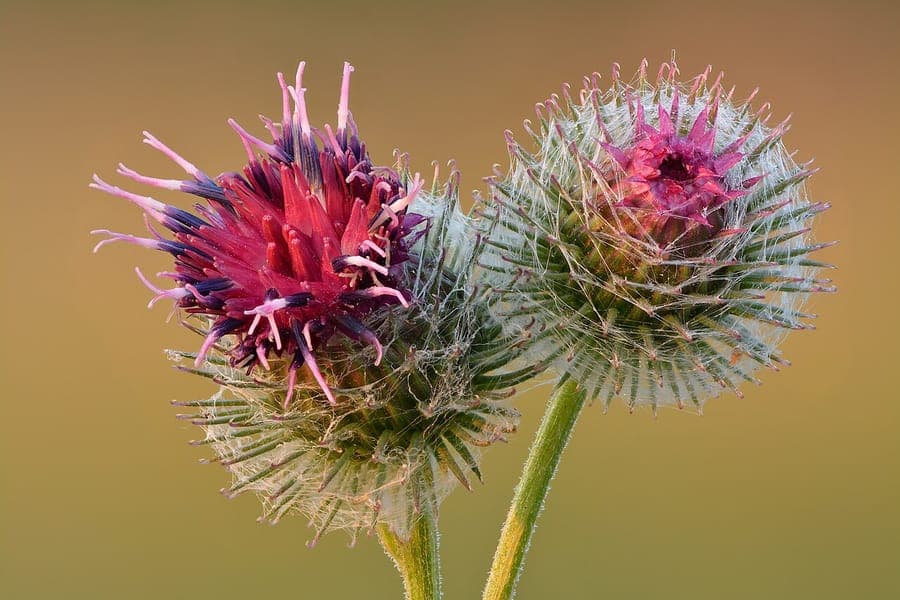
Ivar Leidus / CC BY-SA 4.0, via Wikimedia Commons
Woolly burdock: complete guide
Arctium tomentosum
Want to see Woolly burdock: complete guide in your garden?
1 minute, no credit card
Overview
Woolly burdock (Arctium tomentosum) is a striking, upright herbaceous perennial that stands out for its densely hairy stems and foliage. Native to central and eastern Europe-including Austria, the Baltic States, Belarus, and parts of Russia-this biennial plant thrives in open grasslands, roadsides, and disturbed soils. In the garden, it reaches 120 to 180 cm in height and blooms from July to August with rich purple flower heads. While often overlooked, it's a valuable plant for naturalistic planting schemes, offering structure, texture, and ecological benefits.
At gardenworld.app, you can design a border layout that highlights woolly burdock's architectural form while balancing it with complementary plants.
Appearance & bloom cycle
As a biennial, woolly burdock spends its first year forming a basal rosette of large, heart-shaped leaves. These leaves can grow up to 30 cm across, with a dark green upper surface and a distinctly woolly, whitish underside. The margins are coarsely toothed, and the petioles are equally hairy. In the second year, it sends up a tall, rigid stem topped with multiple spherical flower heads. Each flower head is about 3 cm in diameter, composed of tightly packed, deep purple tubular florets. Blooming occurs from mid-July through August. After flowering, the plant produces the familiar burs-spiny, hook-covered seed heads that cling stubbornly to clothing and animal fur, aiding in seed dispersal.
The dense indumentum (hairy covering) on stems and leaves gives the plant its 'woolly' name and provides protection from excessive transpiration and herbivory.
Ideal location
Woolly burdock thrives in full sun (light level 8/10) but tolerates light afternoon shade. It needs at least 6 hours of direct sunlight daily for optimal flowering. Choose a spot in the back of a mixed border, wildflower meadow, or naturalized area where it has room to grow without crowding. Due to its height and tendency for burs to stick to passers-by, avoid planting near high-traffic paths or seating areas. It performs well against fences or in transitional zones between lawn and woodland.
For placement ideas, use gardenworld.app to visualize spacing and companion arrangements before planting.
Soil requirements
This plant prefers well-drained, moderately fertile soil with a pH between 7.5 and 8.0-slightly alkaline to neutral. It adapts well to loam, sandy loam, or light clay, as long as water doesn't pool around the roots. Poor drainage leads to crown rot, especially in young plants. Incorporate well-rotted compost at planting to improve soil structure and nutrient content. Avoid highly acidic soils (below pH 6.5), as growth will be stunted.
Free design
Want to see Woolly burdock: complete guide in your garden? Make a free design now.
Watering
During the first growing season, water regularly-about 2.5 cm per week-especially during dry spells. Once established, woolly burdock is drought-tolerant thanks to its deep taproot. Mature plants rarely need supplemental watering unless experiencing prolonged drought. Overwatering should be avoided; soggy soil encourages fungal diseases and root decay.
Pruning
Pruning isn't required, but cutting back flower stems after blooming improves garden neatness and reduces self-seeding. If you don't want volunteers spreading, remove spent flower heads before burs mature. Wear gloves when handling-burs are tenacious and can damage clothing and tools. Leave a few stems over winter for structural interest and to provide food and shelter for birds.
Maintenance calendar
- Jan: Dormant; no action needed
- Feb: Dormant; check for early rosettes
- Mar: Clear debris to allow new growth
- Apr: Monitor for emerging leaves
- May: Water young plants weekly if dry
- Jun: Stake tall stems if needed
- Jul: Peak bloom; inspect for aphids or mildew
- Aug: Continue blooming; watch for seed development
- Sep: Cut back finished stems
- Oct: Remove burs to limit spread
- Nov: Leave some stems for winter interest
- Dec: Dormant; mulch lightly in colder zones
Winter hardiness
Woolly burdock is hardy in USDA zones 5 to 8. It survives winter as a basal rosette, with the taproot enduring sub-zero temperatures down to -20°C. The above-ground parts die back in autumn. In zone 5, a light mulch of straw or leaf litter can protect young rosettes from freeze-thaw cycles. In milder zones, no protection is needed.
Companion plants
Pair woolly burdock with other tall summer bloomers like Sanguisorba officinalis, Echinops bannaticus, or Molinia caerulea for a dynamic, prairie-style border. It combines well with grasses and late-flowering perennials such as Helenium and Rudbeckia. Avoid overly aggressive spreaders like mint or goldenrod, which may outcompete it. For pollinator support, plant near teasel (Dipsacus fullonum) or knapweeds (Centaurea spp.).
Closing
Woolly burdock isn't a typical garden staple, but it's a bold choice for eco-conscious gardeners. Its architectural form, ecological value, and low maintenance make it ideal for wild gardens, restoration projects, or natural borders. Available at garden centres across the UK and online, it's worth seeking out for its unique texture and resilience. Just give it space, sun, and well-drained soil-and you'll have a reliable summer highlight year after year.
Want to see Woolly burdock: complete guide in your garden? Make a free design now.
Upload a photo, pick a style, and get a photorealistic design with plant list in under a minute.
No credit card required


Similar plants
Calendula stellata: complete guide
Calendula stellata
Complete guide to Calendula stellata, the star-flowered marigold from Sicily: location, soil, watering and companion planting tips.
Korean chrysanthemum: complete guide
Chrysanthemum x rubellum
Chrysanthemum x rubellum is a hardy autumn perennial with single pink to copper flowers from August to November. Care and combinations.
Helianthus divaricatus: complete guide
Helianthus divaricatus
Helianthus divaricatus is a North American woodland sunflower with yellow summer blooms, ideal for naturalistic borders and shady edges.