
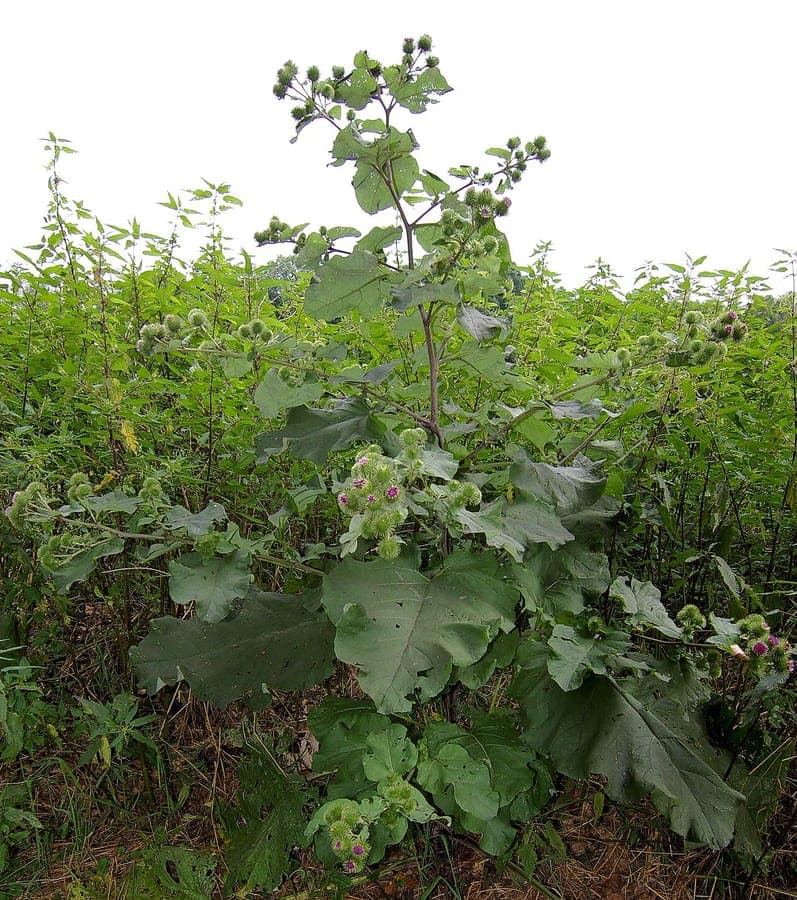
Christian Fischer / CC BY-SA 3.0, via Wikimedia Commons
Beggar's-buttons: complete guide
Arctium lappa
Want to see Beggar's-buttons: complete guide in your garden?
1 minute, no credit card
Overview
Arctium lappa, commonly known as Beggar's-buttons, is a biennial herb that thrives in rough, open areas across temperate zones. Native to parts of Europe and Asia, it's now naturalized in many regions, including the UK and North America. It grows well in USDA hardiness zones 6 to 9 and reaches maturity over two years. While often dismissed as a weed, this plant has a long-standing reputation in herbal medicine and culinary traditions, especially in Japanese and Korean cuisine where the root, known as gobo, is a staple.
On gardenworld.app, you can design a low-effort, wildlife-friendly garden that incorporates Beggar's-buttons as part of a naturalistic planting scheme. This plant isn't about neat borders or tidy flowerbeds – it's for gardeners who appreciate rugged charm and ecological function.
Appearance & bloom cycle
In its first year, Beggar's-buttons forms a low rosette of large, heart-shaped leaves up to 40 cm long. The undersides are woolly, and the edges are wavy. In the second year, it sends up a tall, branching stem that can reach 1.5 to 2 meters in height. From July to August, it produces rounded, thistle-like flower heads, about 2–3 cm wide, in a rich purple hue. These attract bees, butterflies, and hoverflies, making it a valuable addition for pollinators.
After flowering, the seed heads develop distinctive hooked bracts – the infamous burrs that stick to clothing and animal fur. These burs can remain viable in soil for several years, so be mindful of self-seeding if you don't want it spreading.
Ideal location
Beggar's-buttons needs full sun to thrive – aim for a light rating of 8, meaning 6–8 hours of direct sunlight daily. It can tolerate partial shade, but plants will stretch and become leggy. Position it at the back of borders, along fences, or in wild corners where its height and burrs won't be a nuisance. Avoid planting near pathways or play areas unless you're prepared to manage the burs.
Use gardenworld.app to map out sun exposure in your garden and find the perfect spot where Beggar's-buttons can grow without becoming a hassle.
Soil requirements
This plant isn't picky but performs best in deep, loamy, well-drained soil rich in organic matter. The ideal pH range is 7.0 to 7.5 – neutral to slightly alkaline. It can handle clay if drainage is adequate, but avoid waterlogged spots. The taproot can grow over 1 meter deep, so ensure the planting area is free of compacted layers or hardpan.
Before sowing, work in well-rotted compost, especially in sandy soils. Avoid high-nitrogen fertilizers, which promote leafy growth at the expense of root development.
Free design
Want to see Beggar's-buttons: complete guide in your garden? Make a free design now.
Watering
Once established, Beggar's-buttons is drought-tolerant thanks to its deep taproot. During average rainfall, supplemental watering isn't needed. In prolonged summer dry spells, especially in the first year, give a deep soak every 10–14 days. Shallow watering encourages weak root systems.
Young seedlings need consistent moisture for the first few weeks. Keep the soil damp but never soggy.
Pruning
No pruning is required for growth control. However, if you want to prevent self-seeding, cut down the flower stalks after blooming but before the burs fully form. This stops the plant from spreading. Remove dead foliage in autumn, but leave some debris as winter mulch to protect soil biology.
Maintenance calendar
- Jan: No action needed
- Feb: No action needed
- Mar: Sow seeds directly in prepared beds
- Apr: Monitor seedlings, thin if overcrowded
- May: Weed regularly, keep area clear
- Jun: Support tall stems if needed
- Jul: Flowers appear, pollinators active
- Aug: Full bloom, burs begin to form
- Sep: Cut back spent stems to limit seeding
- Oct: Harvest roots (first-year plants), clear debris
- Nov: Prepare soil for next season
- Dec: No action needed
Winter hardiness
Beggar's-buttons is hardy down to -15°C (USDA zone 6). In zones 7–9, it survives winter with ease. The first-year rosette overwinters, while second-year plants die after seeding. Seeds remain dormant in soil and germinate in spring, leading to volunteer seedlings.
Companion plants
Good companions include yarrow, echinacea, and mullein in a wildlife garden. In a permaculture system, grow it near beans or peas for nitrogen fixation, and squash for ground cover. Avoid planting near delicate ornamentals – the burs will cling to everything.
Closing
Beggar's-buttons isn't for every garden, but if you're after a resilient, low-maintenance plant with ecological and culinary value, it's worth considering. It demands little, gives back in pollinator support, and offers edible roots when harvested in the first autumn. You can find seeds at garden centres across the UK, including major chains. Just make sure you've got a spot where it can grow freely without causing frustration. With the right placement, it becomes a useful, if unrefined, part of your garden ecosystem.
Want to see Beggar's-buttons: complete guide in your garden? Make a free design now.
Upload a photo, pick a style, and get a photorealistic design with plant list in under a minute.
No credit card required


Similar plants
Calendula stellata: complete guide
Calendula stellata
Complete guide to Calendula stellata, the star-flowered marigold from Sicily: location, soil, watering and companion planting tips.
Korean chrysanthemum: complete guide
Chrysanthemum x rubellum
Chrysanthemum x rubellum is a hardy autumn perennial with single pink to copper flowers from August to November. Care and combinations.
Helianthus divaricatus: complete guide
Helianthus divaricatus
Helianthus divaricatus is a North American woodland sunflower with yellow summer blooms, ideal for naturalistic borders and shady edges.