
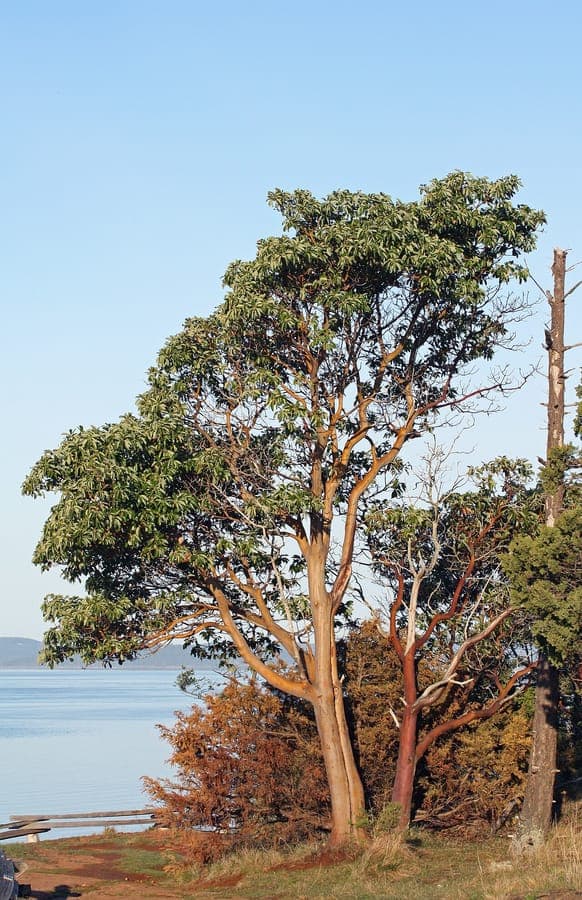
Walter Siegmund (talk) / CC BY-SA 3.0, via Wikimedia Commons
Pacific madrone: complete guide
Arbutus menziesii
Want to see Pacific madrone: complete guide in your garden?
1 minute, no credit card
The Pacific madrone (Arbutus menziesii) ranks among North America's most ornamental native trees, found from British Columbia to Baja California. This slow-grower reaches maturity over 30 to 50 years, but visual rewards from establishment onward justify the patient investment.
The smooth, red to orange-red bark is this tree's signature feature. The bark renews annually, exfoliating in irregular patches to expose fresh, gleaming inner layers. This creates a mottled, sculptural texture especially striking in winter months when frost or fresh snow emphasizes the warm red tones.
The foliage is evergreen, with glossy, dark green leaves measuring 7 to 12 cm long. In full sun, leaf margins often assume purple or bronze tints, especially during cool seasons, adding chromatic depth to the canopy.
Between April and May, pleasantly fragrant, tiny white flowers appear in dense panicles at branch tips. These flowers attract bees and pollinators, resulting in red to orange berries approximately 8 mm in diameter. These fruits ripen in autumn and often persist through winter, providing bird food while adding warm color.
Mature trees reach 10 to 15 meters in height (occasionally 20 meters) with comparable crown width. Growth is slow: approximately 1 meter annually in the first decade, slower thereafter. Plant at young age (1-2 meters height) for best establishment.
The tree requires well-drained soil. Heavy clay, standing water, and wet sites prove fatal. The madrone grows optimally in sandy, gravelly, or loamy soils with pH 4.5 to 7.4. Once established, the tree exhibits strong drought tolerance thanks to deep, exploring roots.
Full sun (minimum 6 hours direct sunlight daily) is essential. Shade reduces growth and flower production. Wind protection, especially when young, is helpful but not critical.
Water regularly in the first growing season, allowing soil to dry between waterings. After establishment (year 2+), supplemental water is rarely needed. In dry summers, additional water supports fruit production.
Pruning is unnecessary and potentially harmful. The tree develops its natural form. Remove only damaged branches.
This tree is hardy to USDA zone 8b (-9 to -12 degrees Celsius). In northern Europe, site in warm, sheltered locations (south-facing walls, protected from cold winds). Young trees often need winter protection in continental climates.
Late autumn through early spring is dormant season. Reduce watering. Avoid fertilizing during dormancy.
The Pacific madrone pairs beautifully with other drought-tolerant trees like Olea (olive), Mediterranean species, and columnar conifers. Underplant with low-growers such as alpine sedums, Delosperma, or Penstemon.
In the UK and northern Europe, specialist nurseries occasionally stock young trees (30-60 cm). Larger material typically requires sourcing from specialized growers in warmer regions. Transport costs can be significant.
Warning: this tree produces abundant seed and can self-sow on steep, erodible slopes. Site accordingly.
An excellent choice for gardeners seeking a durable, sculptural ornamental with minimal maintenance demands.
Want to see Pacific madrone: complete guide in your garden? Make a free design now.
Upload a photo, pick a style, and get a photorealistic design with plant list in under a minute.
No credit card required


Similar plants
Zenobia pulverulenta: complete guide
Zenobia pulverulenta
Everything about Zenobia pulverulenta (honeycup): siting, acid soil, pruning and the fragrant white bells, in this complete care guide.
Dwarf huckleberry: complete guide
Gaylussacia dumosa
Everything about dwarf huckleberry (Gaylussacia dumosa): acidic soil, partial shade, pruning and care for this compact North American berry shrub.
Drooping leucothoe: complete guide
Leucothoe fontanesiana
Everything about drooping leucothoe (Leucothoe fontanesiana): shade tolerance, soil, watering, pruning, hardiness and companion plants.