
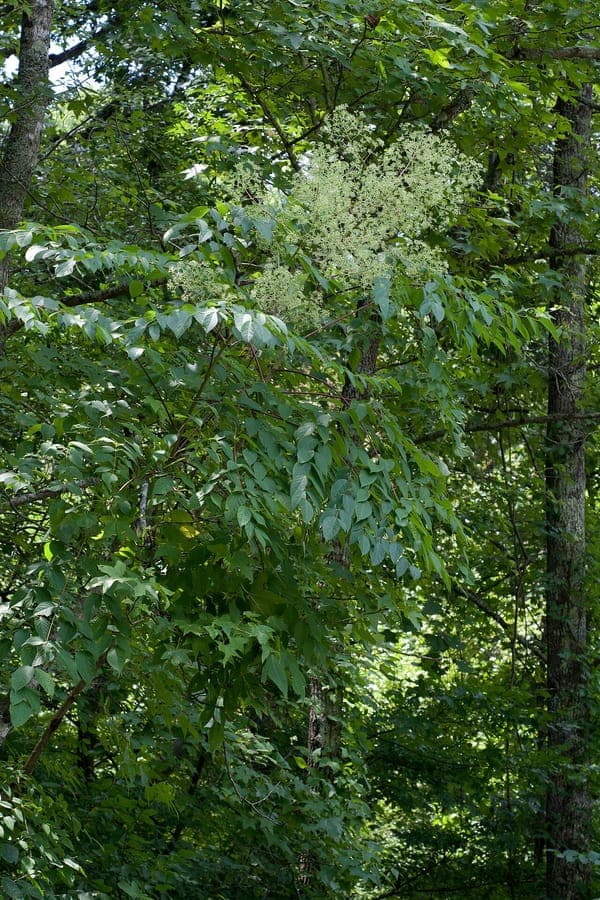
Eric Hunt / CC BY-SA 4.0, via Wikimedia Commons
Aralia spinosa: complete guide
Aralia spinosa
Want to see Aralia spinosa: complete guide in your garden?
1 minute, no credit card
Overview
Aralia spinosa, commonly called Hercules-club, American angelica-tree, or devil's walking-stick, is a dramatic deciduous shrub native to the eastern United States. First botanically described in 1753, this plant has become increasingly popular in European gardens for its bold architectural form and distinctive ornamental thorns that cover nearly every surface. It is truly a statement plant that commands attention and respect.
While not suitable for every garden, Aralia spinosa rewards the adventurous gardener with decades of impressive seasonal display and structural interest. This is a plant that transforms a space simply through its presence.
Appearance and Bloom
Aralia spinosa typically grows 6-8 meters tall in its native habitat, though European specimens often reach 3-5 meters. The entire plant, including stems, branches, and petioles, is densely covered in sharp reddish spines creating a formidable defense mechanism. This is genuinely one of the most heavily armed plants in cultivation.
The bipinnate compound leaves are enormous, often reaching 60 centimeters in length, creating an elegant, fine-textured canopy despite the menacing thorns. Foliage emerges bright green and transforms through yellow-orange to deep red in autumn before dropping.
Small white flowers appear in late summer (July-August) arranged in dense, terminal umbels. These flowers attract abundant pollinators and are followed by glossy black berries the size of peas. These drupes persist well into winter and are eagerly consumed by migrating birds.
Ideal Location
Aralia spinosa demands full sun for optimal performance. While the plant tolerates partial shade, flowering is significantly reduced and the form becomes leggy. Position this plant where it receives at least six hours of direct daily sunlight. Plant it as a specimen in a prominent location, or use it as a dramatic boundary marker.
Place it deliberately away from high-traffic areas and where children play, due to the formidable spines. The visual drama requires appreciation at a safe distance.
Soil
Aralia spinosa adapts well to various soil types, thriving in acidic to neutral conditions (pH 4.8-6.6). The plant prefers well-draining soil and tolerates sandy loam equally as well as clay soils, provided drainage is adequate. Waterlogged conditions lead to root rot.
Enrich the planting hole with organic matter, though this American native evolved in nutrient-poor forest margins and is not demanding. Avoid heavily fertilized soils that encourage excessive soft growth.
Free design
Want to see Aralia spinosa: complete guide in your garden? Make a free design now.
Watering
Established plants are moderately drought-tolerant due to their deep root system, but perform optimally with regular moisture during the growing season. Young plants require more consistent watering until root systems develop.
Water deeply but infrequently, allowing soil to dry somewhat between applications. Excessive moisture is as problematic as prolonged drought. During rainy periods, supplemental watering is unnecessary.
Pruning
Aralia spinosa requires minimal pruning as it develops an attractive natural form. Remove only dead, damaged, or diseased wood. Prune in early spring before active growth begins. Always wear heavy gloves and long sleeves when working with this plant.
To encourage more vigorous branching on older specimens, selectively remove the oldest canes to ground level in early spring, stimulating replacement growth from the base.
Maintenance Calendar
Spring: Inspect for winter damage. Apply compost mulch to stimulate new growth and suppress weeds.
Summer: Monitor moisture during hot, dry periods. Enjoy the abundant flowers and pollinator activity they attract.
Autumn: Allow natural senescence. Collect seed for propagation if desired; birds will harvest the remainder.
Winter: No maintenance required in temperate zones.
Winter Hardiness
Aralia spinosa is fully winter hardy throughout temperate Europe (zones 5-8), surviving temperatures well below -20 degrees Celsius. In northern regions, young plants benefit from winter protection during establishment. The above-ground portions may die back during extreme winters in zone 5, but the plant reliably regenerates from the base each spring.
Companion Plants
Aralia spinosa combines excellently with other American natives such as Amelanchier, select Magnolia species, and native oaks. For foliage contrast, pair with ornamental grasses or fine-textured evergreens. The grey-brown thorns create stunning contrast against bright green foliage.
Maintain 2+ meters distance from walkways and seating areas. Use as a specimen plant or in groups of three for maximum visual impact.
Closing
Aralia spinosa offers the bold gardener substantial rewards: architectural form, pollinator-friendly flowers, bird-attracting fruit, and reliable hardiness. Treat it with respect through careful placement and protective gear, and you will enjoy dramatic seasonal interest for decades. This remarkable American native deserves wider cultivation in European gardens.
Local garden centers and mail-order nurseries increasingly stock young plants. Start with a single specimen and appreciate its sculptural presence year-round.
Gardenworld.app helps you incorporate such architectural drama into your front yard redesign. Hercules-club is just one of thousands of possibilities for creating your perfect outdoor space.
Gardenworld.app: transforming front yards into beautiful, personalized landscapes.
Want to see Aralia spinosa: complete guide in your garden? Make a free design now.
Upload a photo, pick a style, and get a photorealistic design with plant list in under a minute.
No credit card required


Similar plants
American marsh pennywort: complete guide
Hydrocotyle americana
Everything about Hydrocotyle americana: location, soil, moisture and winter care. A delicate groundcover for shaded pond edges and boggy garden borders.
Devil's club: complete guide
Oplopanax horridus
Full guide to growing Oplopanax horridus: ideal site, soil, watering, and care for this dramatic spiny woodland shrub.
Water pennywort: complete guide
Hydrocotyle umbellata
Everything about Hydrocotyle umbellata: ideal location, soil, watering, winter care and pond planting. A versatile aquatic plant for garden ponds and boggy spots.