
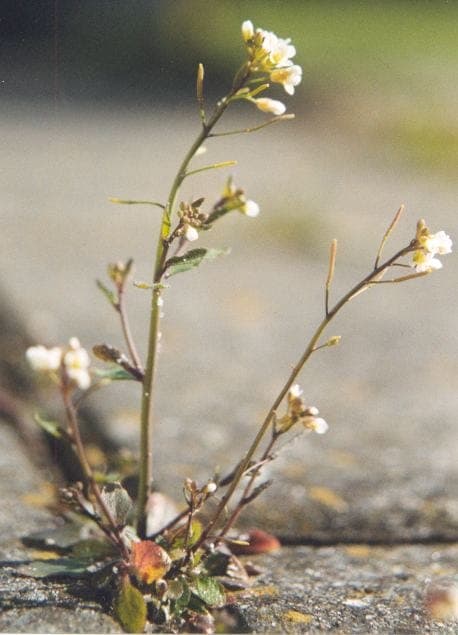
Original uploader was Brona at en.wikipedia. User:Roepers at nl.wikipedia / CC BY-SA 3.0, via Wikimedia Commons
Mouse-ear cress: complete guide
Arabidopsis thaliana
Want to see Mouse-ear cress: complete guide in your garden?
1 minute, no credit card
Overview
Mouse-ear cress, or Arabidopsis thaliana, is a humble little annual herb that often flies under the radar in home gardens. Native to parts of Europe and Central Asia, it's become naturalised across temperate zones, including much of the UK and northern Europe. While it's best known in scientific circles as a model organism for genetic research, in the garden it serves as a quiet, self-sufficient filler that thrives where other plants struggle. It's not flashy, but it's reliable - and that counts for a lot when you're managing a real-world garden.
This plant prefers open, dry conditions and seeds itself readily, making it ideal for informal or wild-style planting. On gardenworld.app, you can design a planting scheme that uses mouse-ear cress to fill bare patches between stones or along path edges, especially in urban gardens with compacted soil.
Appearance & bloom cycle
Mouse-ear cress grows between 10 and 30 cm tall, forming a low rosette of fuzzy, spoon-shaped leaves close to the ground. The foliage is mid- to dark green, with a soft, slightly hairy texture that gives the plant its common name. From March through July, slender flowering stalks rise up, branching lightly and ending in clusters of tiny white flowers, each about 3 mm wide.
The blooms have four petals arranged in a cross - a telltale sign of the Brassicaceae family - and are attractive to early-season pollinators like hoverflies and small bees. After flowering, narrow seed pods (siliques) develop and eventually burst open, scattering seeds for next year's crop. This self-seeding habit means you'll likely see new plants appear in the same spot each spring.
Ideal location
Mouse-ear cress thrives in full sun to light shade, scoring a 6 out of 10 on the light scale. It does best in locations with at least 4–6 hours of direct sunlight daily. Ideal spots include dry rock crevices, gravel paths, or the edges of raised beds where soil drains quickly. It's particularly useful in city gardens where soil compaction and limited moisture are common issues.
Avoid deep shade or heavily shaded corners - the plant will stretch, weaken, and fail to bloom. If you're unsure whether your garden gets enough light, use gardenworld.app to map sun exposure and find the best microclimates for light-loving plants like this one.
Soil requirements
This plant prefers slightly acidic soil with a pH between 5.0 and 5.5. It doesn't need rich soil - in fact, it grows better in poor, lean conditions. Fertile, heavily amended soils often encourage more competitive weeds that will crowd it out. The key is excellent drainage: heavy clay or waterlogged soils will cause root rot.
A mix of sandy loam with a bit of grit or perlite works well. If growing in containers, use standard potting mix with 30% added sand for improved drainage. Do not add compost or fertiliser - this plant is adapted to low-nutrient environments.
Free design
Want to see Mouse-ear cress: complete guide in your garden? Make a free design now.
Watering
Once established, mouse-ear cress is highly drought tolerant. It rarely needs supplemental watering, even during dry springs or early summers. Water only during prolonged droughts, and then lightly. Overhead watering should be avoided - use a watering can at soil level to prevent fungal issues.
Young seedlings are more vulnerable, so keep the top 2–3 cm of soil slightly moist until they're 4–6 weeks old. After that, let the soil dry out between waterings.
Pruning
Pruning isn't necessary for mouse-ear cress. As an annual, it completes its life cycle in one season. However, if you want to limit self-seeding in formal beds, cut back the flower stalks after blooming but before seeds ripen. This keeps the garden tidy and prevents unwanted spread.
Dead foliage can be gently removed in early spring to make space for new growth.
Maintenance calendar
- Jan: Dormant - no action needed
- Feb: Check for early rosettes; remove debris
- Mar: Growth begins; protect seedlings from slugs
- Apr: Full bloom; monitor for pests
- May: Peak flowering; consider deadheading
- Jun: Flowers fade; seed pods form
- Jul: Seeds mature; allow dispersal or collect
- Aug: Plants die back; clean up if desired
- Sep: No maintenance
- Oct: Lightly disturb soil to encourage germination
- Nov: Leave undisturbed
- Dec: Dormant period
Winter hardiness
Mouse-ear cress is hardy to USDA zone 5, making it suitable for most of the UK and northern Europe. It often overwinters as a basal rosette or as seed in the soil. In milder winters, you may see green growth persisting through frost.
No winter protection is needed. Avoid mulching heavily - this can trap moisture and promote rot. Let nature take its course.
Companion plants
This plant pairs well with other drought-tolerant species like thyme, sedum, and dianthus. It fits naturally in rock gardens, gravel beds, or between paving stones. Good companions include Sempervivum, Arabis, and low-growing geraniums.
Avoid planting near aggressive spreaders like ground ivy or bindweed, which will quickly overpower it.
Closing
Mouse-ear cress may not win any beauty contests, but it earns its place in the garden through resilience and simplicity. It asks for little and gives a modest but consistent performance each year. As climate shifts bring drier springs and more unpredictable weather, plants like this become increasingly valuable.
If you're planning a low-maintenance, ecologically sound garden, consider how mouse-ear cress can fit into your design. Use tools on gardenworld.app to visualise its placement and combine it with compatible species. Available at garden centres across the UK and online, often as seed from retailers like Thompson & Morgan or Mr Fothergill's.
Want to see Mouse-ear cress: complete guide in your garden? Make a free design now.
Upload a photo, pick a style, and get a photorealistic design with plant list in under a minute.
No credit card required


Similar plants
Brassica cretica: complete guide
Brassica cretica
Brassica cretica, the Cretan cabbage, grows wild on Aegean cliffs. Discover how to grow this drought-tolerant, yellow-flowered Mediterranean perennial.
Corsican cabbage: complete guide
Brassica insularis
Corsican cabbage is a rare Mediterranean rock cabbage with white flowers and blue-green leaves. Location, soil and winter protection.
Prostrate cabbage: complete guide
Brassica procumbens
Prostrate cabbage is a creeping North African cliff plant with yellow flowers. Discover location, soil type and winter protection.