
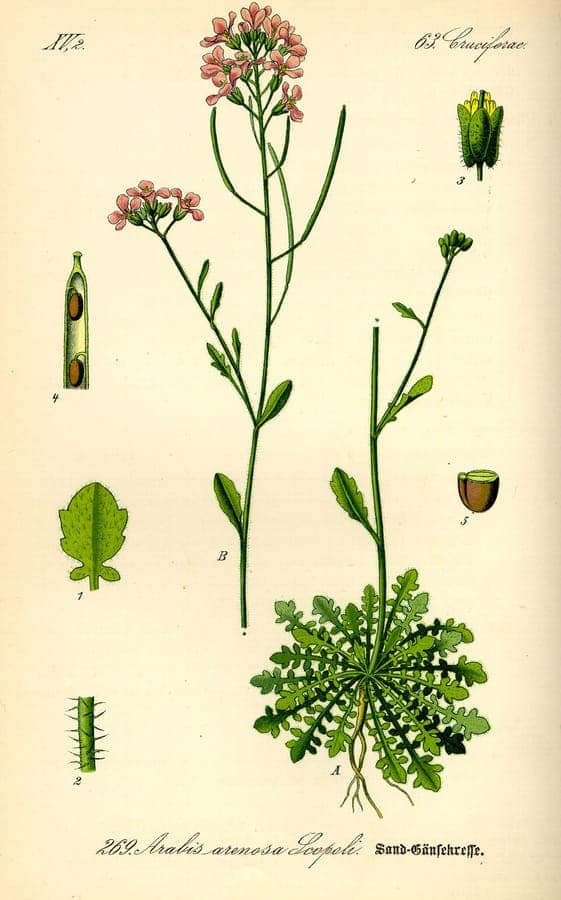
Otto Wilhelm Thomé / Public domain, via Wikimedia Commons
Sand rock-cress: complete guide
Arabidopsis arenosa
Want to see Sand rock-cress: complete guide in your garden?
1 minute, no credit card
Overview
Sand rock-cress (Arabidopsis arenosa) isn't the kind of plant that shouts for attention. It doesn't tower over borders or flaunt flashy petals. But for gardeners who appreciate resilience and quiet charm, this little herb is a quiet winner. Part of the Brassicaceae family, it's related to cabbages, mustards, and radishes - but unlike its edible cousins, it's grown for its toughness and subtle beauty.
Native to central and eastern Europe, it thrives in harsh conditions: rocky outcrops, dry walls, sandy banks, and poor soils where few others dare to grow. It's a biennial or short-lived perennial, typically reaching 15–40 cm in height. While it may not be sold at every garden centre, it's worth seeking out if you're designing a low-input, ecologically sound garden.
On gardenworld.app, you can map out a planting scheme that highlights sand rock-cress alongside drought-tolerant companions and suitable microclimates.
Appearance & bloom cycle
The plant forms a low, rosette-shaped cluster of dark green, slightly hairy leaves at the base. From spring into early summer - April through July - upright stems emerge, bearing delicate clusters of small flowers. Each bloom has four petals in soft shades of blue to pale purple, about 8–10 mm across. They're not showy, but they bring a gentle colour to rock gardens and crevices.
Bees, hoverflies, and small beetles visit the flowers, drawn by minimal nectar and pollen. After flowering, narrow seed pods (siliques) develop and split open to scatter fine seeds. Self-seeding is moderate, so it won't take over, but you may spot new seedlings near parent plants the following year.
The foliage often stays green through winter, especially in milder zones, adding structure when little else is visible.
Ideal location
Full sun is non-negotiable. Plant it where it gets at least 6–8 hours of direct sunlight daily. It thrives in rock gardens, between paving stones, on dry stone walls, or in gravel beds. Avoid shady, damp corners - this isn't a plant for woodland edges or boggy soil.
It does best in open, exposed sites with good air circulation. In crowded borders, it gets leggy and floppy. Keep competition from aggressive groundcovers or fast-growing perennials to a minimum.
Use gardenworld.app to assess your garden's sun exposure and create a layout that maximizes the potential of sun-baked zones perfect for sand rock-cress.
Soil requirements
It loves poor, well-drained soil. Sandy, gravelly, or chalky soils are ideal. A pH between 6.0 and 8.0 suits it fine - it's particularly happy on limestone substrates. Heavy clay or water-retentive soils will spell trouble, leading to root rot.
Don't enrich the soil with compost or manure. This plant evolved in nutrient-poor conditions; too much fertility results in weak growth and fewer flowers. If amending soil, add sharp sand or small grit to improve drainage.
Free design
Want to see Sand rock-cress: complete guide in your garden? Make a free design now.
Watering
Once established, it's drought-tolerant and survives on rainfall alone. During the first growing season, water weekly if there's no rain, just to help roots settle. After that, leave it alone. Overwatering is the fastest way to kill it.
If you must irrigate, use rainwater. Tap water, especially in hard water areas, can leave mineral deposits that harm the foliage over time.
Pruning
No pruning is needed. If you want to limit self-seeding, cut back the flower stems after blooming. Otherwise, leave them - the dried seed pods add winter texture, and the plant often renews itself naturally.
If the plant looks tired after flowering, a light trim just above the basal rosette can encourage fresh growth, but it's rarely necessary.
Maintenance calendar
- Jan: Dormant. Check for slug damage on rosettes.
- Feb: Still resting. Clear any fallen debris.
- Mar: New growth begins. Light watering if dry.
- Apr: Blooms start. Ensure full sun exposure.
- May: Peak flowering. Monitor for pests.
- Jun: Flowering continues. Thin seedlings if overcrowded.
- Jul: End of bloom. Trim spent stems if desired.
- Aug: Dormant. No feeding.
- Sep: Possible late blooms in mild climates.
- Oct: Leave stems for winter interest.
- Nov: Minimal care.
- Dec: Fully dormant.
Winter hardiness
Hardy in USDA zones 4–8 (-34°C to -12°C). The basal rosette often remains evergreen, surviving snow and frost with ease. It doesn't need mulch or protection - in fact, excessive covering can trap moisture and cause rot.
In colder zones, it may die back above ground but re-emerges from the crown in spring.
Companion plants
Pair it with other sun-loving, drought-tolerant species: sedums, thymes, artemisias, or small ornamental grasses like Festuca ovina. It also works well with dwarf lavenders, catmints, and chalk-loving pinks like Dianthus.
Avoid moisture-hungry plants like hostas or astilbes. Keep aggressive spreaders like mint or goldenrod at bay.
Closing
Sand rock-cress is the kind of plant that earns respect over time. It won't win prizes at flower shows, but it'll thrive where others fail. Low maintenance, hardy, and quietly beautiful - it's a smart choice for rock gardens, green roofs, or naturalistic planting schemes.
You won't always find it at mainstream garden centres, but check specialty nurseries or online suppliers. When in stock, it's sometimes sold under its synonym, Cardaminopsis arenosa.
In the UK and US, look for it at independent garden centres or native plant retailers. With a bit of planning - maybe with help from gardenworld.app - you can create a resilient, low-fuss garden where sand rock-cress finds its perfect place.
Want to see Sand rock-cress: complete guide in your garden? Make a free design now.
Upload a photo, pick a style, and get a photorealistic design with plant list in under a minute.
No credit card required


Similar plants
Brassica cretica: complete guide
Brassica cretica
Brassica cretica, the Cretan cabbage, grows wild on Aegean cliffs. Discover how to grow this drought-tolerant, yellow-flowered Mediterranean perennial.
Corsican cabbage: complete guide
Brassica insularis
Corsican cabbage is a rare Mediterranean rock cabbage with white flowers and blue-green leaves. Location, soil and winter protection.
Prostrate cabbage: complete guide
Brassica procumbens
Prostrate cabbage is a creeping North African cliff plant with yellow flowers. Discover location, soil type and winter protection.