
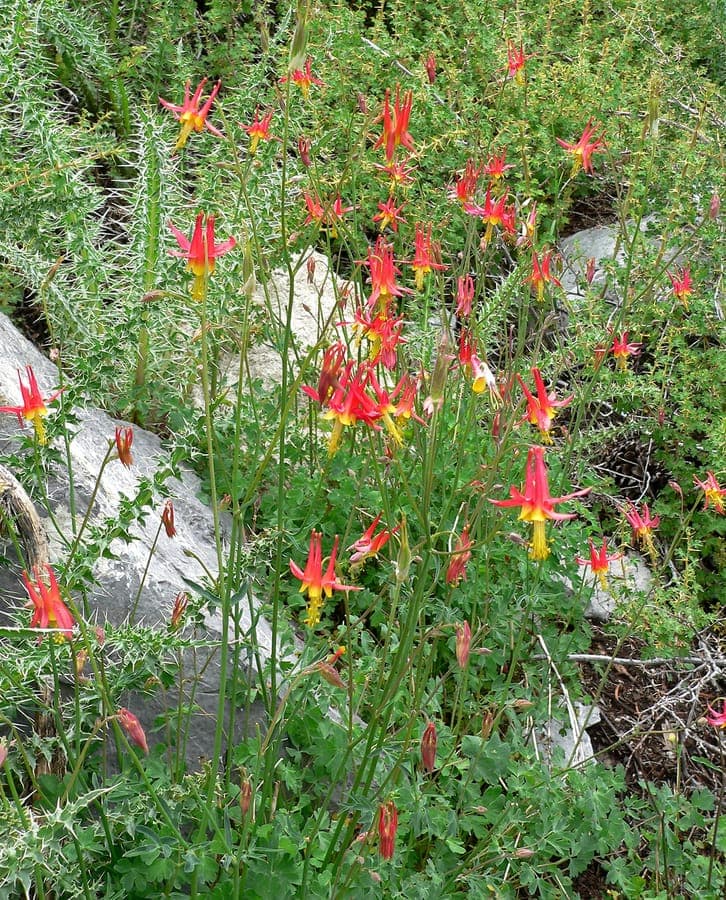
Stan Shebs / CC BY-SA 3.0, via Wikimedia Commons
Western columbine: complete guide
Aquilegia shockleyi
Want to see Western columbine: complete guide in your garden?
1 minute, no credit card
Overview
Aquilegia shockleyi, known as western columbine or Mojave columbine, is a striking wildflower endemic to the warmer mountains of southeastern California and southern Nevada. This diminutive perennial is treasured by native plant specialists and beloved by hummingbirds alike.
This species is ideal for gardeners in arid and semi-arid regions seeking authentic desert flora. With minimal water and careful placement, this plant thrives for decades without intervention.
Appearance and bloom
Western columbine grows as a compact herbaceous plant 15-45 cm tall with finely dissected, blue-green foliage that is highly ornamental.
Flowers are long-spurred, brilliant crimson from April through May, sometimes repeating later in the season. The flower structure is complex: four petals surround elongated sepals with extended spurs containing nectar.
This architecture is perfectly adapted for hummingbird pollination. Each flower measures approximately 4-5 cm in length including the spur. Flowers arise on slender stems above the foliage, making them highly visible.
Following bloom, the plant produces seed capsules containing numerous tiny seeds dispersed by wind and gravity.
Ideal location
Western columbine thrives in full sun to light shade, requiring 4-6 hours of direct daily sunlight. In extremely hot regions (exceeding 35 degrees Celsius in summer), the plant appreciates afternoon shade.
This species naturally grows on rocky slopes and in arroyos with exceptional drainage. Plant this species in rock gardens, scree slopes, green roofs, or other exceptionally well-drained locations.
The plant fails in low, wet areas or regions with poor groundwater drainage.
Soil
Western columbine is quite particular about soil. The plant grows best in rocky, well-draining, mineral-rich substrate with minimal organic matter.
In its native desert habitat, columbine grows in weathered rock soil with pH around 6.5-7.5. The species tolerates saline soils reasonably well.
Avoid heavy clay soils or soils high in organic matter. Add gravel, sand, or inert rock chips to enhance drainage.
Free design
Want to see Western columbine: complete guide in your garden? Make a free design now.
Watering
Once established, western columbine is exceptionally drought-tolerant. Water regularly during the first growing season (6-8 weeks), but sparingly - only when the top 5 cm of soil becomes completely dry.
Once roots penetrate deeply, this plant requires no supplemental watering in regions receiving minimum 250 mm annual precipitation. In very arid areas, irrigation may be needed in July-August.
Never overwater - root rot diseases develop rapidly in perpetually moist soil.
Pruning
Pruning needs are minimal. Leave dead flower structures until they brown - they assist seed dispersal. Remove dead or damaged foliage gently.
In late January or February, cut all dead foliage close to ground. Avoid cutting green tissue.
Maintenance calendar
January-February: Cut back dead foliage March-April: Begin regular watering for young plants May: Enjoy full bloom, hummingbirds visit June-July: Bloom fading, seed ripening August-September: Minimal watering, seed dispersal October-December: Dormancy period, no watering
Winter hardiness
Western columbine is very hardy in southern zones (USDA zones 4-9), though the plant enters semi-dormancy in cold winters.
The species tolerates frosts to -15 degrees Celsius without difficulty. Snow does not damage this plant, particularly since the plant body grows so low.
Companion plants
Western columbine combines beautifully with other desert wildflowers:
Eriogonum fasciculatum (California buckwheat) Lupinus sparsiflorus (annual lupine) Encelia farinosa (brittlebush) Salvia apiana (white sage) Ferocactus acanthodes (fire barrel cactus)
Together these create distinctive desert scenes with minimal water requirements.
Closing
Western columbine is a treasure for desert and semi-arid gardens. The plant requires no fertilizer, no watering once established, and no disease management. Plant this native beauty for hummingbirds and you'll enjoy red blooms on bare rock for years.
Want to see Western columbine: complete guide in your garden? Make a free design now.
Upload a photo, pick a style, and get a photorealistic design with plant list in under a minute.
No credit card required


Similar plants
Drummond's anemone: complete guide
Anemone drummondii
Discover Drummond's anemone (Anemone drummondii): a silvery-grey mountain plant for cool rock gardens and alpine troughs.
Korean clematis: complete guide
Clematis serratifolia
Clematis serratifolia is a hardy climber with fragrant yellow bell flowers in August-September. Pruning group 3, location and care tips.
Aquilegia brevistyla: complete guide
Aquilegia brevistyla
Discover Aquilegia brevistyla, the elegant North American columbine. Growing tips, shade tolerance, and design ideas for woodland and shadowed gardens.