
James St. John / CC BY 2.0, via Wikimedia Commons
Apios: complete guide
Apios americana
Want to see Apios: complete guide in your garden?
1 minute, no credit card
Overview
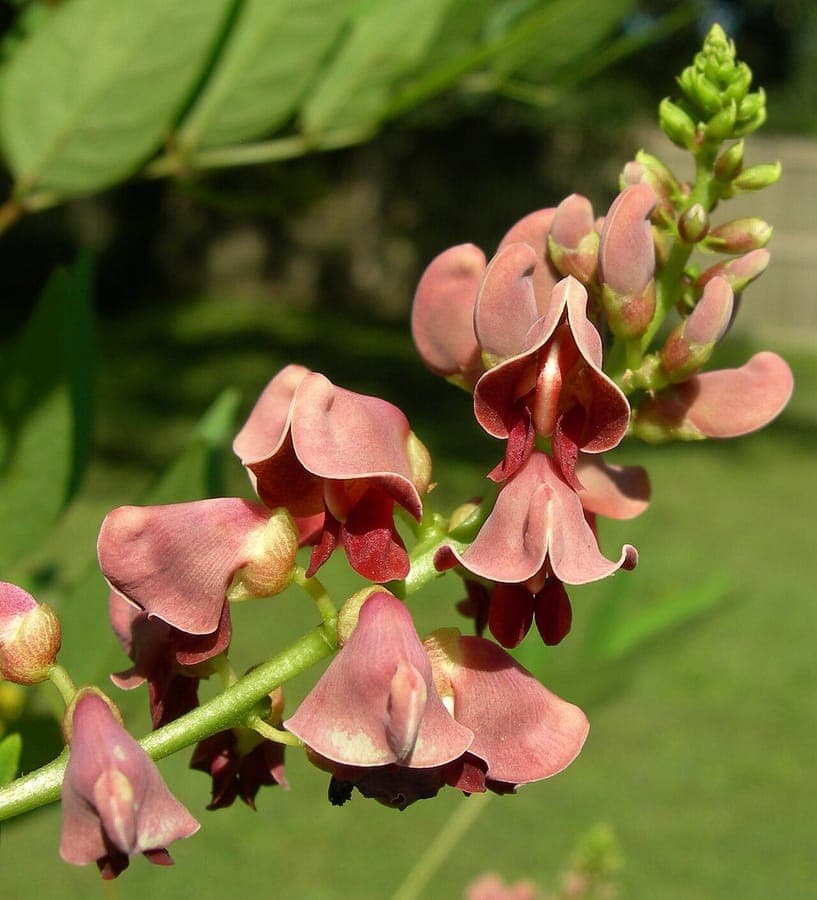
Apios americana, commonly known as Apios or American Groundnut, is a vigorous, herbaceous perennial vine in the Fabaceae family. Native to much of eastern and central North America-from Alabama up to Connecticut and westward into Iowa-this plant thrives in moist woodland edges, stream banks, and wet meadows. In the UK and northern Europe, it's still relatively unknown, but it's a powerhouse for sustainable gardens. The plant produces edible tubers along its roots that taste like a cross between potatoes and chestnuts, with a creamy texture and nutty depth. From mid-summer to early autumn, it bears clusters of rich purple, pea-like flowers that attract bees and butterflies. On gardenworld.app, you can design a layout that integrates this vine into vertical gardening schemes or companion plantings with other nitrogen-fixers.
Appearance & bloom cycle
Apios americana grows as a climbing vine, reaching 3 to 4 meters in a single season. It uses twining tendrils to climb supports like trellises, fences, or shrubs. The foliage is pinnately compound, with 5 to 7 oval leaflets, each 3 to 6 cm long, giving a lush, fern-like appearance. Between July and September, it produces dangling racemes of 5 to 10 purple-brown flowers, each about 1.5 cm long, with a distinct pea-flower shape. After pollination, slender seed pods up to 10 cm long may form, though they rarely set viable seed outside its native range. The real prize lies underground: clusters of knobby, brown-skinned tubers, 4 to 8 cm long, forming along the rhizomes. These develop fully by late September and can be harvested through early winter.
Ideal location
This vine prefers partial shade to full sun, ideally with morning sunlight and afternoon shade. An east- or northeast-facing wall or trellis works best. It needs a sturdy support structure-wooden posts, wire mesh, or a pergola-to climb. Avoid hot, dry south-facing spots unless soil moisture is consistently maintained. In cooler climates, a sunnier spot helps tuber development. Use gardenworld.app to simulate light patterns in your garden and find the perfect microclimate for Apios.
Soil requirements
Apios americana grows best in moist, loamy or clay-loam soils with good organic content. The ideal pH range is 6.0 to 7.5. While it tolerates average garden soil, amending with compost or well-rotted manure at planting time boosts both vine vigor and tuber yield. Avoid sandy soils unless heavily mulched, as they dry out too quickly. The tubers need loose, well-aerated soil to expand-compact or stony ground restricts their growth.
Free design
Want to see Apios: complete guide in your garden? Make a free design now.
Watering
Keep the soil consistently moist, especially from May through September. During dry spells, water deeply once or twice a week. Mulch with 5 cm of straw or leaf litter to retain moisture and suppress weeds. Overhead watering is fine, but avoid waterlogging, particularly in heavy clay soils, as this can lead to root rot.
Pruning
Minimal pruning is required. After the first hard frost in autumn, cut back the dead vines to 10–15 cm above ground level. This tidies the patch and reduces overwintering pests. Do not prune in spring, as new shoots emerge directly from the crown. Use clean, sharp secateurs to prevent disease transmission.
Maintenance calendar
- Jan: No action; plant dormant.
- Feb: Prepare planting beds; order tubers.
- Mar: Divide and plant tubers 5–8 cm deep, spaced 30 cm apart.
- Apr: Mulch lightly; monitor for sprouts.
- May: Water weekly if dry; install supports.
- Jun: Guide young vines onto trellis; check for pests.
- Jul: Flowers appear; maintain consistent moisture.
- Aug: Tuber formation peaks; avoid drought stress.
- Sep: Flowers fade; pods may form.
- Oct: Vines die back; cut to ground.
- Nov: Apply mulch for winter insulation.
- Dec: Dormant; no care needed.
Winter hardiness
Apios americana is hardy to USDA zone 4 (-34°C). In the UK and most of Europe, it survives winter without protection, especially when mulched. The top growth dies back, but the tubers remain viable underground and resprout in April or May. In areas with fluctuating winter temperatures, a thick mulch layer prevents frost heaving.
Companion plants
Plant Apios with moisture-loving perennials like Joe-Pye weed (Eutrochium maculatum), cardinal flower (Lobelia cardinalis), or native sedges (Carex spp.). As a nitrogen-fixer, it benefits nearby heavy feeders like squash or corn. Avoid invasive groundcovers or aggressive spreaders. In forest gardens, it pairs well under open-canopy trees such as alder or birch.
Closing
Apios americana is a resilient, productive plant that deserves a spot in more gardens. It offers edible tubers, attractive blooms, and ecological benefits with little maintenance. Tubers can be roasted, boiled, or added to stews-harvest from October to March. You can source Apios tubers from garden centres or online nurseries in the UK and Europe, or try local permaculture suppliers. Look for it at garden centres like those in the OBI or Hornbach network, or explore specialty growers. Whether you're expanding your edible garden or designing a wildlife-friendly space, Apios americana is a smart, long-term investment.
Want to see Apios: complete guide in your garden? Make a free design now.
Upload a photo, pick a style, and get a photorealistic design with plant list in under a minute.
No credit card required


Similar plants
Tall Silky Lupine: complete guide
Lupinus elatus
Tall silky lupine is a fast-growing Californian perennial with silvery foliage and blue-purple flower spikes, ideal for a prairie-style garden.
Garfield Lupine: complete guide
Lupinus garfieldensis
The Garfield lupine is a rare, fast-growing American perennial for alkaline, dry grassland gardens, with striking blue flower spikes.
Lupinus elegans: complete guide
Lupinus elegans
Lupinus elegans, the elegant lupine, is a spectacular blooming plant from Mexico with blue flower spikes. Care, cultivation and garden use.