
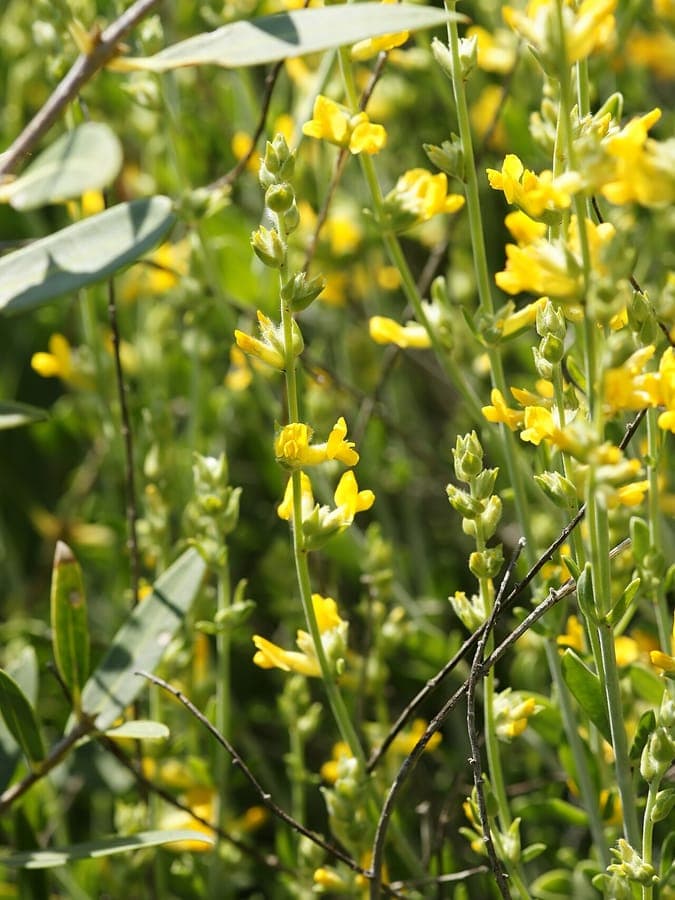
Hans Hillewaert / CC BY-SA 3.0, via Wikimedia Commons
Anthyllis cytisoides: complete guide
Anthyllis cytisoides
Want to see Anthyllis cytisoides: complete guide in your garden?
1 minute, no credit card
Anthyllis cytisoides, commonly known as albaida or broom-like kidney-vetch, is a handsome, frost-hardy shrub from the Fabaceae family. Native to the Mediterranean region, particularly southern Spain, Balearic Islands, southern France and North Africa (Morocco, Algeria), this plant flourishes naturally on dry, calcareous slopes and rocky terrain. It is an excellent choice for warm, dry gardens, delivering a compact silhouette with vivid yellow flowers throughout the season.
Overview
Anthyllis cytisoides is a semi-woody, compact shrub reaching 60 to 120 centimetres in height, occasionally taller in favourable years. Growth is slow to moderate, developing an upright, stiffly branched silhouette. Foliage is compound, grey-green to silvery-grey, rendering the plant attractive even without flowers. From May to June (sometimes longer), brilliant yellow, globular flower clusters crown the branch tips. These blooms are highly attractive to bees and other pollinators. After flowering, minute legume pods form. The plant is exceptionally drought-tolerant and frost-hardy to approximately -12 degrees Celsius in well-draining soil.
Appearance and bloom
Anthyllis cytisoides flowers are compact yellow spheres approximately 1-1.5 centimetres in diameter, highly conspicuous against grey-green foliage. They appear in dense clusters at branch terminals. The flowering season extends from May through June, occasionally longer in favourable years. The plant flowers abundantly, providing weeks of full yellow blooming. After flowering, spent flowers, seed pods and branched structure remain attractive through autumn. Over multiple seasons, the plant assumes a voluminous, regular silhouette, highly sculptural in character.
Ideal location
Position Anthyllis cytisoides in full sun; this plant requires minimally 7-8 hours of direct sunlight daily for optimal growth and flowering. Growth occurs in light shade but flowering is less profuse. Ensure open, ventilated locations with good air circulation. This prevents wind scorch and promotes sturdy development. Avoid dense, warm corners or sheltered spots where heat and humidity stagnate. This is a plant for hot, dry, sunny gardens in Mediterranean climates or protected, sunny locations in temperate regions.
Soil preparation
Anthyllis cytisoides is extremely undemanding regarding soil chemistry and flourishes on calcareous, dry substrates. It strongly prefers pH 7.5-8.0 (alkaline to highly alkaline). Well-draining, lean to moderately fertile soils are ideal. Sand, gravel and lime are welcomed. In very heavy clay, growth is compromised; incorporate sand and gravel (minimally 40% of the mixture). For container cultivation, use a mixture of garden soil, coarse sand and perlite or small stones in ratio 50:30:20. The plant tolerates waterlogged conditions poorly; perfect drainage is essential.
Free design
Want to see Anthyllis cytisoides: complete guide in your garden? Make a free design now.
Watering
Once established, Anthyllis cytisoides is exceptionally drought-tolerant and requires minimal watering. Water carefully the first 3-4 weeks after planting. Thereafter, water only when soil feels extremely dry, typically once per 2-3 weeks in dry periods or monthly during rainy seasons. The plant tolerates drought far superior to water excess. In warm summers, it thrives on rainfall alone without supplementary irrigation. For container cultivation, water very cautiously, typically weekly in hot, dry conditions. In winter, as growth ceases, scarcely water at all.
Pruning and maintenance
Minimal pruning required; the plant prefers retaining its natural form. After flowering (July), you may remove spent blooms for neatness, but this is unnecessary for next year's flowering. In late August, you may gently remove 10-15% of total length to encourage more compact growth. Heavy pruning is not recommended. Monitor for pests; generally highly resistant. Spider mites may occur under extremely dry conditions. Minimal feeding required; as a legume, it fixes nitrogen, so fertilisation is nearly unnecessary.
Maintenance calendar
May-June: Sow seeds in cool, dry medium; seeds may be pre-soaked 24 hours in lukewarm water. June-July: Transplant seedlings into small pots when large enough to handle. August-September: Plant outdoors into garden or larger containers. October-April: Growing period; water very cautiously. May-June: Flowering; no feeding required thanks to nitrogen fixation. July-August: Cut back if necessary; remove spent flowers for neatness.
Winter hardiness
Anthyllis cytisoides is moderately frost-hardy, withstanding temperatures to approximately -12 degrees Celsius in USDA zones 8-9. In well-draining soil and dry winters, it may extend further to zones 7-8 (-15 degrees Celsius). In wet, cold climates, it perishes from moisture excess rather than cold itself. In very cold zones (3-6), grow it in containers relocated indoors for winter. The plant tolerates wet winters far worse than dry frost. In Mediterranean climates (zones 9-10) it grows year-round without any protection.
Companion planting
Anthyllis cytisoides combines beautifully with other Mediterranean, drought-tolerant plants. Position it with lavender, Rosmarinus, Santolina, other grey-foliaged specimens and dry-ground specialists. In rock gardens it fits perfectly. For colour contrast, place it before purple Salvia or white flowers of other Mediterranean plants. The compact, yellow blooming works well with silvery-grey foliage of companion shrubs. It is perfect for Mediterranean cottage gardens or xeriscaping schemes.
Closing remarks
Anthyllis cytisoides is for gardeners possessing warm, dry, sunny gardens who desire something robust flowering year after year without excessive fuss. Sow in May, plant in August, water minimally, prune lightly, and enjoy. This is not a plant for wet, cold regions, but for those with dry summers and well-drained soils, it is a genuine winner. Yellow blooming attracts pollinators and the entire plant is biologically fascinating.
Sources in UK: Visit local garden centres for seed or young plants. German suppliers (OBI, Hornbach) often have greater selection. Online seed merchants specialise in Mediterranean plants. A highly robust, reliable bloomer for dry, sunny locations!
Want to see Anthyllis cytisoides: complete guide in your garden? Make a free design now.
Upload a photo, pick a style, and get a photorealistic design with plant list in under a minute.
No credit card required


Similar plants
Tall Silky Lupine: complete guide
Lupinus elatus
Tall silky lupine is a fast-growing Californian perennial with silvery foliage and blue-purple flower spikes, ideal for a prairie-style garden.
Garfield Lupine: complete guide
Lupinus garfieldensis
The Garfield lupine is a rare, fast-growing American perennial for alkaline, dry grassland gardens, with striking blue flower spikes.
Lupinus elegans: complete guide
Lupinus elegans
Lupinus elegans, the elegant lupine, is a spectacular blooming plant from Mexico with blue flower spikes. Care, cultivation and garden use.