
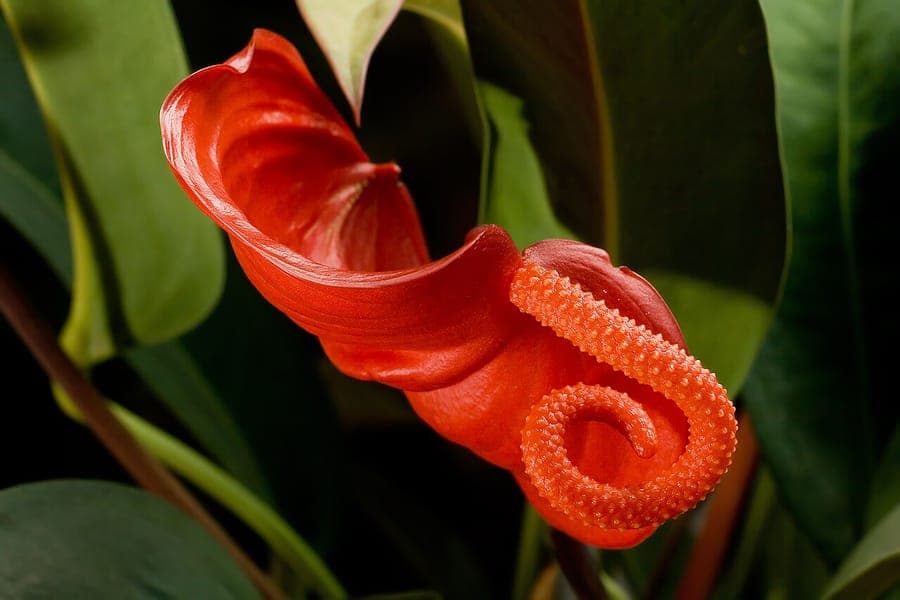
JJ Harrison (https://www.jjharrison.com.au/) / CC BY-SA 3.0, via Wikimedia Commons
Flamingo flower: complete guide
Anthurium scherzerianum
Want to see Flamingo flower: complete guide in your garden?
1 minute, no credit card
Flamingo flower grows best in airy, light potting soil formulated for houseplants or bromeliads, or you can make your own mix from equal parts peat, perlite, and bark. Good drainage is essential; the plant tolerates waterlogging poorly and quickly develops root rot. Water when the top centimeter feels dry, usually once weekly during active growth and less frequently in winter. Ensure water drains freely and never leave the pot sitting in water. Shower the leaves monthly to remove dust and maintain humidity levels. The plant loves humid conditions, so place in a steamy bathroom or set on a tray filled with moist pebbles with the pot standing above the water level. Feeding: fertilize at half strength during the growing season (April to October) every two to three weeks with liquid fertilizer. A potassium-rich formula encourages more flowers. In winter, reduce feeding substantially as growth slows. Temperature is important: flamingo flower thrives between 20-25 degrees Celsius and cannot tolerate temperatures below 13 degrees; sudden temperature fluctuations cause leaf wilting. Keep the plant away from cold drafts and radiators. Expansion is slow, typically requiring two to four years to form large specimens. Division is possible in spring when the plant has at least two well-developed shoots. Use a sterile knife or spade and ensure each fragment carries at least two growth points and strong roots. Pot onto prepared soil and keep very moist in the first weeks. The plant remains relatively pest-free if healthy conditions are maintained, though spider mites and mealybugs sometimes occur in very dry environments; spray weekly with water if pest signs become visible.
Want to see Flamingo flower: complete guide in your garden? Make a free design now.
Upload a photo, pick a style, and get a photorealistic design with plant list in under a minute.
No credit card required


Similar plants
Arrowhead vine: complete guide
Syngonium auritum
Everything about Syngonium auritum, the tropical five-fingers houseplant. Care, location, watering, and pruning explained clearly for beginners and enthusiasts.
Minute duckweed: complete guide to Lemna perpusilla
Lemna perpusilla
Everything about Lemna perpusilla, the minute duckweed: ecology, pond management, water quality and care in garden water features.
Dead horse arum lily: complete guide
Helicodiceros muscivorus
Everything about the dead horse arum lily (Helicodiceros muscivorus): growing conditions, spectacular bloom, thermogenesis, and care for this Mediterranean aroid.