
Wikimedia Commons / Public domain, via Wikimedia Commons
Holy-grass: complete guide
Anthoxanthum nitens
Want to see Holy-grass: complete guide in your garden?
1 minute, no credit card
Overview
Holy-grass, or Anthoxanthum nitens, is a perennial grass species that brings subtle charm and sweet fragrance to gardens. Native to damp meadows across temperate regions - from Alaska to Austria - it thrives where moisture meets poor soil. Unlike flashy ornamentals, it doesn't shout for attention. Instead, it whispers, with slender blades and vanilla-scented flowers that emerge in late spring. It's a go-to for naturalistic planting schemes and wildlife gardens. On gardenworld.app, you can design a low-maintenance garden layout that positions holy-grass where moisture collects, avoiding dry patches and competition from greedy neighbours.
Appearance & bloom cycle
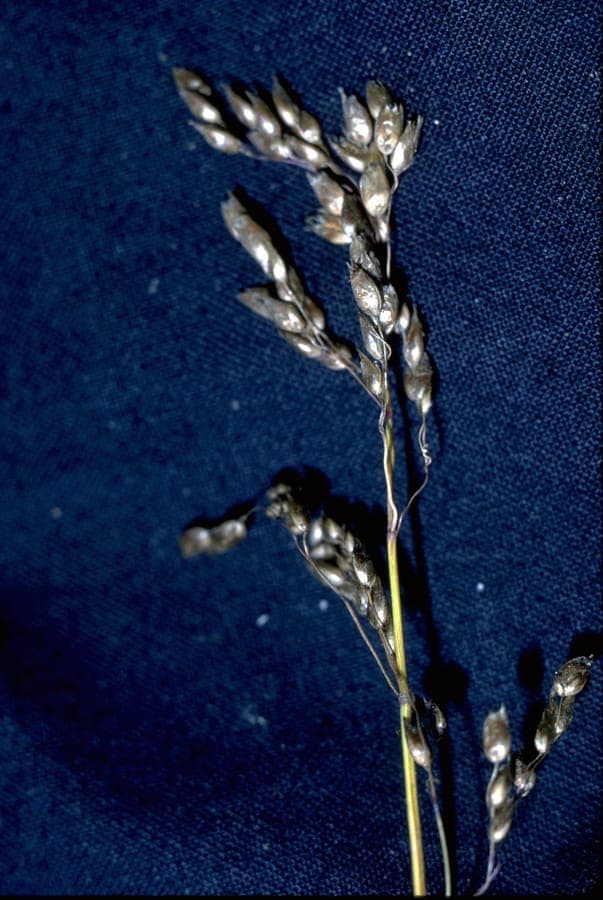
This graminoid grows in tight clumps, reaching 25–50 cm in height. The leaves are narrow, bright green, and slightly glossy - a trait reflected in its species name nitens. From April to June, delicate golden-yellow spikelets rise just above the foliage. When crushed or warmed by the sun, both leaves and flowers release a distinct vanilla-like aroma, thanks to coumarin. The scent intensifies when the grass is dried, which is why it was traditionally bundled into hay or used in potpourri. It doesn't produce flashy displays, but its presence is felt through scent and texture.
Ideal location
Plant holy-grass in full sun to partial shade. It performs best with at least 5–6 hours of direct light daily. While it tolerates light shade, especially under open-canopy trees, it won't thrive in deep shade or under dense root competition. It loves damp areas - think pond margins, bog gardens, or low-lying spots that stay moist. Avoid placing it in hot, dry borders. Use gardenworld.app to simulate light patterns in your garden and find the perfect microclimate for your holy-grass before planting.
Soil requirements
The soil should be consistently moist but well-drained. It prefers acidic to neutral pH (4.5–6.8) and does well in peat, loam, or clay-loam soils. Avoid overly fertile or sandy soils - this grass prefers nutrient-poor conditions. If your soil drains too quickly, mix in some organic matter like leaf mould or well-rotted compost to improve water retention. Don't fertilize heavily; holy-grass grows slower and may flop over if overfed.
Watering
Keep the soil moist through the growing season, especially during dry spells in spring. Once established, it can endure short dry periods, but prolonged drought causes the clumps to thin out. Water deeply once a week during dry weeks, using rainwater if possible. Tap water with high lime content can alter soil pH over time, which may affect growth. A moisture meter helps monitor root zone conditions without guesswork.
Free design
Want to see Holy-grass: complete guide in your garden? Make a free design now.
Pruning
No pruning is needed during the growing season. However, in late winter or early spring (February–March), cut back old foliage to 5–10 cm above ground level. This clears space for new growth and prevents the clump from becoming too dense. Use clean shears to avoid disease transfer. If you want to preserve the scent, hang small bundles upside-down in a dark, dry room for 1–2 weeks to dry.
Maintenance calendar
- Jan: Check clumps for frost heave, gently press down if lifted
- Feb: Cut back old growth, prepare soil around plants
- Mar: Monitor new shoots, no fertiliser needed
- Apr: Spikelets begin to form, maintain moisture
- May: Peak bloom and fragrance, avoid disturbing
- Jun: Flowering ends, watch for self-seeding in damp spots
- Jul: Dormant phase, no action required
- Aug: Divide overcrowded clumps if needed
- Sep: Collect seeds for propagation in moist areas
- Oct: Leave seed heads for winter interest and bird food
- Nov: Mulch lightly with leaf litter to protect roots
- Dec: No maintenance, let clumps rest
Winter hardiness
Holy-grass is hardy in USDA zones 4–8. It survives temperatures down to -34°C with no protection. The foliage turns tan or beige in winter, providing subtle visual interest. Ensure the crown isn't sitting in waterlogged soil, as this may cause crown rot. A thin layer of leaf mulch helps insulate without smothering.
Companion plants
Pair holy-grass with moisture-loving companions like tussock sedge (Carex elata), marsh marigold (Caltha palustris), or blue flag iris (Iris versicolor). In wilder gardens, it blends well with wood anemone (Anemone nemorosa) or creeping jenny (Lysimachia nummularia). Avoid pairing with aggressive spreaders like bamboo or mint. The vanilla scent contrasts beautifully with the sharp aroma of wild mint (Mentha arvensis), which can be planted nearby but contained.
Closing
Holy-grass is a quiet achiever - unsung, but deeply rewarding. It asks for little and returns scent, texture, and ecological value. You'll find it at garden centres across the US and UK, especially those specialising in native or habitat plants. Look for it at spring plant sales or order online from specialist nurseries. And remember: on gardenworld.app, you can create a garden plan that respects the natural rhythm of holy-grass, from bloom time to winter dormancy.
Want to see Holy-grass: complete guide in your garden? Make a free design now.
Upload a photo, pick a style, and get a photorealistic design with plant list in under a minute.
No credit card required


Similar plants
Sporobolus pungens: complete guide
Sporobolus pungens
Sporobolus pungens is a stoloniferous Mediterranean coastal grass with outstanding salt and drought tolerance, perfect for seaside and dry gardens.
Mediterranean aegilops: complete guide
Aegilops biuncialis
Everything about Aegilops biuncialis, a Mediterranean annual grass with ornamental spikes and outstanding drought tolerance for dry gardens.
Silver bluestem: complete guide
Bothriochloa saccharoides
Full guide to Bothriochloa saccharoides (silver bluestem): site, soil, watering, winter hardiness, pruning, and garden companions.