
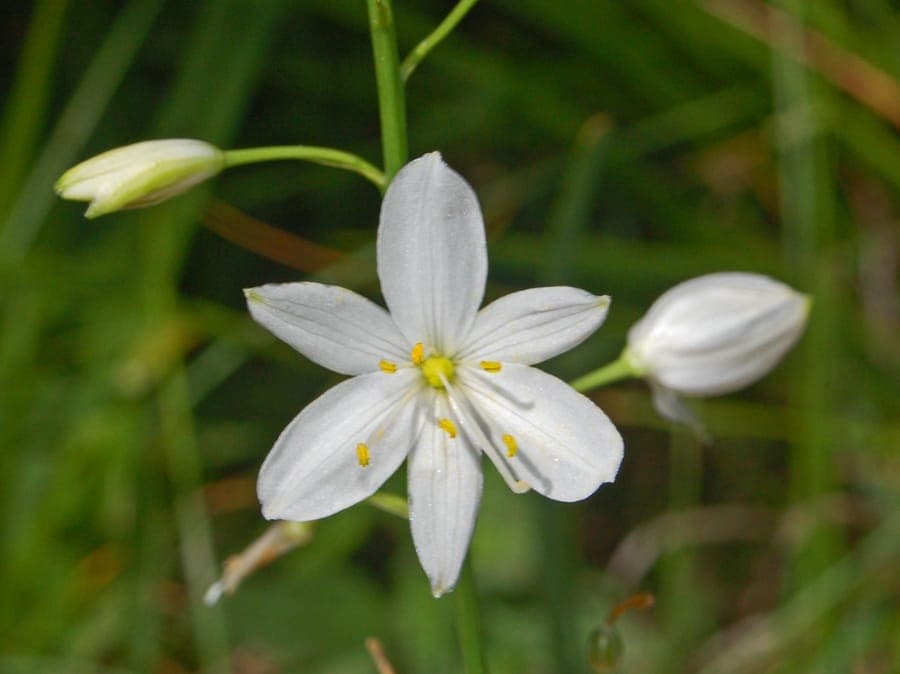
Hectonichus / CC BY-SA 3.0, via Wikimedia Commons
Branched st. bernard's-lily: complete guide
Anthericum ramosum
Want to see Branched st. bernard's-lily: complete guide in your garden?
1 minute, no credit card
Overview
Anthericum ramosum, commonly known as branched st. bernard's-lily, is a graceful perennial that brings quiet elegance to woodland edges, dry slopes, and naturalistic garden designs. Native to central and eastern Europe-found in countries like Austria, Germany, Poland, and the Baltic states-this member of the Asparagaceae family thrives in conditions that mimic its natural habitat. On gardenworld.app, you can design a planting scheme that incorporates this plant into low-maintenance, ecologically sound gardens.
Though not a common sight in typical suburban gardens, its understated beauty appeals to gardeners who favour native, resilient plants. It grows 40–60 cm tall with a spread of about 30 cm, forming clumps of narrow, blue-green foliage. The plant is fully hardy down to USDA zone 4, making it suitable for most temperate climates, including the UK and large parts of North America.
Appearance & bloom cycle
The branched st. bernard's-lily sends up slender, multi-branched flowering stems in early summer. From June to August, clusters of small, star-shaped white flowers open along the upper stems. Each flower has six tepals and a faint, sweet fragrance noticeable in the evening. The branching pattern gives the plant its common name and creates a delicate, airy effect above the grassy foliage.
After blooming, seed capsules develop and split open in autumn, releasing small black seeds. This natural reseeding allows the plant to slowly colonise suitable spots, especially in open woodland or meadow-style plantings. The leaves remain semi-evergreen in mild winters, providing some winter interest.
Ideal location
This plant prefers partial shade to light shade-around a 6 on the 1–10 light scale. While it can tolerate full sun in cooler climates, it performs best with protection from intense afternoon sun, especially in dry soils. An ideal spot is under light-canopy trees like birch or hazel, or at the back of a mixed border with tall grasses.
It's perfect for naturalistic plantings, wild gardens, or even gravel gardens with good drainage. Consider pairing it with shade-tolerant perennials like epimedium, heuchera, or astrantia. On gardenworld.app, you can visualise how these combinations work together in your garden space before planting.
Soil requirements
Anthericum ramosum likes well-drained, neutral to slightly alkaline soil with a pH between 7.0 and 7.5. It doesn't demand rich soil-average to poor fertility is fine. Avoid heavy clay or waterlogged conditions, which can lead to root rot. If your soil is too acidic, a light application of garden lime can help, but don't overdo it.
In cultivation, amend heavy soils with grit or horticultural sand. A mix of topsoil, sand, and a little compost supports healthy growth without encouraging excessive leafiness at the expense of flowering.
Free design
Want to see Branched st. bernard's-lily: complete guide in your garden? Make a free design now.
Watering
Once established, this plant is drought-tolerant and rarely needs supplemental watering. Young plants, however, require consistent moisture during their first growing season. Water deeply once a week during dry spells, using about 1 litre per plant.
Avoid overhead watering, as wet foliage can promote fungal diseases. Water at the base, early in the morning, to allow any splashed leaves to dry quickly. In rainy summers, no additional watering is needed.
Pruning
Pruning is minimal. After flowering finishes in late summer, cut back the spent flower stems to the base. Leave the basal foliage intact-it continues to photosynthesise and helps the plant store energy for next year.
If you're trying to limit self-seeding, remove flower heads before they set seed. This won't harm the plant and keeps the garden looking tidy.
Maintenance calendar
- March/April: Clear away old foliage if it's damaged. Watch for new shoots emerging.
- May: Apply a light top dressing of compost if desired. Prepare for blooming.
- June–August: Peak bloom period. Water young plants in prolonged dry spells.
- September: Cut back flower stems. Monitor for seed dispersal.
- October–November: Leave foliage in place. No feeding required.
- December–February: Dormant period. No maintenance needed.
Winter hardiness
Hardy to USDA zone 4 (-34°C to -29°C), Anthericum ramosum handles cold winters well. In milder zones (7–9), the foliage may remain green through winter. In colder areas, it dies back but returns reliably each spring.
The main threat in winter is not cold, but wet soil. Ensure good drainage, especially in regions with heavy winter rainfall. Raised beds or sloped areas are ideal for preventing waterlogging.
Companion plants
This lily works well with plants that share its preference for dappled light and well-drained soil. Try pairing it with:
- Geranium macrorrhizum – for aromatic, ground-covering foliage
- Euphorbia amygdaloides var. robbiae – for bold texture and early greenery
- Melica altissima – an ornamental grass with soft seed heads
- Digitalis purpurea – for vertical contrast and pollinator appeal
You can find Anthericum ramosum and its companions at garden centres across the UK and North America, especially those specialising in native or woodland plants.
Closing
The branched st. bernard's-lily isn't flashy, but it's a quietly confident performer. Its airy blooms, low water needs, and resilience make it a smart choice for gardeners seeking elegance without excess. Use it to soften edges, add movement, or support biodiversity in naturalistic designs. Let it grow where it likes-give it space, and it'll reward you with years of subtle beauty.
Want to see Branched st. bernard's-lily: complete guide in your garden? Make a free design now.
Upload a photo, pick a style, and get a photorealistic design with plant list in under a minute.
No credit card required


Similar plants
Narrow-leaved dracaena: complete guide
Dracaena angustifolia
Everything about Dracaena angustifolia - the narrow-leaved dracaena: location, care, overwintering and use as a houseplant or patio plant.
Chaparral yucca: complete guide to Hesperoyucca whipplei
Hesperoyucca whipplei
Hesperoyucca whipplei (Our Lord's candle) is a dramatic rosette-forming plant from California that produces a towering flower spike, ideal for dry and gravel gardens.
False lily-of-the-valley: complete guide
Maianthemum dilatatum
Everything about Maianthemum dilatatum, the false lily-of-the-valley. Care, shade location, propagation and garden combinations for this popular shade ground cover.