
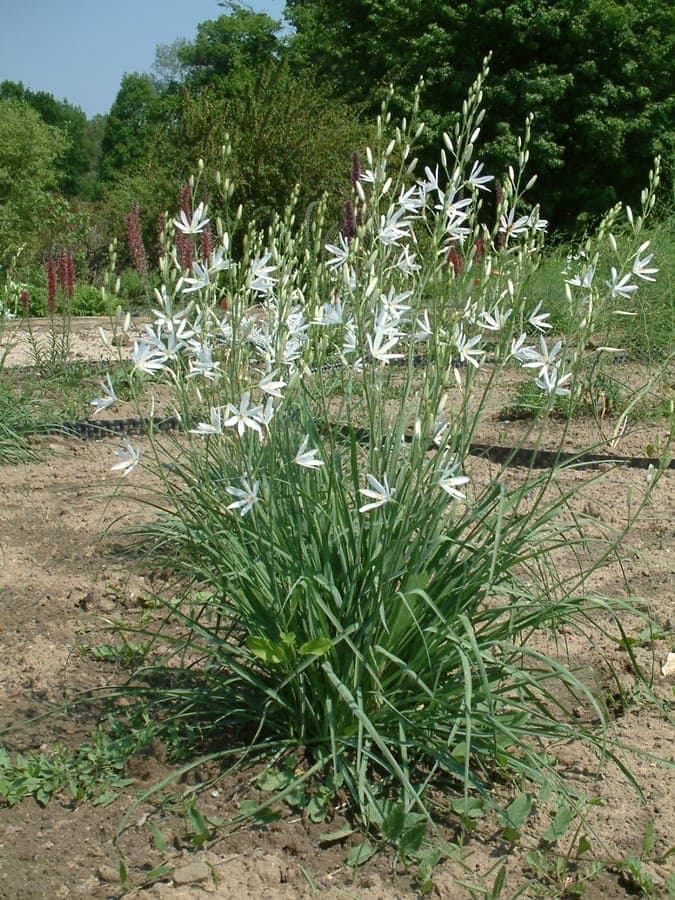
Wikimedia Commons / CC BY-SA 3.0, via Wikimedia Commons
St. bernard's lily: complete guide
Anthericum liliago
Want to see St. bernard's lily: complete guide in your garden?
1 minute, no credit card
Overview
Anthericum liliago, commonly known as St. Bernard's lily, is a refined perennial that brings quiet elegance to shaded garden corners. Native to central and southern Europe, this member of the Asparagaceae family thrives in woodland edges, gentle slopes and partially shaded meadows across countries like Hungary, Austria and Greece. In temperate gardens, it's a reliable performer that returns year after year with minimal fuss.
What sets this plant apart is its effortless charm and resilience. It spreads slowly by rhizomes, forming neat clumps without becoming invasive. The slender, grass-like foliage creates a soft backdrop, while the upright white blooms add vertical interest. If you're designing a naturalistic planting scheme, gardenworld.app offers tools to map out how St. Bernard's lily fits into your garden's rhythm and texture.
Appearance & bloom cycle
From May through July, you'll see slender stems rise to 40–50 cm above the foliage, each tipped with airy clusters of pure white flowers. Each bloom is about 3 cm across, with six gracefully reflexed tepals that resemble miniature lilies. The flowers open progressively from the base upward, giving the inflorescence a long-lasting display.
The blooming period can extend six weeks under good conditions. After flowering, small rounded seed pods form, adding visual interest into late summer. The evergreen to semi-evergreen leaves stay tidy throughout the year, reaching 30–40 cm in height and slowly expanding the clump over time.
Ideal location
St. Bernard's lily prefers light shade to partial shade. It does best under deciduous trees, along north-facing walls, or in borders that receive morning sun but are shaded from the hot afternoon rays. In full sun, the plant may suffer from drought stress, especially in sandy soils.
Avoid deep, dense shade - the plant won't bloom well there. A spot with dappled light, such as beneath a hazel or birch tree, is ideal. If you're unsure whether your garden has enough filtered light, gardenworld.app has a sunlight planner that helps you place shade-loving plants like this lily with confidence.
Soil requirements
This plant thrives in well-drained, moderately moist soil with a neutral to slightly acidic pH (6.0–7.0). It tolerates clay if amended with compost, but performs best in loamy or humus-rich ground. In sandy soils, mix in organic matter to improve moisture retention.
Avoid waterlogged areas - Anthericum liliago is prone to root rot in persistently wet conditions, especially over winter. A small handful of coarse sand mixed into the planting hole improves drainage. No heavy fertilizing is needed; a light top-dressing of compost in spring is sufficient.
Free design
Want to see St. bernard's lily: complete guide in your garden? Make a free design now.
Watering
During active growth (April to August), water regularly during dry spells - aim for about 2.5 cm per week. Use rainwater when possible, as this plant can be sensitive to lime in tap water.
In winter, rainfall is usually enough. Only water during extended dry periods, especially if the ground is frozen and snow-covered. Overwatering is more harmful than underwatering, so let nature do the work once growth slows.
Pruning
St. Bernard's lily requires little pruning. After flowering, cut back spent flower stems to just above the base of the foliage. Leave the leaves intact - they photosynthesize all year and strengthen the plant for next season.
In early spring, remove any damaged or old leaves. Use sharp, clean shears to prevent disease. Never cut back the entire foliage - this weakens the plant and delays blooming.
Maintenance calendar
- February–March: Tidy up old leaves; apply a thin layer of compost around the base.
- April: Begin watering during dry spells. Loosen the soil surface gently.
- May–July: Peak bloom. Keep consistent moisture; deadhead if desired.
- August: Reduce watering. Allow seeds to develop or remove for neatness.
- September–December: Let the plant rest. No feeding or pruning needed.
- January: Check for winter damage. Avoid watering unless conditions are unusually dry.
Winter hardiness
Anthericum liliago is hardy down to USDA zone 5 (–20°C). In the UK and most of the US, it survives winters without protection. In areas with heavy snow or prolonged frost, a light mulch of leaves or straw helps, but isn't essential.
The real threat isn't cold - it's wet soil. Ensure good drainage to prevent crown rot. Raised beds or sloped areas are ideal in rainy regions.
Companion plants
Pair St. Bernard's lily with other shade-lovers like Helleborus, Epimedium or Lamium maculatum. Its upright form contrasts beautifully with low-growing ground covers.
It also works well with woodland perennials such as Anemone nemorosa, Geranium phaeum or Carex species. Avoid aggressive sun-lovers like Rudbeckia or Echinacea - they'll outcompete it in shade.
Closing
St. Bernard's lily is a graceful, dependable addition to any garden that values subtlety and structure. Its white blooms and tidy foliage bring a sense of calm to borders and woodland edges. It's perfect for gardeners who prefer plants that thrive with little intervention.
You can find Anthericum liliago at garden centres across the UK and US. Look for it in spring for the best establishment. Combine it with other shade-tolerant perennials, and use gardenworld.app to plan a cohesive layout that highlights its quiet beauty.
Want to see St. bernard's lily: complete guide in your garden? Make a free design now.
Upload a photo, pick a style, and get a photorealistic design with plant list in under a minute.
No credit card required


Similar plants
Narrow-leaved dracaena: complete guide
Dracaena angustifolia
Everything about Dracaena angustifolia - the narrow-leaved dracaena: location, care, overwintering and use as a houseplant or patio plant.
Chaparral yucca: complete guide to Hesperoyucca whipplei
Hesperoyucca whipplei
Hesperoyucca whipplei (Our Lord's candle) is a dramatic rosette-forming plant from California that produces a towering flower spike, ideal for dry and gravel gardens.
False lily-of-the-valley: complete guide
Maianthemum dilatatum
Everything about Maianthemum dilatatum, the false lily-of-the-valley. Care, shade location, propagation and garden combinations for this popular shade ground cover.