
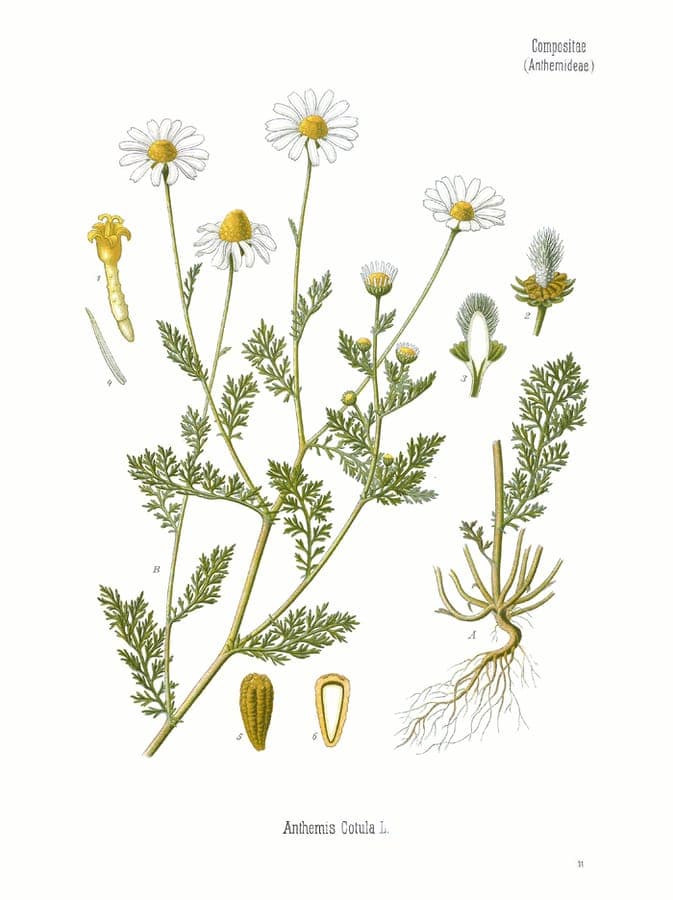
Köhler, F. E. (Franz Eugen) / Public domain, via Wikimedia Commons
Foetid chamomile: complete guide
Anthemis cotula
Want to see Foetid chamomile: complete guide in your garden?
1 minute, no credit card
Overview
Foetid chamomile (Anthemis cotula) is an annual herb in the Asteraceae family, often mistaken for true chamomile at first glance. But scratch the leaves and you'll quickly know the difference - this plant emits a foul, acrid smell, like burnt rubber or rotten herbs. Native to southern and central Europe - including Albania, Austria, the Baltic States, and Belarus - it has naturalized across much of the northern hemisphere. You'll find it on roadsides, waste ground, and field margins, thriving where soil has been disturbed.
This isn't a plant for formal beds or patio containers. Its aggressive self-seeding and pungent odor make it a poor neighbor to more delicate species. That said, it has a role in wild gardens, restoration plots, or educational beds where low-maintenance, resilient plants are valued. On gardenworld.app, you can design a low-effort planting scheme that includes foetid chamomile as part of a dynamic, evolving ecosystem.
Appearance & bloom cycle
Foetid chamomile grows 30 to 60 cm tall with upright, branching stems and finely divided, fern-like foliage. The leaves are dark green, deeply cut, and covered in fine hairs that release the unpleasant odor when bruised. From June to September, it produces daisy-like flower heads: 1.5 to 2.5 cm wide, with white ray florets surrounding a dense, button-like yellow center.
Unlike true chamomile (Matricaria chamomilla), the central disk remains stiff and doesn't flatten as it matures. The blooming period is long, especially in dry, sunny locations. Because it self-seeds readily, new plants often pop up the following year - sometimes dozens from a single parent. Keep an eye on spread if you don't want it taking over.
Ideal location
Full sun is best - at least 6 hours of direct light daily. The plant thrives in open, dry areas like meadows, gravel beds, or along fence lines. It tolerates partial shade but becomes leggy and produces fewer blooms. Avoid planting near patios, pathways, or seating areas; the smell is strong enough to linger on clothing after brushing past.
It's best suited for wild corners of the garden, not manicured spaces. Think of it as a pioneer species - tough, fast-growing, and great for stabilizing poor soil. On gardenworld.app, you can map your garden's sun exposure and see exactly where this plant would perform best without disrupting your main growing areas.
Soil requirements
Anthemis cotula is not fussy. It grows in sandy, loamy, or even rocky soils with a pH from 5.5 to 7.5. It prefers well-drained, low-fertility ground - in fact, it outcompetes other plants on poor soils. Avoid heavy clay or waterlogged spots; these encourage root rot.
No fertilizer needed. Overfeeding may weaken the plant or increase lush growth that's more prone to disease. If you're introducing it intentionally, scatter seeds on bare soil in spring. It germinates quickly when soil temps hit 10–15°C.
Free design
Want to see Foetid chamomile: complete guide in your garden? Make a free design now.
Watering
Drought-tolerant once established. Water only during prolonged dry spells in the first 4–6 weeks after germination. After that, rely on natural rainfall. If watering is needed, apply 5–10 liters per m² once a week at most. Overhead watering isn't recommended - it can promote fungal issues on the foliage.
Pruning
No pruning needed for shape or health. However, deadheading spent flowers helps reduce reseeding. Cut back the entire plant in late autumn or early winter to ground level (leave 5 cm stubs). Wear gloves - the sap can irritate sensitive skin.
Maintenance calendar
- Jan: Dormant; check for overwintering debris
- Feb: No action required
- Mar: Soil warming; watch for early seedlings
- Apr: Remove unwanted seedlings; thin if overcrowded
- May: First blooms begin; water lightly if dry
- Jun: Peak flowering; inspect for pests
- Jul: Continue bloom; deadhead to limit spread
- Aug: Seeds mature; prepare for self-seeding
- Sep: Final blooms; monitor seed dispersal
- Oct: Cut back stems; clear plant residue
- Nov: Keep area free of leaf litter to prevent mold
- Dec: Full dormancy
Winter hardiness
As an annual, foetid chamomile doesn't survive winter as a living plant. However, its seeds overwinter in the soil and germinate in spring when temperatures rise above 10°C. It performs well in USDA hardiness zones 5 through 9, acting as a winter-annual in milder climates where seeds may germinate in autumn.
Companion plants
Avoid pairing with herbs or delicate perennials - the smell can overwhelm them. Instead, grow it alongside tough, weedy species like yarrow (Achillea millefolium), stinging nettle (Urtica dioica), or knapweed (Centaurea nigra). These combinations work in wild meadow settings. Note: it doesn't attract bees, but may draw hoverflies or small flies.
Closing
Foetid chamomile is not a garden favorite - and for good reason. Its smell, aggressive spread, and weedy nature keep it out of most curated spaces. But in the right context - a restoration project, a teaching garden, or a low-input landscape - it has value. If you're determined to grow it, do so with caution: monitor seedlings, avoid high-traffic zones, and keep it contained. Seeds or transplants can be found at general garden centres in Europe, but check labels carefully - it's often sold by mistake as true chamomile. On gardenworld.app, you can create a custom maintenance plan that alerts you to reseeding windows and helps you manage its lifecycle year-round.
Want to see Foetid chamomile: complete guide in your garden? Make a free design now.
Upload a photo, pick a style, and get a photorealistic design with plant list in under a minute.
No credit card required


Similar plants
Calendula stellata: complete guide
Calendula stellata
Complete guide to Calendula stellata, the star-flowered marigold from Sicily: location, soil, watering and companion planting tips.
Korean chrysanthemum: complete guide
Chrysanthemum x rubellum
Chrysanthemum x rubellum is a hardy autumn perennial with single pink to copper flowers from August to November. Care and combinations.
Helianthus divaricatus: complete guide
Helianthus divaricatus
Helianthus divaricatus is a North American woodland sunflower with yellow summer blooms, ideal for naturalistic borders and shady edges.