
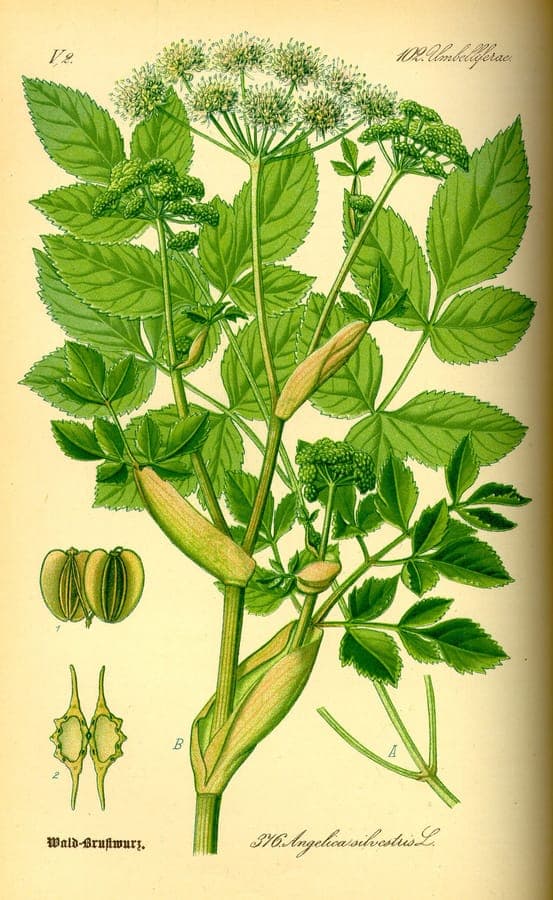
Wikimedia Commons / Public domain, via Wikimedia Commons
Wild angelica: complete guide
Angelica sylvestris
Want to see Wild angelica: complete guide in your garden?
1 minute, no credit card
Overview
Wild angelica (Angelica sylvestris) is a striking biennial herb that thrives in moist, shaded areas across Europe. If you've walked through damp woodlands or stream banks in the UK or northern Europe, you've likely seen this tall, architectural plant swaying in the breeze. It's not just for wild spaces-gardeners are increasingly turning to wild angelica for its bold presence and value to pollinators. At 120 to 200 cm tall, it adds vertical interest and movement to borders, especially in the second year when it blooms. On gardenworld.app, you can design a planting scheme that balances its height and spread with complementary foliage and bloom times.
This plant is often mistaken for its culinary relative, garden angelica (A. archangelica), but wild angelica has darker stems, more feathery foliage, and a looser, airier flower structure. It blooms from June to August and dies after seeding, typical of biennials. While it self-seeds readily, it's not invasive if managed-just deadhead the spent umbels to control spread.
Appearance & bloom cycle
In its first year, wild angelica forms a rosette of dark green, pinnate leaves up to 60 cm wide. The foliage has a fresh, aromatic scent when crushed. The stems are hollow, green to purple-tinged, and slightly hairy. In the second year, a central stalk shoots up to 1.8 m, topped with large compound umbels (15–25 cm across) of small greenish-white to pale pink flowers. These bloom from late June through August, attracting hoverflies, bees, and butterflies.
After flowering, the plant produces ribbed, dark brown fruits that disperse easily by water and wind. Each plant typically dies after setting seed, but new seedlings appear the following spring, ensuring a continuous presence if wanted.
Ideal location
Choose a spot with dappled shade to light shade-around a 5 on the light scale (1 = full sun, 10 = full shade). Wild angelica excels along pond edges, stream banks, or in low-lying areas of the garden that stay moist. It tolerates full sun only if the soil remains consistently damp. Avoid hot, dry borders.
It's perfect for wildlife gardens, cottage-style borders with a natural feel, or woodland plantings. For gardeners designing a damp, shaded corner, gardenworld.app offers visual tools to map out spacing and prevent overcrowding with other moisture-loving perennials.
Soil requirements
Wild angelica prefers rich, moisture-retentive loam or clay with a pH of 5.5 to 6.5. Avoid chalky or sandy soils-they dry out too quickly. If your soil is sandy, amend it with well-rotted compost or manure to improve water retention. The key is consistent moisture; drought stress, especially in the first year, can kill young plants.
Mulch annually with leaf mould or composted bark to maintain moisture and suppress weeds. Avoid lime-heavy soils-this plant dislikes high calcium levels.
Free design
Want to see Wild angelica: complete guide in your garden? Make a free design now.
Watering
Keep the soil evenly moist, particularly during dry spells in spring and early summer. Young plants need watering once a week if rainfall is below 25 mm. Use rainwater when possible, as tap water with high chlorine content can affect sensitive seedlings.
In wetland gardens or near water features, supplemental watering may not be needed. In raised beds or free-draining soils, monitor moisture weekly-stick your finger into the soil up to 10 cm to check.
Pruning
Deadhead spent flower umbels if you want to limit self-seeding. Otherwise, leave a few to encourage natural spread. Cut back dead stems in late autumn or early spring, but consider leaving them through winter for structure and to shelter overwintering insects.
Use clean, sharp secateurs and disinfect between cuts, especially if working near diseased plants.
Maintenance calendar
- Jan: No action
- Feb: Clear damaged stems, prepare for spring
- Mar: Mulch around base to protect new growth
- Apr: Watch for emerging seedlings
- May: Water regularly if dry
- Jun: Flowering begins, monitor for pests
- Jul: Peak bloom, maintain soil moisture
- Aug: Deadhead if controlling spread
- Sep: Remove dead stems, allow some seedlings
- Oct: Leave foliage for winter cover
- Nov: Apply mulch
- Dec: Dormant period
Winter hardiness
Wild angelica is hardy to USDA zone 5 (-20°C). Young rosettes may suffer in harsh winters without snow cover. A layer of mulch in November protects the crown. Mature plants survive well, and standing dead stems add winter interest.
Companion plants
Pair wild angelica with other moisture-loving species: Meadowsweet (Filipendula ulmaria), Joe-Pye weed (Eutrochium maculatum), Yellow loosestrife (Lysimachia vulgaris), and Bugbane (Actaea racemosa). In woodland gardens, combine with ferns, wild garlic (Allium ursinum), and native nettles for a layered, naturalistic effect.
Avoid pairing with drought-tolerant plants like lavender or sedum-they won't survive the same conditions.
Closing
Wild angelica isn't for low-maintenance, tidy gardens-it's a plant with attitude, spreading freely and commanding space. But if you garden for wildlife and love dynamic, evolving plantings, it's a gem. Its tall stems and airy blooms bring movement and life to shaded corners. You can find it at garden centres across the UK in spring, or grow it from seed. Be cautious not to confuse it with poisonous hemlock (Conium maculatum)-check the stem: wild angelica has purple mottling but lacks the hairless, spotted stems of hemlock. On gardenworld.app, you can design a planting scheme that balances its height and spread with complementary foliage and bloom times.
Want to see Wild angelica: complete guide in your garden? Make a free design now.
Upload a photo, pick a style, and get a photorealistic design with plant list in under a minute.
No credit card required


Similar plants
Whorled carrot: complete guide
Daucus involucratus
Daucus involucratus is a Mediterranean umbellifer with white flower heads framed by lacy bracts. Growing this gravel garden gem.
Daucus muricatus: complete guide
Daucus muricatus
Daucus muricatus, the spiny wild carrot, grows wild on Mediterranean coasts. Discover sowing, June-July bloom, and wildflower meadow use.
Daucus pumilus: complete guide
Daucus pumilus
Daucus pumilus is a dwarf wild carrot relative with white lacy umbels, thriving on dunes and coastal rock in poor, fast-draining soil.