JJ Harrison (https://www.jjharrison.com.au/) / CC BY-SA 3.0, via Wikimedia Commons
Chinese anemone: complete guide
Anemone hupehensis
Want to see Chinese anemone: complete guide in your garden?
Full design in HD: €7.99
Look after your Chinese anemone with the GardenWorld app
Identify plants with your camera and get a care calendar with reminders for this plant.


Overview
The Chinese anemone (Anemone hupehensis) is one of those perennials that brings a border back to life just as summer begins to fade. From late August, when many plantings look tired and parched, slender stems rise above the foliage and carry soft pink or white saucer-shaped flowers that keep coming well into October. It belongs to the buttercup family (Ranunculaceae) and grows wild in central and south-western China, on grassy slopes, woodland edges and in clearings among scrub.
This species is a parent of many of the Japanese anemones found in gardens. Crossed with Anemone vitifolia, it gave rise to the large group known as Anemone × hybrida, which includes classics such as 'Honorine Jobert'. The Chinese anemone itself usually stays a little shorter and neater than those hybrids, which makes it very useful in smaller gardens. Its variety var. japonica, grown in Japan for centuries, explains why the plant is often simply called Japanese anemone. Well-known cultivars include 'Hadspen Abundance' (deep pink with paler edges), 'Splendens' (warm pink), 'September Charm' (silvery pink) and 'Prinz Heinrich' (purplish pink, semi-double).
If you want a border that stays interesting from spring to autumn, you can have a garden design made on gardenworld.app in which Japanese anemones take over exactly when the summer flowers start to flag.
Appearance and bloom cycle
Anemone hupehensis forms a dense clump of coarsely divided, dark green leaves. The foliage stays fairly low, around 30 to 40 cm, and gives the border a fresh green filling from May onwards. During the summer, branched flower stems shoot up from the clump, usually reaching 60 to 90 cm in the species.
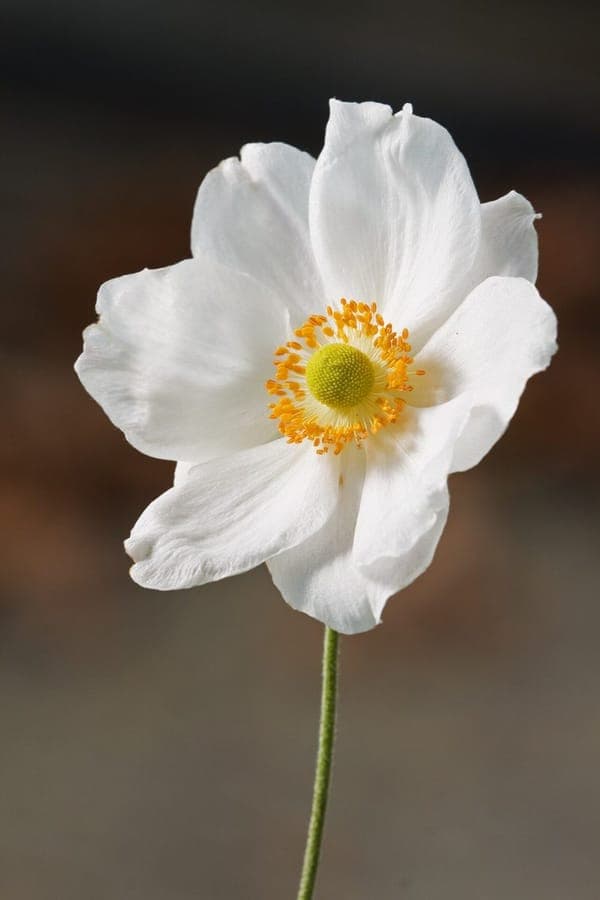
The flowers are simple in structure, and that is exactly where their charm lies. What look like petals are in fact coloured sepals: five or six in the single forms, a few more in semi-doubles. They measure 4 to 6 cm across, soft pink or white on the inside and often a darker shade on the back. At the centre sits a green knob surrounded by a ring of golden-yellow stamens. Bees and hoverflies visit them eagerly, which makes the plant a welcome late source of food for pollinators.
Flowering usually starts in mid-August and carries on until the first frost, often until the end of October. Afterwards, round seed heads form and burst into woolly tufts. Leave them standing: they give the border a silvery sheen well into November.
Ideal location
The Chinese anemone is a true plant for partial shade. It is happiest with morning sun and shade during the hottest hours of the day, for example on the east side of a house, along the edge of a shrub border or under the light canopy of a tree. It can also thrive in full sun, as long as the soil holds enough moisture.
Choose a position that is somewhat sheltered from strong wind. The tall stems are sturdy, but autumn gales can still knock over taller plants. Bear in mind its tendency to spread, too: Anemone hupehensis produces underground rhizomes and, once established, will steadily colonise a fair stretch of border. It is not regarded as invasive in the wild in Europe, but in the garden it can become dominant.
Space plants 40 to 50 cm apart. A group of three to five will look convincing within two seasons.
Soil requirements
Japanese anemones like a fertile, humus-rich soil that does not dry out in summer and does not become waterlogged in winter. An ordinary, well-cultivated garden soil enriched with some compost usually suits them perfectly. Loam and lighter clay are ideal, provided water can drain away. On heavy, wet clay the roots can rot in winter, so work in some coarse grit and leaf mould across the top 30 cm when planting.
They also grow on poor sandy soil, but there you will need to add plenty of compost or well-rotted manure at planting time and water more often in summer. Soil pH is not critical: anything from slightly acid to slightly alkaline (pH 6 to 7.5) is fine.
Free preview
Want to see Chinese anemone: complete guide in your garden? Make a free preview of your design.
Watering
In the first year after planting, the Chinese anemone needs regular watering. In dry spells give each plant a full watering can once a week so the water soaks deep into the ground. Do not worry if it does little in that first season: Japanese anemones are known as slow starters, but once their roots have settled, they are very hard to get rid of.
Established plants generally manage on rainfall alone. During prolonged drought in July and August, just as the buds are forming, extra watering pays off; too little moisture at that stage means fewer and smaller flowers. Water at the base of the plant, preferably in the morning, and keep the leaves dry to limit powdery mildew. No watering is needed in winter.
Pruning
Pruning in the usual sense is not needed. During flowering you can snip off faded blooms if you want a tidy look, although the plant carries on flowering without your help.
After flowering, it is best to leave the stems and seed heads standing until late winter. In late February or early March, cut everything down to just above ground level, before the new leaves appear. Wear gloves: like many members of the buttercup family, Anemone hupehensis contains compounds that can irritate the skin and are harmful if eaten by people or pets. Keep young children and rabbits or guinea pigs away from the leaves.
To propagate the plant or keep it in check, slice off a section of the clump with a sharp spade in spring.
Maintenance calendar
February-March: Cut old stems back to the ground. Remove dead leaves and weeds around the clump.
April: Spread a layer of compost or leaf mould. A good time to plant or to divide an oversized clump.
May-June: The foliage fills out. Keep young plants moist and give a little organic feed if needed.
July: Flower stems shoot up. Water during dry spells. Dig out unwanted runners at the edge of the clump.
August-October: Peak flowering. Deadhead if you like. The plant calendar on gardenworld.app shows what else is in flower at that moment and which border jobs are waiting.
November-January: Leave stems and seed heads in place. Protect young plants in their first winter with a layer of leaves.
Winter hardiness
The Chinese anemone is fully hardy across the UK and the Low Countries. Established plants cope with temperatures down to around -20 °C without trouble. The top growth dies back in autumn; the rhizomes overwinter safely in the soil and push up new leaves in April.
The only real risk is wet, compacted soil combined with hard frost, so good drainage matters more than any winter cover. In the first winter after planting, especially if you planted late in autumn, a layer of dry leaves or a few conifer branches over the crown is a sensible precaution. Plants in containers are more vulnerable; move them against a wall during long cold spells.
Companion plants
Japanese anemones are ideal partners for plants that peak in late summer. Combine them with New England asters (Symphyotrichum novae-angliae) for a purple and pink autumn scene, or with ice plant (Hylotelephium spectabile) for a contrast between the airy anemones and the flat, fleshy flower heads. Ornamental grasses such as Chinese silver grass (Miscanthus sinensis) or fountain grass add structure and move beautifully in the breeze.
In partial shade they work well next to hostas (Hosta sieboldiana), ferns and Japanese forest grass. The broad hosta leaves form a calm backdrop in summer, after which the anemones take over in autumn. Panicle hydrangea (Hydrangea paniculata) is a classic match: its white or pink cones flower at the same time and create a romantic picture. Avoid planting it right next to small, delicate perennials that its spreading rhizomes could swamp.
Final thoughts
The Chinese anemone (Anemone hupehensis) is a perennial that asks for little and gives a great deal. It fills the border with fresh foliage in summer and produces a steady stream of graceful flowers from August to October, just when the garden needs them most. Give it partial shade, a humus-rich soil that stays moist and a little patience in its first year, and it will stay with you for decades.
Start with a small group of three plants at the edge of a shrub border and watch how, within a few seasons, they grow into a generous autumn display that glows in the low October sun.
Frequently asked questions about Chinese anemone
Is Chinese anemone winter hardy?
The Chinese anemone is fully hardy across the UK and the Low Countries. Established plants cope with temperatures down to around -20 °C without trouble.
When and how do you prune Chinese anemone?
Pruning in the usual sense is not needed. During flowering you can snip off faded blooms if you want a tidy look, although the plant carries on flowering without your help.
How much water does Chinese anemone need?
In the first year after planting, the Chinese anemone needs regular watering. In dry spells give each plant a full watering can once a week so the water soaks deep into the ground.
Where does Chinese anemone grow best?
The Chinese anemone is a true plant for partial shade. It is happiest with morning sun and shade during the hottest hours of the day, for example on the east side of a house, along the edge of a shrub border or under the light canopy of a tree.
What soil does Chinese anemone need?
Japanese anemones like a fertile, humus-rich soil that does not dry out in summer and does not become waterlogged in winter. An ordinary, well-cultivated garden soil enriched with some compost usually suits them perfectly.

See it in your garden
See Chinese anemone in your garden
One photo of your garden and a few questions. You see the result in about a minute.
Try it with a photoIdentify this plant in your own garden. Identify a plant
Similar plants
New England aster: complete guide
Symphyotrichum novae-angliae
Learn all about New England aster (Symphyotrichum novae-angliae), a stunning fall-blooming perennial.
Showy stonecrop: complete guide
Hylotelephium spectabile
Everything about Showy stonecrop (Hylotelephium spectabile): flowering, cultivation and care. Tips for successful frost resistance, drought tolerance and maintenance in borders and containers.
Panicle hydrangea: complete guide
Hydrangea paniculata
Master the panicle hydrangea (Hydrangea paniculata): cultivation tips, summer blooming, pruning techniques, soil requirements and hardiness. A versatile shrub for modern gardens.
