
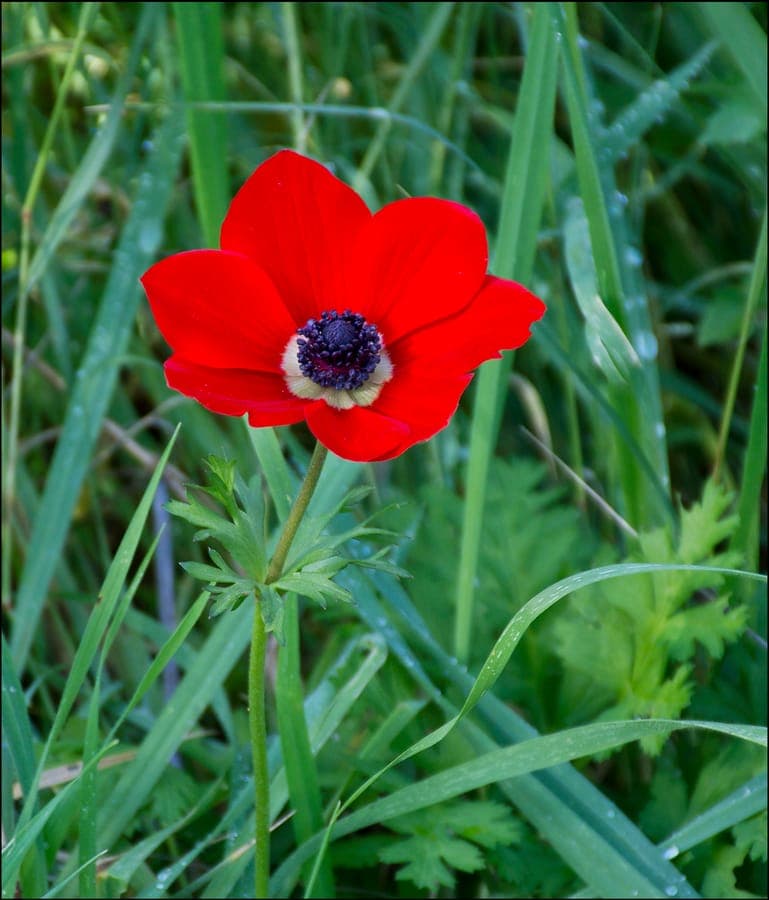
Zachi Evenor / CC BY 2.0, via Wikimedia Commons
Poppy anemone: complete guide
Anemone coronaria
Want to see Poppy anemone: complete guide in your garden?
1 minute, no credit card
Overview
Anemone coronaria, commonly known as the poppy anemone, brings bold colour and elegant form to spring gardens. Native to the Mediterranean basin - from Cyprus to southern France and across North Africa - this perennial tuber thrives in warm, dry conditions and blooms reliably from late spring into early summer. In cooler climates like the UK and northern Europe, it's often grown as a half-hardy perennial or even treated as an annual, depending on winter drainage.
Reaching heights between 20 and 40 cm, the plant produces striking, poppy-like flowers on slender, upright stems. It's a favourite among cut-flower growers for its vase life and rich hues. Plant the tubers in autumn (September to November) for spring bloom, or in late winter in pots under cover. The tubers resemble clawed pieces of dried root - always plant them point-side up or sideways, 5–8 cm deep.
On gardenworld.app, you can design a planting scheme that maximizes bloom time by pairing poppy anemones with complementary spring bulbs.
Appearance & bloom cycle
The flowers of Anemone coronaria are showstoppers. They open wide to 5–8 cm across, revealing silky petals in intense shades of crimson, violet, white, or electric blue. The dark, almost black centre creates a dramatic contrast, drawing the eye. Petals are smooth, slightly reflective, and often held horizontally.
Bloom time runs from April to early June, depending on planting date and local climate. In mild springs, flowering starts in late April. Each plant typically produces 3–5 flowers over a 4–6 week period, especially if deadheading is practiced.
The foliage is finely divided, dark green, and fern-like, emerging with or just before the flowers. It forms a low mound beneath the upright stems, adding texture even after bloom.
Ideal location
Full sun is essential - aim for at least 6 hours of direct sunlight daily. In partial shade, stems stretch and flop, and flowering reduces significantly. Choose a sheltered spot; the delicate blossoms tear easily in heavy rain or strong wind.
Poppy anemones shine in borders, rock gardens, or containers. Plant in groups of 10 or more for visual impact. They pair beautifully with late tulips, grape hyacinths, and early alliums. Avoid overcrowding - they need air circulation to prevent fungal issues.
Soil requirements
Well-drained soil is non-negotiable. Heavy clay will rot the tubers unless amended with sharp sand or grit. Sandy loam or gritty soil is ideal. pH should be neutral to slightly alkaline (6.5–7.5), but they tolerate mild acidity.
Do not add compost or fertilizer at planting - excess nutrients encourage rot. Soak tubers in lukewarm water for 2–4 hours before planting to rehydrate. Plant 5–8 cm deep, 10 cm apart. In pots, use a mix of 2 parts loam, 1 part grit, 1 part perlite.
Free design
Want to see Poppy anemone: complete guide in your garden? Make a free design now.
Watering
Water thoroughly after planting, then only when the top 2–3 cm of soil feels dry. Once established, poppy anemones are drought-tolerant. Overwatering, especially in cool weather, leads to tuber rot.
Containers dry out faster. Check weekly and water when the surface is dry. Always empty saucers after watering to prevent waterlogging.
Pruning
No formal pruning needed, but deadheading spent flowers encourages more blooms and keeps the display tidy. Cut stems just above a leaf node. Leave foliage intact after flowering - it feeds the tuber for next year's growth. Only cut back when leaves turn yellow and die naturally, usually by mid-June.
In colder zones, lift tubers after foliage dies. Dry for a week in a shaded, airy spot, then store in paper bags at 10–15°C.
Maintenance calendar
- September–November: plant tubers in ground or pots
- December–March: protect from frost with fleece if in ground; keep pots in frost-free area
- April–June: peak bloom; deadhead, water sparingly
- July: lift and store tubers (if in zone <7b) or leave in well-drained soil
- August: inspect stored tubers, prepare for autumn planting
Use gardenworld.app to generate a custom maintenance calendar based on your location and planting choices.
Winter hardiness
Anemone coronaria is hardy in USDA zones 7b to 10. In zone 7 and above, tubers can stay in the ground if soil is free-draining. In wetter areas or heavy soils, lift and store them. In containers, move pots to a cold frame or unheated greenhouse over winter.
Mulch with grit or gravel, not organic matter, to avoid moisture retention.
Companion plants
Pair with drought-tolerant, sun-loving plants: lavender, catmint, thyme, or ornamental onions like Allium hollandicum 'Purple Sensation'. Late tulips such as 'Queen of Night' create a moody contrast with deep red anemones.
Avoid moisture-loving plants like hostas or astilbes - their needs conflict.
Closing
The poppy anemone earns its place in any spring garden with vibrant colour and graceful form. With simple care and the right conditions, it returns year after year. Buy firm, healthy tubers in autumn from garden centres or online retailers. Look for plump, undamaged specimens.
With a little planning, this Mediterranean gem becomes a dependable highlight every spring.
Want to see Poppy anemone: complete guide in your garden? Make a free design now.
Upload a photo, pick a style, and get a photorealistic design with plant list in under a minute.
No credit card required


Similar plants
Drummond's anemone: complete guide
Anemone drummondii
Discover Drummond's anemone (Anemone drummondii): a silvery-grey mountain plant for cool rock gardens and alpine troughs.
Korean clematis: complete guide
Clematis serratifolia
Clematis serratifolia is a hardy climber with fragrant yellow bell flowers in August-September. Pruning group 3, location and care tips.
Aquilegia brevistyla: complete guide
Aquilegia brevistyla
Discover Aquilegia brevistyla, the elegant North American columbine. Growing tips, shade tolerance, and design ideas for woodland and shadowed gardens.