
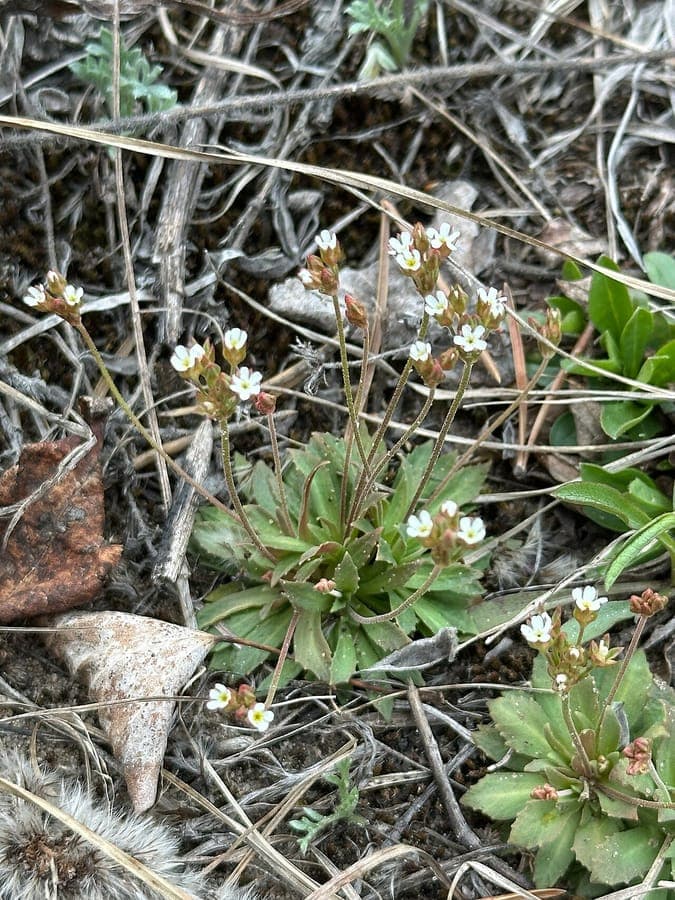
Kallum McDonald https://www.inaturalist.org/people/kallummcdonald / CC0, via Wikimedia Commons
Pygmyflower rockjasmine: complete guide
Androsace septentrionalis
Want to see Pygmyflower rockjasmine: complete guide in your garden?
1 minute, no credit card
Overview
Pygmyflower rockjasmine (Androsace septentrionalis) isn't the kind of plant that shouts for attention. It doesn't tower over borders or drape dramatically from containers. Instead, it whispers - a quiet presence hugging the ground, thriving where other plants give up. As a member of the Primulaceae family, this forb/herb is native to cold, high-altitude regions across North America and Eurasia, including Alaska, Alberta, the Alps, and parts of Siberia. It's built for extremes: thin soils, sharp drainage, long winters, and intense sun.
In garden settings, it's a gem for the thoughtful grower. It's not sold in every garden centre, but when you spot it - usually in specialist alpine sections - it's worth picking up. Its compact size (max 5 cm tall) and creeping habit make it perfect for rock gardens, wall crevices, or the front edge of a gravel bed. On gardenworld.app, you can design a miniature landscape where Pygmyflower rockjasmine plays a natural role, nestled between stones with just enough room to form tight rosettes.
Appearance & bloom cycle
This plant forms dense, moss-like mats of narrow, hairy leaves arranged in tight rosettes. The foliage is dark green to grey-green, often with a soft, velvety texture. Each rosette spreads slowly via stolons, creating a network of low cushions over time.
From late May to early July, slender flowering stalks rise 3–8 cm above the foliage, each bearing a cluster of tiny, star-shaped flowers. The blooms are white to pale pink, with five notched petals and a contrasting yellow or dark central throat. They're small - only 5–7 mm wide - but numerous, creating a delicate haze over the plant when in full bloom. Pollinators like small bees and hoverflies are drawn to them, though the plant doesn't attract swarms.
After flowering, seed capsules form and split open to release fine seeds. Self-seeding occurs gently, rarely becoming invasive. You might find a few new seedlings in nearby cracks the following spring.
Ideal location
Full sun to light shade is best. Think south- or east-facing rock gardens, raised beds with sharp drainage, or stone walls that absorb heat during the day and release it at night. The key is good air movement and direct sunlight for at least 6 hours a day.
Avoid heavy shade or humid, stagnant spots - these invite fungal issues. In hotter climates (USDA zones 7 and above), provide afternoon shade to prevent scorching. A sheltered pocket in a rock wall, where roots stay cool but the crown gets sun, is ideal. On gardenworld.app, you can simulate microclimates and test virtual placements before committing to a physical layout.
Soil requirements
This plant hates wet feet. Use a fast-draining mix: 2 parts loam, 1 part sharp sand, and 1 part grit or perlite. Avoid rich compost - too many nutrients lead to leggy growth and poor winter survival. A pH between 6.0 and 7.0 is optimal.
In containers, use a commercial alpine mix available at garden centres like those stocking specialist rock garden plants. If making your own, include small gravel to mimic natural scree conditions. Never plant in heavy clay without amending it deeply with grit.
Free design
Want to see Pygmyflower rockjasmine: complete guide in your garden? Make a free design now.
Watering
Water sparingly. During active growth (April to August), give a light soak once a week during dry spells. Use rainwater if possible - tap water with high lime content can build up and harm the roots over time.
In winter, stop watering altogether unless the plant is in a container and the soil dries out completely. Snow cover is ideal - it insulates without drowning the plant. Avoid overhead watering in cold months; ice formation can damage the rosettes.
Pruning
No pruning is required. Simply remove dead or damaged leaves in early spring with fine scissors to improve airflow. If the mats become thin or patchy after 3–4 years, divide them gently in spring or early autumn. Replant the rosettes in fresh mix and keep them shaded and moist for the first few weeks.
Maintenance calendar
- January: Check for frost heave; avoid disturbing frozen soil
- February: Monitor for desiccation in exposed sites
- March: Clear old foliage; inspect for aphids
- April: Begin light watering; no feeding
- May: Bloom begins; protect from late frosts
- June: Peak bloom; maintain light moisture
- July: Flowering ends; trim spent stalks if desired
- August: Dormancy begins; reduce watering
- September: No fertiliser; check for fungal spots
- October: Leave dead leaves as light winter mulch
- November: Protect young plants with pine needles
- December: Watch for rodent activity under mulch
Winter hardiness
Pygmyflower rockjasmine is reliably hardy in USDA zones 3–7 (-40°C to -15°C). It survives snow cover well and tolerates freeze-thaw cycles if drainage is sharp. The main threat in winter is wet soil, not cold.
In containers, move pots to a sheltered spot against a wall or into an unheated greenhouse. Use breathable mulch like straw or pine needles - never plastic. In zone 7, ensure plants aren't sitting under roof overhangs where they can dry out.
Companion plants
Pair with other alpine species that share its needs:
- Saxifraga oppositifolia
- Sedum spurium
- Arabis albida
- Campanula cochleariifolia
Space plants 10–15 cm apart to allow air circulation. Avoid vigorous ground covers like ivy or periwinkle that could smother it. A well-designed rock garden on gardenworld.app can help you visualise spacing and light exposure before planting.
Closing
Pygmyflower rockjasmine won't win any beauty contests, but it earns quiet respect. It's for gardeners who appreciate resilience, subtlety, and plants that thrive without coddling. It asks for little - sun, grit, and patience - and gives back with quiet beauty year after year.
Start small: buy one or two plants from a garden centre or online alpine specialist. Test it in a crevice or raised bed. Let it spread slowly. On gardenworld.app, you can track its growth over seasons and adjust your design as it matures, ensuring it always has the space and conditions it needs.
Want to see Pygmyflower rockjasmine: complete guide in your garden? Make a free design now.
Upload a photo, pick a style, and get a photorealistic design with plant list in under a minute.
No credit card required


Similar plants
Primula incana: complete guide to silvery alpine primrose
Primula incana
Silvery primrose (Primula incana), a delicate alpine flower with white blooms and powdered grey-green leaves. Growing, care, and cultivation guide.
Mealy cowslip: complete guide
Primula pulverulenta
Grow the Mealy cowslip (Primula pulverulenta): striking candelabra flowers in red and purple tones, moisture-loving and ideal for shady, damp garden corners.
Cliff dwarf-primrose: complete guide
Androsace laevigata
Full guide to growing Androsace laevigata, a rare Pacific Northwest alpine cushion plant. Planting, care, and garden design tips explained.