
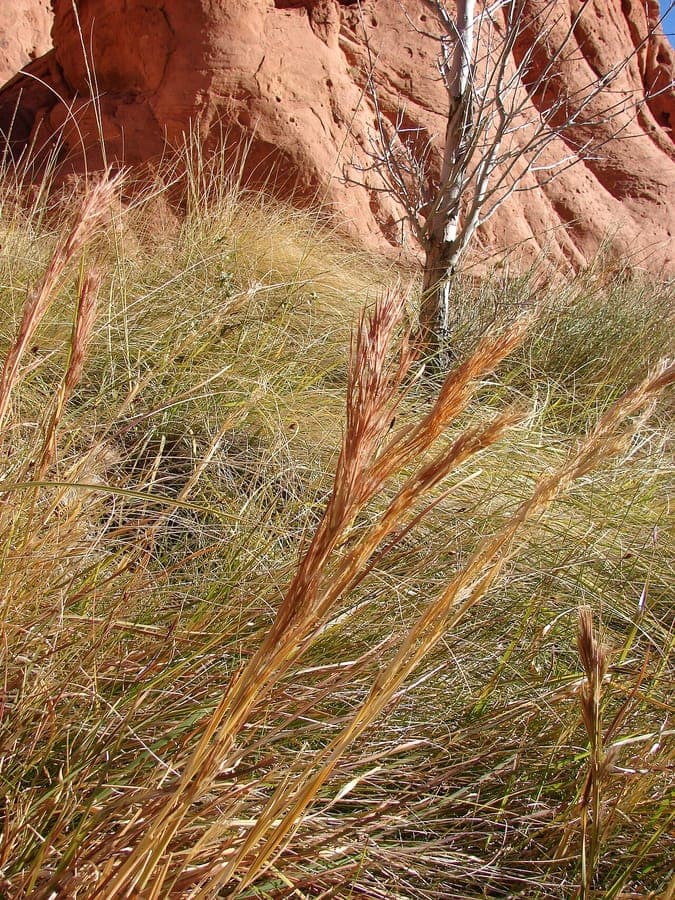
Forest & Kim Starr / CC BY 3.0, via Wikimedia Commons
Bushy bluestem: complete guide
Andropogon glomeratus
Want to see Bushy bluestem: complete guide in your garden?
1 minute, no credit card
Overview
Bushy bluestem, botanically known as Andropogon glomeratus, is a distinctive clump-forming grass species in the family Poaceae. This North American prairie and wetland plant differs from its more famous relative Andropogon gerardii (big bluestem) by its preference for moister growing conditions and its strikingly fluffy, white to silver-grey plumes in autumn. The species was first formally described by Walter and later combined by Britton, Sterns and Poggenb in 1888.
The plant goes by several common names in English: 'bushy bluestem', 'bushy beard grass', 'broomsedge', and 'chalky bluestem'. In French it is called 'panache'. Its native range is impressively broad, covering the eastern United States from Massachusetts to Florida and westward, through Central America, the Caribbean islands, and into South America as far as Guyana and Venezuela. It has been introduced in Hawaii and Japan.
On gardenworld.app, garden designers are increasingly finding a place for native North American grasses like bushy bluestem in naturalistic designs for wet corners, pond margins, and bog gardens. The plant provides a beautiful autumn and winter effect with its soft, cottony plumes that persist on the stems well into winter and catch the light on frosty mornings.
Appearance and bloom cycle
Andropogon glomeratus forms dense clumps of multiple upright stems that branch from the base and can reach 80 to 150 cm in height. The foliage is green and fine in texture - finer than most other members of the grass family. Through summer the plant looks modest: upright fine-textured stems with narrow leaves. The real show begins in autumn.
From August-September onward, flower heads appear as fluffy white spikelets clustered tightly at the stem tips. This creates the plant's characteristic 'broom-like' silhouette - stems radiating outward like the bristles of a brush. The flowers are white in color, not particularly showy in botanical terms, but the mass of fluffy, silvery-white plumes is visually very effective in the landscape.
After flowering the plumes remain white to grey-white, giving the plant a winter presence that stays attractive deep into the cold months. The seeds are brown and inconspicuous. The plant is a warm-season species that leafs out late in spring and actively grows through summer. Growth rate is moderate.
Ideal location
Where Andropogon gerardii belongs on dry prairie, Andropogon glomeratus prefers wetter conditions. In nature it grows alongside marshes, river and lake margins, wet meadows, and moist woodland edges - always in places with higher soil moisture than its drought-tolerant relatives.
Despite its wetland preference, bushy bluestem still requires a sunny to lightly shaded position. A minimum of four to five hours of direct sunlight per day is needed for good flowering and sturdy stems. In full shade the plant grows weakly and barely flowers.
In the garden, Andropogon glomeratus is particularly well suited to:
- Wet corners and low-lying boggy areas
- Pond, stream, and water feature margins
- Rain gardens and infiltration basins
- Wet prairie-style borders
- As a buffer plant in bog gardens
Visit gardenworld.app for inspiring garden designs that combine wetland species like bushy bluestem with other bog garden classics for a naturalistic planting scheme.
Soil
Andropogon glomeratus is in its element in moist to wet, acidic to slightly acidic soils. The optimal pH range is 5.0 to 6.3 - considerably more acidic than most garden plants prefer. This makes it ideally suited to peaty or boggy soils that are too wet and acidic for most other ornamental plants.
Soil characteristics:
- Moist to permanently wet: the plant tolerates brief flooding.
- Acid-loving: pH 5.0-6.3 is optimal; on alkaline soils it grows poorly.
- Peaty or loamy texture: heavy, poorly draining soils are actually appropriate.
- Low fertility: like most wetland plants it thrives in relatively nutrient-poor conditions.
In pots or containers: use a blend of peat compost and unfertilized potting mix. Ensure the pot can always hold some standing water. Pots with a water reservoir tray that never fully drains are ideal.
Do not add lime to the growing medium - this raises pH and harms the plant. Excessive fertilizing is equally harmful and leads to lush but weak growth.
Watering
As a wetland and marginal plant, Andropogon glomeratus has different water needs than most garden plants. It is adapted to permanently moist to wet conditions and does not need dry periods - quite the contrary: drought is harmful.
In the garden:
- At pond and stream margins: plant in the shallow marginal zone (maximum 5-10 cm water depth) or directly beside the water's edge.
- In borders: ensure sufficient ground moisture or irrigate regularly during dry periods.
- In pots: keep the saucer filled with water at all times so the roots never dry out.
- During extended drought (more than two weeks): water thoroughly every two to three days.
The plant gives clear signals when it is too dry: leaf tips turn brown and stems go limp. Recovery through immediate watering is usually possible if the drought has not lasted too long.
When planted in rain gardens and infiltration basins, bushy bluestem thrives without extra care by drawing on runoff water.
Free design
Want to see Bushy bluestem: complete guide in your garden? Make a free design now.
Pruning
Like Andropogon gerardii, bushy bluestem requires just one maintenance session per year. The dead stems and white plumes remain attractive throughout autumn and winter, providing shelter for insects and small animals, and food for seed-eating birds such as finches and sparrows.
Cutting schedule:
- February-March: Cut clumps back to 10-15 cm above ground, before new growth begins. Use sharp shears or a hedging cutter. Tie the clump together with twine before cutting for a tidier result.
- Spring-summer: No cutting required. Allow the plant to grow freely.
- Autumn-winter: Leave stems and plumes standing for ecological benefit and winter decoration.
Division: when clumps grow too large or you want new plants, lift and divide in early spring (March) using a sharp spade. Each section with sufficient roots can be replanted in a new location.
Maintenance calendar
A practical month-by-month guide for Andropogon glomeratus:
- February-March: Cut back to 10-15 cm. Also the time to divide clumps if needed.
- April-May: Plant new specimens after the frost period. Ensure moist soil at planting time.
- May-July: Check regularly for drought stress, especially during dry summers. Roots do not tolerate desiccation.
- August-September: First flowers appear. The fluffy white plumes begin to develop.
- October-November: Full plume display. Winter silhouette builds. Leave stems standing.
- December-January: White plumes in winter light, food for birds. No maintenance required.
For tailored garden design - including wet corners and water margin plantings with clump-forming species like bushy bluestem - gardenworld.app lets you plan and visualize your own front or back garden easily.
Winter hardiness
Andropogon glomeratus is a reliably hardy plant for the Benelux and neighboring regions. Based on its native distribution in the eastern and southern United States and Caribbean (USDA zones 5-10), it can be considered hardy to zone 5, corresponding to minimum winter temperatures of approximately -26 degrees Celsius. In Dutch and Belgian garden practice it overwinters without difficulty in normal winters.
In cold winters the above-ground portion dies back, but the rhizome remains intact. From April-May, new foliage emerges and the plant quickly regrows into a full clump.
Winter care tips:
- No special protection is needed in Northwestern Europe when grown in the ground.
- Leave the stems standing: they provide light insulation to the root crown and serve as winter decoration.
- In containers: move the pot to a frost-free location or wrap the pot in burlap to prevent freeze damage - roots in a small volume of substrate tolerate prolonged frost less well than roots in open ground.
- Additional risk: prolonged frozen wet soil can damage roots. In open ground this is rarely a problem; in containers some protection is advisable.
Companion plants
The best companions for Andropogon glomeratus are species that share its preference for wet, acidic soils. Drought-tolerant plants make poor partners in the same bed.
Recommended companions:
- Iris pseudacorus (yellow flag iris): the classic marginal plant with yellow flowers that beautifully contrasts the white plumes of bushy bluestem.
- Lobelia cardinalis (cardinal flower): vivid red summer flowers with the same preference for wet soils.
- Scirpus/Schoenoplectus species (bulrushes): other wetland plants that work well in the marginal zone.
- Juncus effusus (soft rush): another clump-forming marginal plant that grows well alongside bushy bluestem.
- Lysimachia punctata (garden loosestrife): summer-blooming with yellow flowers on moist soils.
- Caltha palustris (marsh marigold): early-season bloomer that thrives in the same wet conditions.
Avoid drought-loving plants such as lavender, sage, and agastache - they will rot in the permanently wet soil that bushy bluestem requires.
Closing
Andropogon glomeratus, bushy bluestem, is a remarkable plant for gardeners dealing with persistently wet, acidic corners in their garden. Where other plants give up, this wetland grass excels. It provides a long season of interest: modest green structure through summer, beautiful white plumes in autumn, and elegant winter silhouettes well into the new year.
Seeds and plants of Andropogon glomeratus can be found at specialist wetland and marginal plant nurseries, and occasionally at garden centres. For professionally designed wet garden areas or rain gardens incorporating wetland grasses, gardenworld.app provides design tools that take into account soil type, moisture level, and seasonal interest to help you create the perfect planting plan.
Give this remarkable plant the wet, acidic spot it deserves - and it will reward you with one of the most fascinating autumn and winter displays in your garden.
Want to see Bushy bluestem: complete guide in your garden? Make a free design now.
Upload a photo, pick a style, and get a photorealistic design with plant list in under a minute.
10,000+ gardens designed already
No credit card required

