
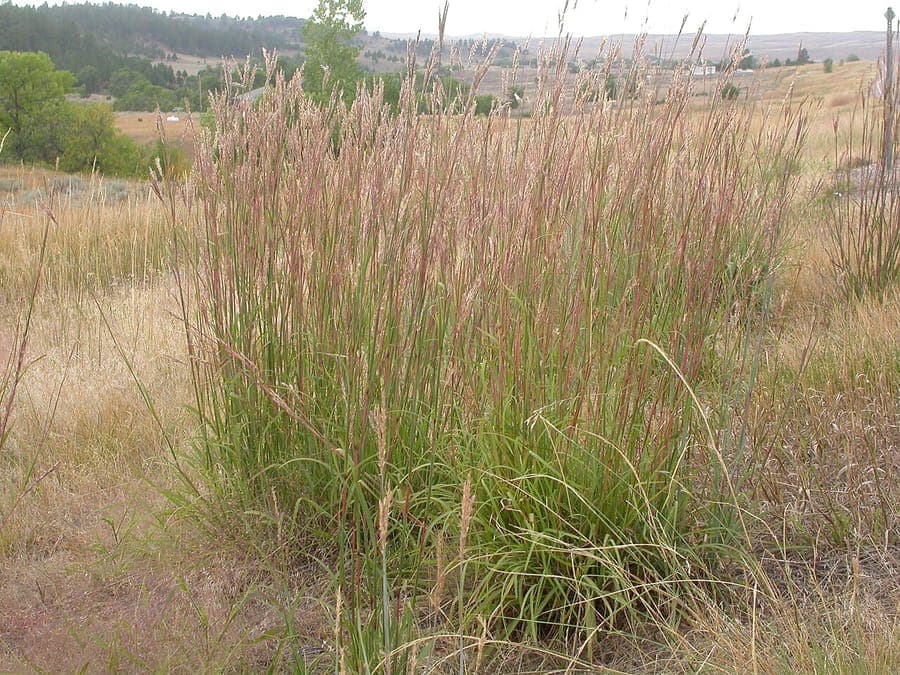
Matt Lavin from Bozeman, Montana, USA / CC BY-SA 2.0, via Wikimedia Commons
Big bluestem: complete guide
Andropogon gerardii
Want to see Big bluestem: complete guide in your garden?
1 minute, no credit card
Overview
Big bluestem, botanically known as Andropogon gerardii, is one of the most iconic ornamental grasses of the North American prairie. This impressive clump-forming grass belongs to the family Poaceae and was first formally described by the Italian botanist Vitman in 1792. In garden design, big bluestem has gained steadily growing popularity over recent decades as a structural plant in naturalistic borders, prairie gardens, and low-maintenance landscape designs.
The common name 'big bluestem' refers to the blue-green stem color early in the season. The plant also goes by the name 'turkeyfoot grass' because of its distinctive three-branched flower head that resembles a turkey's foot. In French it is called 'barbon de Gerard' or 'barbon fourchu'. The species epithet 'gerardii' honors the French botanist Louis Gerard.
In its natural habitat, big bluestem dominates the mixed-grass prairies of central North America, from Canada through the central United States down to Texas. On gardenworld.app, naturalistic garden designs incorporating ornamental grasses like big bluestem are particularly popular for modern front gardens that prioritize low maintenance without sacrificing visual impact. The plant can reach heights of 120 to 200 cm, making it a genuine focal point in the late-season garden.
Appearance and bloom cycle
Big bluestem is a warm-season clump-forming grass that regrows each year from a deep root system. The stems are blue-green in spring - hence the name 'bluestem' - and develop a deeper blue-green character through summer. In autumn, after the first cool nights, the foliage transforms into striking shades of copper-red, burgundy, and burnt orange, making this one of the most spectacular grasses for autumn color in the garden.
The flower heads appear in August-September as three to five branching spikelets at the tip of the stem - the characteristic turkeyfoot shape that gives the plant its nickname. The flowers themselves are yellowish but not particularly showy; the ornamental value lies mainly in the ripening plumes that remain standing through the rest of the season, bringing winter character to the garden long after the leaves have fallen.
Height varies from 120 cm under moderate conditions to 180-200 cm in richer, moister soils. Mature clumps spread to 60-90 cm wide. Growth rate is moderate: in the first year the plant focuses on root development and grows relatively slowly above ground. From the second year onward, growth accelerates significantly.
Ideal location
Big bluestem is an uncompromising sun-lover and requires at least six hours of direct sun per day. In its native range - the open grasslands of central North America - it grows in full sun on open plains and gentle slopes. In the garden it performs best in a warm, sunny position.
In partial shade the plant becomes noticeably weaker: stems grow lax, height is reduced, and autumn color is less intense. A south- or west-facing border is ideal. The plant tolerates moderate wind but in extremely exposed positions the tall stems may lean or lodge in severe storms.
Big bluestem works beautifully in:
- Naturalistic borders and prairie-style gardens
- Dry slopes and embankments
- As a bold single-specimen accent among lower perennials
- Combined with other prairie species
- As a screen or windbreak element in larger gardens
Visit gardenworld.app to explore garden designs that use big bluestem as a structural highlight in naturalistic layouts combined with echinacea, rudbeckia, and other prairie classics.
Soil
One of big bluestem's great strengths is its broad soil adaptability. In nature it grows on everything from heavy clay to sandy loam. The plant does however prefer well-drained, moderately lean substrates.
The optimal pH range is 6.5 to 7.5 - neutral to slightly alkaline. On slightly acidic soils above pH 6.0 the plant grows well too, but very acidic or strongly alkaline conditions are less suitable.
Key soil tips:
- Heavy clay: improve drainage by working in coarse sand and grit, or plant big bluestem on slightly raised areas.
- Sandy soils: add a little compost for improved moisture retention, but do not over-enrich - overly fertile soils produce floppy, top-heavy plants.
- No waterlogged conditions: standing water for extended periods damages the root system.
- Mulching: a layer of organic mulch in spring helps retain moisture and suppresses weeds.
Notably, big bluestem stands firmer in lean soils than in rich ones. Excess nitrogen promotes lush leafy growth at the expense of structural rigidity.
Watering
Once well established, big bluestem is a remarkably drought-tolerant plant. Its long vertical roots can reach up to 3 meters deep in the soil, accessing moisture reserves that shorter-rooted plants cannot reach. This makes the species particularly well suited to regions with dry summers.
In the first year after planting, big bluestem requires more regular watering than in subsequent seasons. The root system is not yet fully developed and the plant is vulnerable to drought spells longer than two weeks. During this first season, water thoroughly once a week during dry periods.
From the second year onward:
- With normal rainfall: no supplemental watering needed.
- During extended drought (more than three weeks without rain): one thorough watering every 10-14 days is sufficient.
- Never water shallowly and frequently; this encourages surface rooting rather than deep root development.
- Drip irrigation at the base of the plant is more effective than overhead sprinklers.
In containers big bluestem requires more regular monitoring of moisture levels, but the same principle applies: err on the dry side rather than the wet.
Free design
Want to see Big bluestem: complete guide in your garden? Make a free design now.
Pruning
Maintenance of big bluestem is essentially limited to one annual cut-back in early spring. The dead stems and plumes remain decorative throughout winter and provide shelter and food for birds and small mammals during the colder months.
Pruning schedule:
- February-March: Cut the clump back to approximately 10-15 cm above ground level, before new growth begins. Use sharp shears or a hedging cutter for larger clumps.
- Summer: No cutting needed. Allow the plant to grow freely.
- Autumn-winter: Leave the stems standing for winter effect and ecological benefit.
Some gardeners practice controlled burning (a method used on North American prairies) to stimulate new growth in early spring. This is often impractical or restricted in urban gardens; cutting achieves the same result.
Tip for tidier cutting: tie the clump together with a length of twine before cutting so the debris stays in a compact bundle and is easier to remove.
Maintenance calendar
Here is a practical month-by-month overview:
- February-March: Cut back the clump to 10-15 cm. This is also the time to divide if clumps have grown too large.
- March-April: Plant new specimens or divisions after the frost period.
- April-June: Water regularly during dry spells in the first growing season. Keep the area around young plants free of weeds.
- July-August: Flower heads begin to emerge. Minimal maintenance required.
- August-September: Full bloom. Enjoy the plumes and the deepening blue-green foliage.
- October-November: Autumn color in copper-red and burgundy. Leave stems standing.
- December-January: Plumes provide winter decoration. Birds eat the seeds.
For personal garden advice and planting designs tailored to your garden space, gardenworld.app offers design tools and naturalistic garden inspiration featuring ornamental grasses.
Winter hardiness
Big bluestem is an extremely cold-hardy plant. The species is rated to USDA hardiness zone 3, corresponding to minimum winter temperatures of -40 degrees Celsius. For the Benelux, Germany, and northern France, winter hardiness is therefore never a concern: the plant overwinters reliably across all regular garden climate zones in these regions.
In cold winters the above-ground portion dies back completely, but the root system survives without difficulty. From March-April, new foliage appears and quickly grows into a full clump.
Winter care tips:
- No extra protection is needed in Northwestern Europe.
- Leave the stems standing until spring: they provide light insulation for the crown and wildlife habitat.
- In wet winters: ensure good drainage, as prolonged waterlogging is more damaging than frost alone.
- Young plants in their first year: a light layer of straw or dry leaves around the crown provides added security during extremely cold winters.
Companion plants
Big bluestem is an outstanding structural plant that combines well with a wide range of prairie and border plants. The vertical lines and autumn color of the grass provide a beautiful backdrop for flowering perennials.
Ideal companions:
- Echinacea purpurea (purple coneflower): blooms July to September; the warm tones complement the blue-green of big bluestem perfectly.
- Rudbeckia fulgida (black-eyed Susan): yellow flowers through autumn, a classic prairie partner.
- Salvia nemorosa (wood sage): blue-purple flowers in early summer, good height proportion alongside big bluestem.
- Monarda species (bee balm): attracts butterflies and bees; combined with big bluestem creates a genuine prairie border feel.
- Other ornamental grasses: combine with Panicum virgatum or Sorghastrum nutans for a varied grass planting.
- Aster species: late-autumn flowering that coincides with the finest autumn color of the grass.
Avoid combining with water-demanding plants or species that will be outcompeted for light.
Closing
Big bluestem (Andropogon gerardii) is a remarkably versatile and low-maintenance plant that offers something of interest throughout the entire year. In summer it provides structure and movement, in autumn a display of copper-red tones, and in winter decorative silhouettes that attract birds. With its deep roots and drought tolerance it is moreover ideally suited to the garden climates of the future: warmer and drier than we have historically been used to.
Seeds and plants are available at specialist perennial nurseries and at garden centres throughout the UK, Netherlands, and Germany. To integrate big bluestem optimally into your own garden design, gardenworld.app lets you create your own front garden plan, complete with plant advice and visual examples of naturalistic garden styles.
Give big bluestem the space, the sun, and the lean dry soil it deserves - and it will reward you year after year with one of the most impressive autumn displays in the garden.
Want to see Big bluestem: complete guide in your garden? Make a free design now.
Upload a photo, pick a style, and get a photorealistic design with plant list in under a minute.
10,000+ gardens designed already
No credit card required

